


From commission to crowdfunding support campaign
One year after her death, Hadewych Hammenecker (1944-2020) received a special, posthumous tribute during a concert for which her husband, prof. Willy Sansen, had commissioned a composition from Johan Sluys. The widower and the composer had jointly decided that the work would be built around the system of the seven chakras. Since the couple Sansen-Hammenecker had spent a long time abroad, the woman had become very interested in Zen Buddhism and Eastern culture in general. It was the wish of the commissioner that Shabda Braham would be performed regularly, and this week it is happening. After a private performance, the work will have its first public premiere on February 18, 2024.
[caption id="attachment_52245" align="aligncenter" width="300"]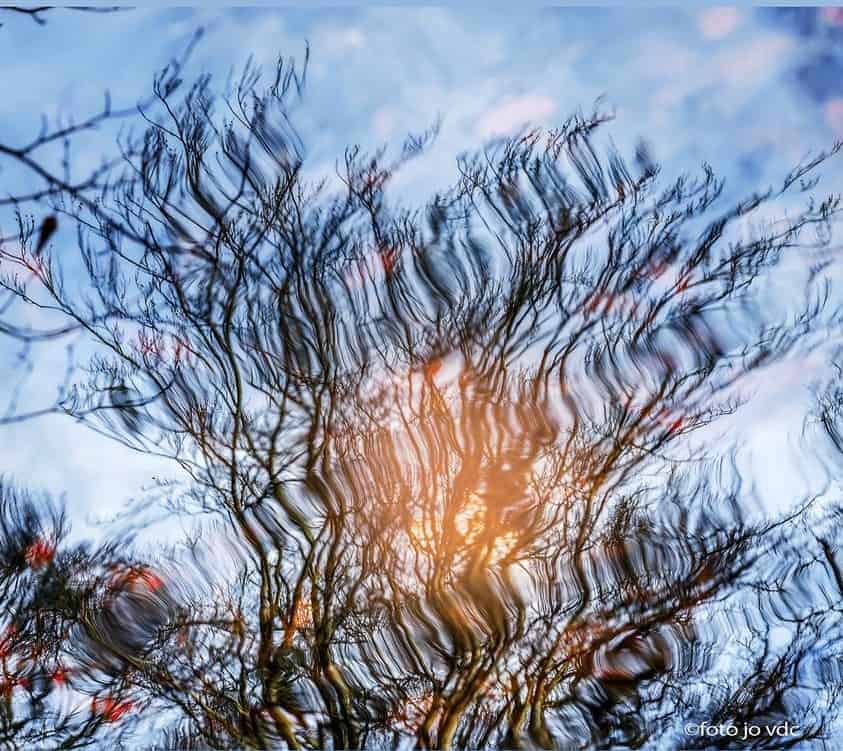 My body is like a tree
with roots deep in the earth[/caption]
Shabda Brahman has evolved from a memorial concert into a meditation concert. Not only has the composer retouched his work here and there in the meantime, meditative texts have also been added. Comparable to the liturgical prayers in Haydn's Seven Last Words, before each section the listener will hear a text that guides their thoughts towards one of the seven chakras and the associated music. The texts are by and will be read by Katleen Van Bavel, radio producer, curator and presenter at Klara.
Third chakra.
It is quite remarkable that the composition receives another public performance. After the creation of contemporary music, the score often moves into a drawer where it remains forever. Even though Johan Sluys finds that his third chakra (the fire) is his least developed, he nonetheless takes the initiative and risk of presenting Shabda Brahman to the world independently. The decision came after a cumbersome subsidy application yielded nothing and an interested organizer withdrew at the last moment.
The artistic risks are small: the work has had time to mature and audiences these days are receptive to adventurous music with a certain spiritual connotation. The financial picture is another matter.
Johan Sluys: "It would really be interesting to investigate how much of the subsidy money that remains these days goes to administration and what percentage goes to the musicians themselves, let alone the composer. I like to compare the situation with that of the farmer who also makes a vital product for people, gets paid only a few cents for it while the consumer has to pay several euros for it. I think something similar is happening with us musicians. The current subsidy structure no longer allows for supporting a standalone concert; without all possible (artistic, financial, promotional...) partners, you simply cannot manage it anymore. The time when public broadcasting performed and recorded every new classical music score is long gone.
The composers who can write on commission can be counted on one hand. Many do their utmost to be performed here and there. Or they go abroad where the costs of a performance are lower. I'm certainly not the only fool who occasionally spends a lot of money on this. The crowdfunding campaign counter stands at €1,100 today while the real costs are almost ten times higher. So it will be necessary to use savings, won't it?"
Four and seven.
Because there is not much you can do musically with Zen Buddhism, the commissioner prof. Willy Sansen and composer Johan Sluys found it more interesting to work with the seven-part structure of the chakras as a framework for the composition. Even those who don't do yoga may be aware of the seven chakras, which according to ancient Hindu tradition are seven energy centers, mini-brains of our body, each with a different frequency. They are connected to each other and are linked to various medical, psychological and philosophical concepts. They represent different aspects of human functioning such as survival, joie de vivre, willpower, love, communication, intuition and insight.
Logically, Shabda Brahma consists of seven parts, the first four of which also (again) refer to the elements earth, water, fire and air. The music is played by an ensemble of seven instruments: clarinet, horn, viola, double bass and three percussionists. The four singers who also play some (non-classical) instruments are all bass singers, which refers to Tibetan monks.
The letters H, A, D, E, C from the name Hadewych generated the musical theme that is omnipresent throughout the work. The structure of the first four parts, which average seven minutes, is identical and is built according to the principle of the Golden Ratio. From a first musical segment, there follows up to seven times a shorter variation (with a coefficient of 0.618) until eventually almost nothing remains. The resting point is in the middle and provides a moment of meditation. Students in music analysis would certainly find a beautiful but also very transparent challenge in this.
In terms of style, Johan Sluys is indebted in Shabda Brahma to both Gérard Grisey and Tan Dun. More than ever, he has been searching for appropriate instrumentation. The four elements are given voice through flowing water, a waterphone, rainstick, ribbed tubes, woodblocks, ...
Specifically for this composition, he had seven sound bowls designed in Cologne that produce each other's overtones and sound wonderfully together. You could say they approach Pythagoras' Harmony of the Spheres, the sound of the cosmos.
Sunday 18 February 2024 at 3pm and at 5pm, in the recently restored church of 3040 Sint Agatha-Rhode, Admission: €20, reservations: email johan.sluys@telenet.be crowdfunding via: steunactie.nl/arts-culture/shabda-brahman-1/-18416 Those who make a contribution will be mentioned in the program booklet.
[embed]https://www.youtube.com/watch?v=VRKBXm38Wvg[/embed]
The ensemble consists of: Geert Baekelandt (clarinet), Guillame Michiels (horn), Dimitri Dumon, Silas Van den Spiegel and Gideon Van Canneyt (percussion), Jeroen Robbrecht (viola), Ludo Joly (double bass) and four bass singers (Luc Martens, Lieven Van den Eede, Eli Paredis, Guillaume Morauw), conducted by Daniel Gazon.
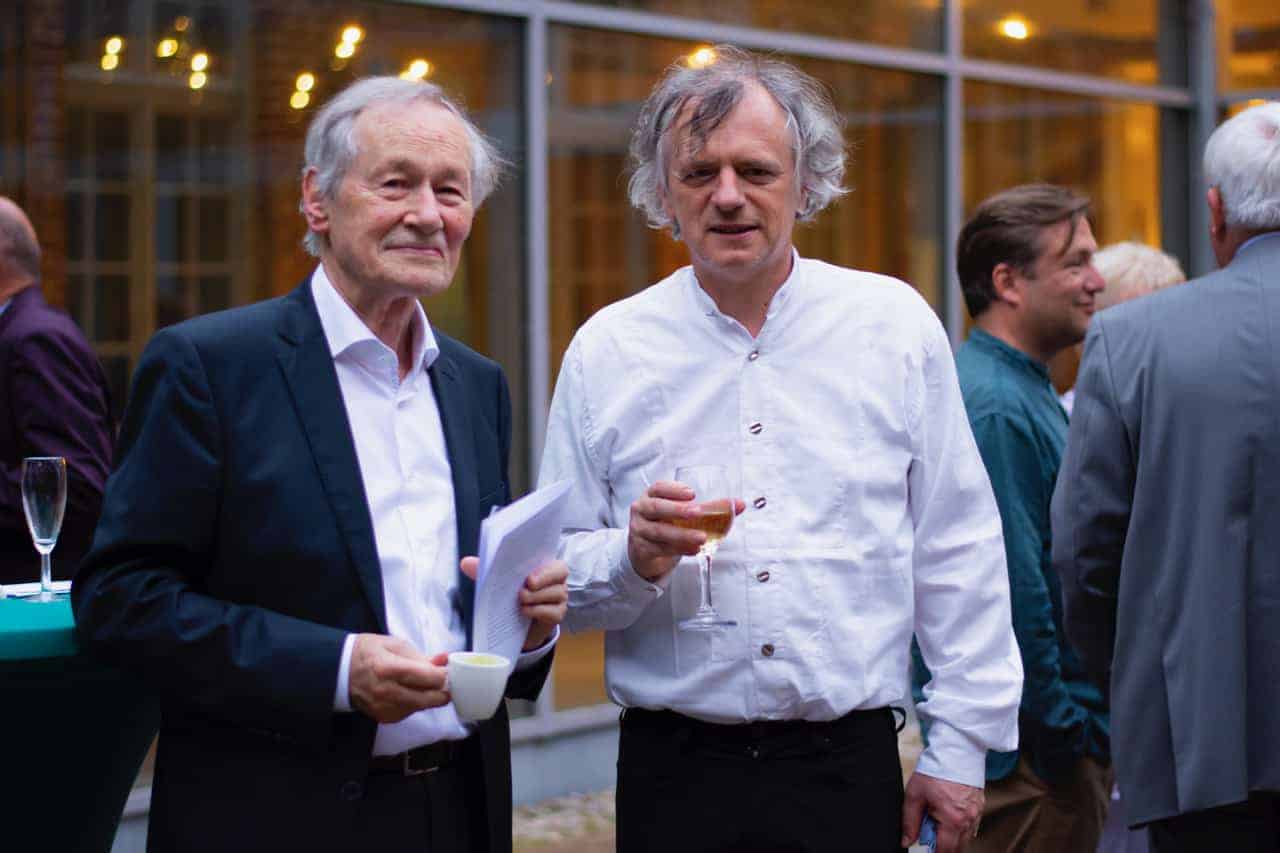
Johan Sluys (right) is a classical philologist and pianist, obtained a master's degree in composition from Claude Ledoux and studied choir direction with Erik Van Nevel and Daniel Gazon. He is a lecturer at the Leuven Conservatory.
Prof. Willy Sansen (left) is co-founder of MICAS at Esat, the Department of Electrical Engineering at KU Leuven. Together with his wife, he spent many years abroad, where they developed an interest in Zen Buddhism.