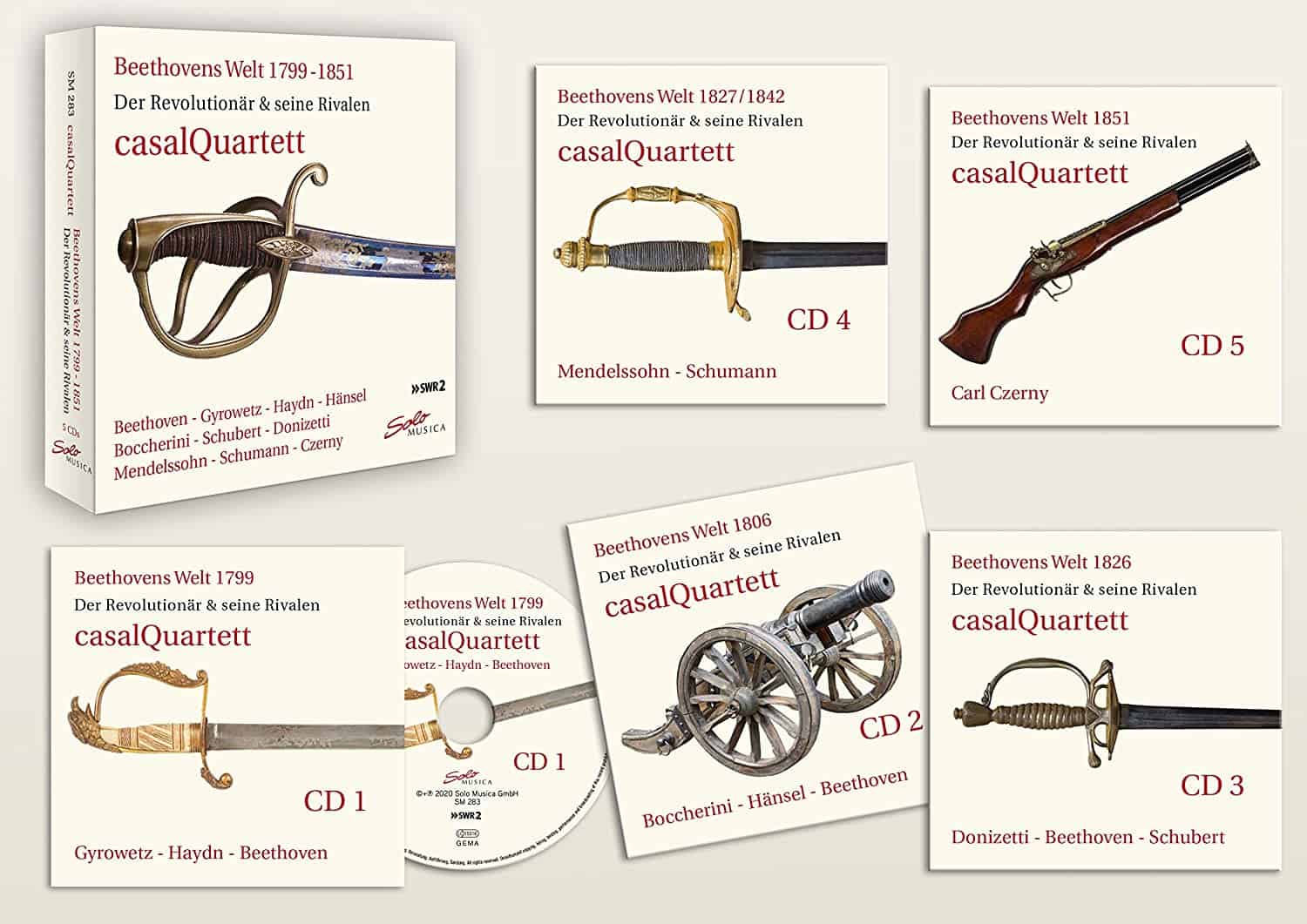
That is more or less the starting point for this in several respects surprising cd-box by the Swiss casalQuartett. For however groundbreaking, idiosyncratic or original the compositional paths he took in his life, without a close circle, predecessors, fellow pioneers and adepts, even Beethoven would have sparked a different kind of revolution in music.
26 January 1851. Insofar as anything is ever finished, Carl Czerny (1791-1857) puts the finishing touches on a string quartet in A-flat. It was only one of many, many hundreds of pieces he left behind. The prolific composer is nonetheless known today less as a composer than as a pedagogue: a much-sought-after piano teacher who himself received lessons from Beethoven for a few years as a teenager and taught Franz Liszt the tricks of the trade. "[…] he preferred to dedicate his art to the advancement of others rather than to place himself at the center of attention", writes Markus Fleck in the extensive commentary that accompanies Beethovens Welt 1799-1851. Reason enough, the violist of the casalQuartett must have thought, to add an extra disc to their five-part cd-box devoted exclusively to the selfless Czerny. For that homage, the quartet even knocked on the door in Washington. The autograph of one of the more than thirty string quartets that the man left unpublished was unearthed from the collections of the Library of Congress. This Quartetto number 28, in the key of A-flat, is one of a total of three Weltersteinspielungen that can be heard thanks to this project.
In the past, accursed annus covidius, the birthday boy Beethoven already overshadowed all his colleagues – or at least that was the initial intention. The casalQuartett's approach is in that sense both welcome and interesting: Ludwig the festive pig as a prism to bring a broader spectrum of composers into the spotlight in a thoughtful way. Beethoven still claims the leading role in this series of recordings, but is flanked by forgotten contemporaries such as Adalbert Gyrowetz (1763-1850) and Peter Hänsel. Music history proves to be a merciless glutton, for these two gentlemen each in turn provided an extensive contribution to the genre with several dozen string quartets. And yet the works chosen here appear for the very first time on cd. During his lifetime, by contrast, Gyrowetz' literary fruits found eager sales. In Vienna, where the Bohemian – born as Vojtěch Matyáš Jírovec – rose to the rank of vice-kapellmeister of the 'imperial and royal' Kärntnertortheater. But also elsewhere in Europe, without quite realizing it. "For example, Gyrowetz had to experience that after arriving in Paris in 1789 […] he met a publisher who made excellent business with his music, but who neither knew him personally nor had ever corresponded with him." It is but one of many striking experiences to which this globe-trotter avant la lettre reflects in his autobiography, and to which the cd booklet refers.
Success has many fathers
But in the case of both Gyrowetz and Beethoven, and by extension just about everyone who worked on string quartets alongside them, there is actually one composer who stands out whose influence cannot be overestimated. His name was a famous hallmark that publishers and nobles made extensive use of. And that had its consequences. For the closer one came to Joseph Haydn's style, the greater the chance of commercial recuperation, something that Gyrowetz – again him! – also experienced. More fortunate, on the other hand, was the simultaneous commission that the music-loving patron and (then still) wealthy prince Franz Lobkowitz (1772-1816) would place with both Haydn and Beethoven in the late 18th century. The result of that double commission – "eine Art Künstlerwettstreit zwischen dem weltbekannten Wiener Klassiker und dem jungen, ehrgeizigen Aufsteiger aus dem Rheinland", according to Fleck – colours the first cd of Beethovens Welt. Der Revolutionär & seine Rivalen. This zooms in on the year 1799. Gyrowetz' more than noteworthy string quartet in D (opus 47 no. 3) is followed by the first works from opus 77 and 18 respectively. Whoever lets themselves be guided only by numbers sees Beethoven emerge victoriously from this supposed competition. Final score: 2-6. But Haydn's 'meagre harvest' was relative in more than one respect. Not only did Die Jahreszeiten another, grand-spiritual work demand his attention. The ambition of the late sixty-year-old had also waned after the six pieces of opus 20, 33, 50, 64 and 76 – to name just a handful of collections. Beethoven, on the other hand, was keen to prove himself in a medium that was new to him and at the same time respected. He spared himself no effort in taking the torch from his former teacher, gratefully making use of the facilities that Lobkowitz put at his disposal.
26 August 1801. "Among the new works appearing here, excellent compositions by Beethoven stand out", thus praised the Allgemeine musikalische Zeitung his first string quartets. At the same time, the weekly fired a shot across the bow by explicitly pointing out the high degree of difficulty of this music. "Three quartets provide full proof of his art: yet they must be played more often and very well, as they are very difficult to perform and are by no means popular." Today, the demands that Beethoven set so unprecedentedly carefully no longer stand in the way of a apt and equally nuanced performance. Thus the upright casalQuartett in the quartet in F (opus 18 no. 1) has both eye and ear for both the pointillism with which the composer enlivens the opening section of this work (Allegro con brio), as well as for the dynamic tension that is subsequently evoked by the chiaroscuro of the subtly phrased and carefully balanced Adagio affettuoso ed appassionato. Alongside the empathy, a great commitment to one another in the following two sections makes the essential difference. With occasionally swift articulation, the musicians bring all manner of short and less short motifs to the surface in the playful scherzo (Allegro molto). Now carefully timed and then sharp and incisive, the way the quartet interrupts each other mercilessly in the closing Allegro finally rings out. The impetuous, sometimes downright rough dialectics that Beethoven prescribes in this finale are absent from Gyrowetz's string quartet. But that does not make his music any less appealing or engaging. Together with him, the casalQuartett illustrates how embedding does not have to stand in the way of personal development. The spirited outer movements provide enough examples of ingenuity for that (Allegro). Equal skill, consultation and positive energy are recorded by the Swiss ensemble in Haydn's quartet in G (opus 77 no. 1), as evidenced by the exuberant minuet and the spiritedly played final movement (Presto). Yes, even in his old age Haydn could still come up playfully. And incidentally strike more than one sensitive chord. Just listen to the brilliant harmonies from the Adagio. You will already hear the most striking moment from this slow movement, by coincidence or not, from 1:06 in the following promotional video.
Better Late Than Never
Peter Hänsel (1770-1831) might think so now that a string quartet by him has finally been released on cd: a nice birthday present for this contemporary of Beethoven, who was born in Silesia good two weeks before Ludwig. He makes his surprising debut on the second cd, which pauses in the year 1806. Hänsel was not only an excellent violinist. As a composer studying – again! – with Haydn, he also developed a clear preference for the intimate work, and the art of the string quartet in particular, which he would further cultivate in Paris with Ignaz Pleyel. "The direct contact with the musical culture of France", remarks Markus Fleck, "had a decisive effect on the final development of Hänsels creative aesthetics." But equally, "der grosse Unbekannte" incorporated other stylistic elements into his music. In this way, a charming polonaise appears in the quartet in C (opus 20 no. 3), where one would expect the usual minuet – a tribute to Elżbieta Lubomirska (1736-1816), the Polish princess who had settled in Vienna and with whom he was employed as concertmaster? The victorious Allegro con brio with which Hänsel opens this work does not yet leave a memorable impression with its virtuosic fireworks and numerous runs. Things change in the splendid slow movement. The Adagio ma non troppo, with its meticulous monologues, delicate little dialogues and – above all – a beautifully articulated, baroque harmonic retardation in the cello, does indeed have a lingering emotional effect. One is naturally delighted by such unexpected frankness. As much as by the apt interplay in the joyful finale (Allegro molto). Although far from radical, the rehabilitated Hänsel certainly deserves a place in Beethovens Welt.
27 February 1807. "Also, three new, very long and difficult Beethoven violin quartets are attracting the attention of all connoisseurs." And the Allgemeine musikalische Zeitung added the following reservations: "They are profoundly conceived and excellently crafted, but not universally comprehensible – the 3rd in C major, perhaps excepted, which through its peculiarity, melody and harmonic force must win every educated music lover." Today all three works from Beethoven's opus 59 are admired in one breath, however difficult they were to grasp in their time. "His current fame rests not so much on the compositions with which he then pleased the public, but precisely on those in which he challenged it", confirms Oxford musicologist Laura Tunbridge in Beethoven. A Life in Nine Compositions (Unieboek | Het Spectrum, 2020). The Razumovsky quartets were moreover not only a challenge for the listeners. The performers too were extraordinarily put to the test. Fortunately for Beethoven's heroic experimental drive, there was an Ignaz Schuppanzigh (1776-1830) and his professional string colleagues to serve as a sounding board. But whether, for instance, the confrontation with the frenzied finale of the last quartet (Allegro molto), the frantic organ point of the entire triptych, was really so pleasant for the musicians to play ... Fortunately for us, the casalQuartett knows how to handle Beethoven's ingenious whims and innovative musical language that make the quartet in C (opus 59 no. 3) so magnificent. Not only because they tighten themselves firmly at the end and thus create a dizzying tempo, but equally for the cohesive sound created in the enigmatic introduction or the much more thoughtful and gracefully accented flow that the collective manages to maintain throughout the captivating Andante con moto quasi allegretto. While a far from silent first revolution in the string quartet genre was taking place in Vienna, Luigi Boccherini (1743-1805) raised his swan song in Madrid. Of the unimaginable misfortune that befell the composer in his last years of life, not a trace can be found in the sunny quartet in F (opus 64 no. 1). Nor any desire for innovation. "It is the work piece that has been polished to a shine", which at the same time stands as a symbol for a bygone era. With their polishing, the casalQuartett again delivers no half measure, but rather a triptych characterized by precision, eloquence and a swinging Allegro vivo.
Questions are welcome …
Have you ever heard of Johann Simon Mayr? In 1825 the answer would certainly have been more affirmative than today. The native Bavarian crossed the Alps as a twenty-year-old, sought and found his fortune in Bergamo and grew to considerable prominence as the universally beloved "father of Italian opera" (1763-1845). Incidentally, Mayr also devoted himself in his adopted country as a fervent impresario for Viennese classicism. Thus he brought the string quartet to the attention of his fellow townsman and protégé Gaetano Donizetti (1797-1848). With results, because in this way bel canto found its way to the genre and to the third cd of Beethovens Welt. Whether the groundbreaking maestro was a great fan of the substantial amount of theatrical flair with which Donizetti injected the medium is highly questionable. For his irritation and rivalry over how Rossini e tutti quanti after the Congress of Vienna (1814-1815) had monopolized the local opera with their frills was still too fresh. With its elegant and mildly spicy Allegro, the simple yet sweetly sentimental middle sections and a catchy apotheosis straight from the stage, Donizetti's seventeenth (and penultimate) quartet in D is a charming crowd-pleaser. To these seductive melodies you can easily listen for a whole day, especially when they are performed with such attentiveness and uninhibitedly as here. On the other hand, these lighthearted playful pieces stand almost completely at odds with the avant-garde and once again revolutionary Neue Bahnen that Beethoven took with the string quartet in his final life phase.
29 March 1827. Twitter, Instagram, TikTok and co are still distant future music. Even without social media, Beethoven brings together some 20,000 followers to accompany him to the Währinger Ortsfriedhof. Czerny and Gyrowetz were also there that Thursday. While Mayr –
– wrote a cantata in his memory, they carried their illustrious colleague, mentor or idol towards the grave together with, among others, Hummel and Schubert. Beethoven and Schubert brotherly on the same disc has always had something moving about it. Something of a correction moreover, since it is guesswork whether both composers ever had the chance to exchange thoughts about their work with each other. In the case of Schubert's "Der Tod und das Mädchen", a hymn of praise would undoubtedly have flowed from it, Fleck assumes: "Hätte Beethoven dieses Quartett gekannt, hätte er mit Sicherheit seinen Author treffen wollen, hätte er in ihm den einzig wahren Gleichgesinnten seiner Zeit erkannt und dessen Kunst seine tiefste Verbundenheit ausdrücken wollen." Yet that bond is expressed less distinctly when the renowned fourteenth string quartet in d (D810) is followed by Beethoven's opus 135. Not only because of the divergent form – his ultimate quartet, completed in October 1826, is by far the shortest of the late cycle, and in that sense not comparable to the expansive cry of the heart from Schubert's crisis year 1824. There are also remarkable differences in content. Between the almost unfathomable drama of the harassed 'Schwammerl', as it is fought out in the astounding series of variations of the Andante con moto with gripping intensity, and the perfect detachment of the resigned Lento assai, cantante e tranquillo, after which his refined example exclaimed tongue in cheek: "Es muss sein!". Which song should the casalQuartett play at your funeral, dear Beethoven? A "schwer gefasste Entschluss" imposes itself.Young began, half won
Felix Mendelssohn (1809-1847) must have thought so when he ventured as a precocious daredevil into both an opera (Die Soldatenliebschaft), multiple string symphonies, concertos as well as chamber music. In that regard, the octet (opus 20, 1825) and the subsequent concert overture to A Midsummer Night's Dream (opus 21, 1826) are repeatedly cited as the same two famous works. The crowning glory of this melodious coming of age story followed a year later, however, with the impressive string quartet in a. While the general public ignored the five late quartets of Beethoven as incomprehensible, the multi-talented Mendelssohn engaged with them in a very ingenious way with his opus 13. The result is stunning, and opens the fourth CD seamlessly in this exploration of Beethovens Welt. For his first attempt in the genre, Mendelssohn draws on the (love) song Frage (opus 9 no. 1), which is paraphrased in the slow introduction and culminates in the repeated question "Ist es wahr?". These opening moves into the sultry Allegro vivace become a recurring motto that, like the "Muss es sein?" from the finale of Beethoven's last string quartet, receives an answer throughout the score. It gives this piece a cyclic character, something the author emphasizes in the concluding Adagio non lento by quoting the original song once more. The swirling Presto that precedes this is but one of the highlights with which the casalQuartett firmly and sharply appeals to the listener. Their empathy and engagement resonate delightfully in the preceding movements as well. Such as in the contrasting rhythms of the Intermezzo for example: a sensuous earworm with a sprightly interlude (Allegretto con moto – Allegro di molto). Perhaps Mendelssohn won so many hearts because he showed that beauty also dwells in the playful.
1842. "Haydns, Mozarts, Beethovens Quartette, wer kendte sie nicht […]?", so asked Robert Schumann (1810-1856) himself rhetorically in the Neue Zeitschrift für Musik. "Ist es gewiß das sprechendste Zeugnis der unzerstörbaren Lebensfrische ihrer Schöpfungen, daß sie noch nach einem halben Jahrhundert alle Herzen erfreuen, so doch gewiß kein gutes für die spätere Künstlergeneration, daß sie in so langem Zeitraume nichts jenen vergleichbares zu schaffen vermochte." And so the composer took up the challenge in the summer of that same year, partly inspired by the trio of string quartets that Mendelssohn had written a few years earlier (opus 44) and to whom Schumann would ultimately dedicate his own triplet of opus 41. Furthermore, he had his romantic confessions performed for his beloved Clara on 13 September. She expressed her enthusiasm for this unique birthday gift in the family diary: "[...] ich kann über die Quartette Nichts sagen als daß sie mich entzückten bis in's Kleinste. Da ist Alles neu, dabei klar, fein durchgearbeitet und immer quartettmäßig." But however bright or finely constructed, the idiom of the third string quartet in A tells no simple narrative. This is ensured not only by the turbulent variation sequence (Assai agitato) and the plot twists in the animated finale (Allegro molto vivace). At least as precarious is the tension-building and extended, tender lyricism that the yearning opening step (Andante espressivo) and subsequent opening section (Allegro molto moderato) presuppose. No small feat, then, how the casalQuartett, without hesitation or stumbling, manages to keep its finger on Schumann's stubborn pulse. Or how resolutely and yet solidly the Adagio molto glides by. With a depth that is exemplary for this entire dive into Beethoven's World.
In his introduction to Beethoven, a particularly worthwhile contribution by Jos van der Zanden to the Elementaire Deeltjes series of Amsterdam University Press (2016), the Dutch musicologist attributes his greatness to the continuous struggle with his environment, with himself, and with life. "Had Beethoven died in 1802, he would nonetheless have gone down in the history books as one of the greatest of his time, a worthy equal of Mozart and Haydn", we also read further on (p. 17). But the unpredictable Ludwig fortunately sang it for much longer, long enough to settle that continuous struggle with an artistic coup d'état. Thanks to these both edifying and instructive encounters with nine, sometimes largely forgotten composers from Beethoven's entourage, Felix Froschhammer, Rachel Späth, and the Fleck brothers demonstrate convincingly what this musical coup d'état implied for the string quartet. How our protagonist created a new future for the genre not once but twice where others were deterred. Or inspired. Complete recordings of all Beethoven quartets are abundantly available, especially now that the celebration of his 250th birthday is already past. If you would like somewhat more – much more – context, then the casalQuartett offers with this großartige journey of discovery through Beethoven's World 1799-1851 a truly splendid kaleidoscope.
- WHAT: Beethovens Welt 1799-1851. Der Revolutionär & seine Rivalen
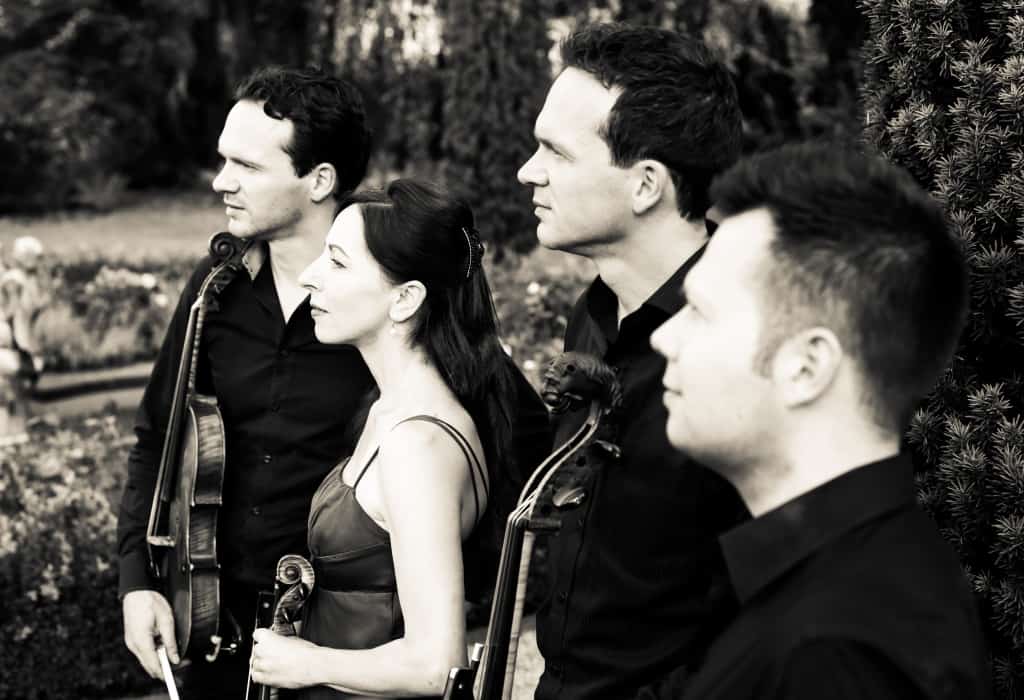
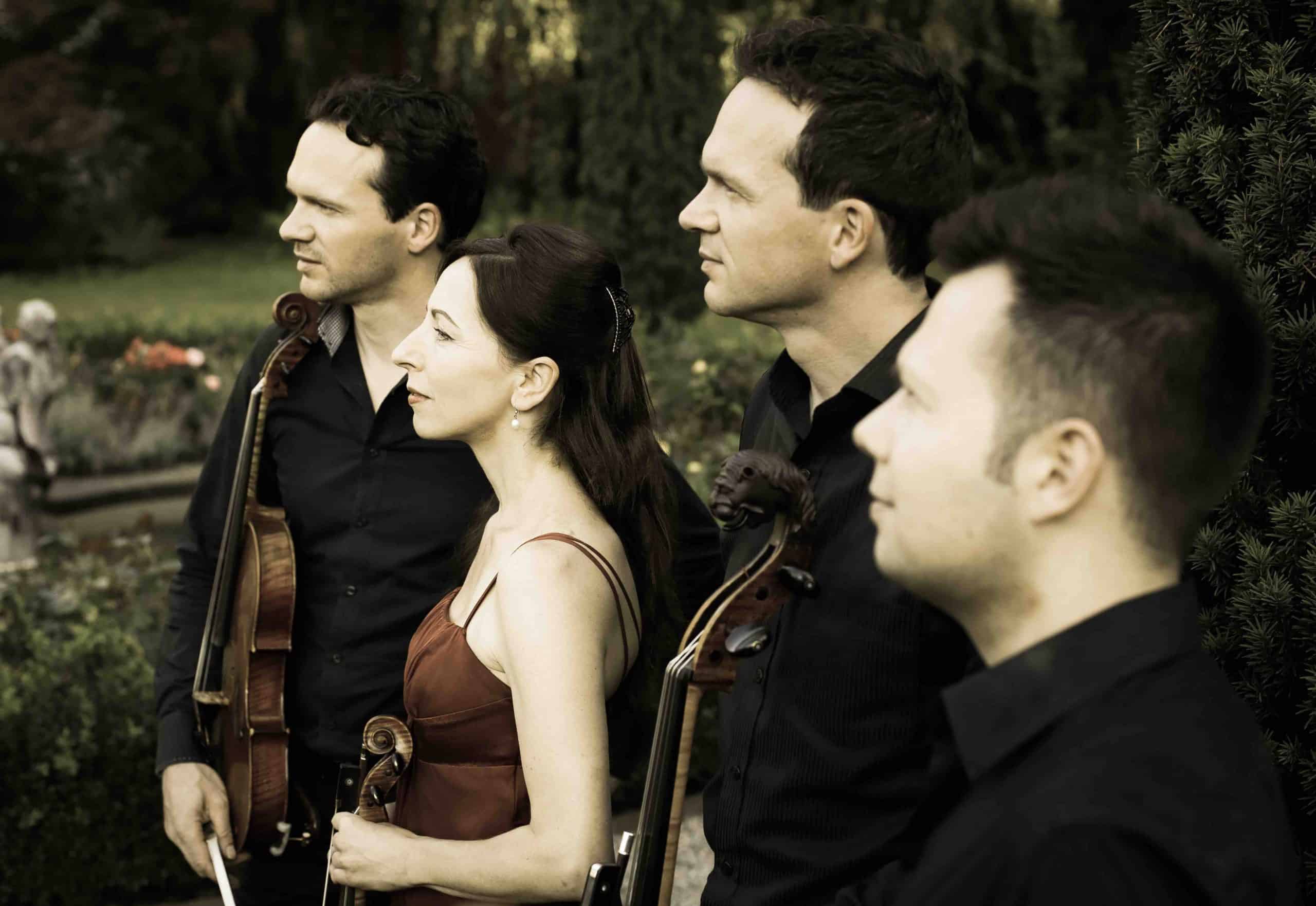
- WHO: casalQuartett [Felix Froschhammer & Rachel Rosina Späth (violin), Markus Fleck (viola), Andreas Fleck (cello)]
- LABEL: Solo Musica (SM 283) in cooperation with Südwestrundfunk (SWR)2
- PHOTO: © David Guyot & Beethoven-Haus Bonn
- WEBSITE: http://casalquartett.ch/
- ORDER: JPC