

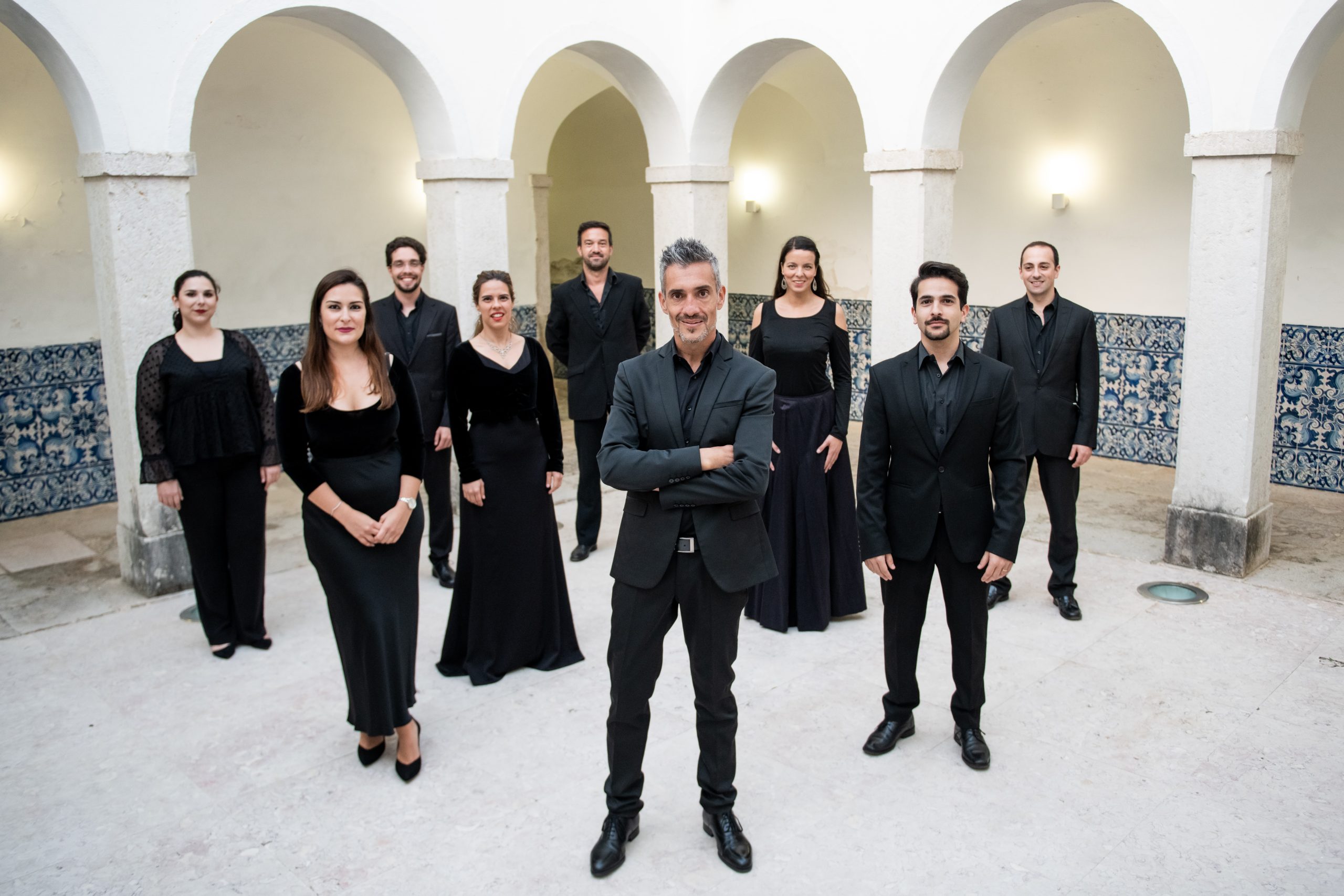
What was cautiously suspected during the concert was unmistakably confirmed at the end: Officium Ensemble received a standing ovation that lasted for minutes. And as far as I'm concerned, this was the most beautiful concert of this edition of Laus Polyphoniae so far.
Much came together this evening: beautiful Iberian polyphony, an ensemble that completely makes this music its own, a conductor who seems to breathe the singing, and a musicality that worked irresistibly from beginning to end. What reached the ship in the church from the ensemble was not only a refined sound culture, but also a palpable commitment to the music.
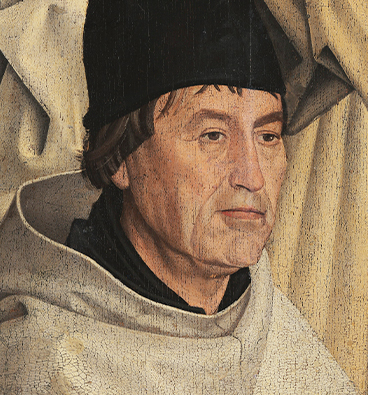 The programme was largely built around Estêvão Lopes Morago (1575-1630), a composer of Spanish origin who studied and worked in Portugal. At the end of the concert, conductor Pedro Teixeira told us more about this. It immediately explained an impression that had struck me several times while listening: some passages strongly recalled Tomás Luis de Victoria.
Morago was approximately thirty years younger than Victoria. Whether there was direct influence, I'll leave to the musicologists, but the stylistic affinity was sometimes remarkably great. And perhaps that shouldn't be surprising either: in the Iberian musical landscape of that time, the borders between Spain and Portugal were presumably much more porous than we experience them today. My ears certainly heard unmistakable Victoria at times.
An additional special feature of this programme is that a considerable part of this music was reconstructed and transcribed for modern performance practice by musicologist José Abreu from the University of Coimbra. This allowed us to listen to the Missa ferialis, surrounded by eucharistic motets and some eight-voice works by Morago and his contemporaries. It proved to be a particularly fascinating discovery.
Polyphony that lives
Officium Ensemble brings this polyphony with a natural conviction. The ensemble makes the music completely its own. Perhaps it sounds traditional, but I believe it is the right way to approach this repertoire: organically, sustainedly and without the need to make it academic or artificial.
The music is brilliant in itself, but it is the singers who truly bring it to life. The ensemble consists of excellent voices, without anyone seeming to feel the need to put themselves in the foreground. Everything is in the service of the music.
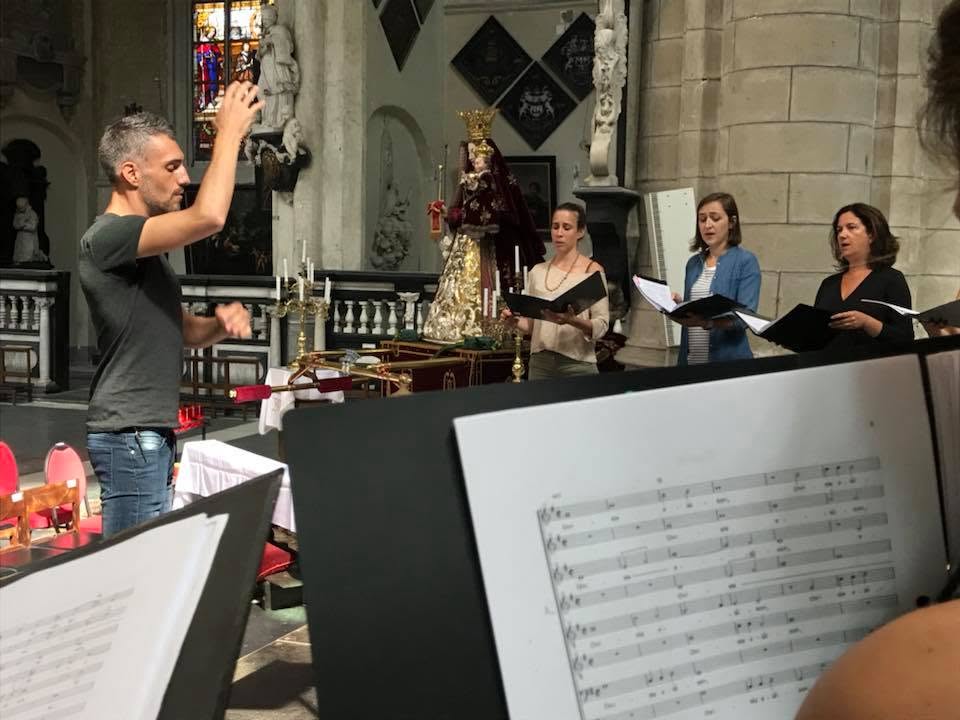
The conducting style of Pedro Teixeira also fits seamlessly with this. He does not impose anything on his singers and conducts with remarkable naturalness. His gestures support more than they direct. The conducting seems continuously connected to the breathing of the music itself, allowing the sound to develop naturally.
If I may highlight two voices, I would like to begin with the bass voice. This not only formed a solid foundation for the ensemble, but also sought out contact with the audience quite often. Because he stood in the corner and I sat in the third row, this was particularly striking. It may seem like a small detail, but it makes an essential difference: the singers do not sing above the audience, but communicate with them.
On the other side stood the soprano. In polyphony concerts, the soprano often naturally fulfills the role of cantus, but here she was much more than that. The voice gave the ensemble stability and direction, but above all a colour that sometimes seemed almost otherworldly.
With this, I certainly do not wish to detract from the other voices. The deep altos and convincing tenors, with their recognizable Iberian flair, together formed a homogeneous and rich soundscape.
The first cold shiver
 Musically, there were several moments when I wanted to put down my pen. The first real cold shiver I got with Vinea electa mea. There it became particularly clear to me how close Morago sometimes comes to Victoria.
But it was especially Audivi vocem that completely captivated me.
The soprano began Audivi vocem, "I heard a voice from heaven", with a conviction that immediately drew the attention of the entire church. And then there were those beautiful dissonances: pure, refined and delivered completely naturally.
Pedro Teixeira also showed that he possesses a beautiful voice. With the intonation of Benedicamus Domino and at the start of the lamentation, he repeatedly gave energy to the group.
When the church begins to resound
In a space like the Sint-Andrieskerk, it remains a challenge to perform polyphony in such a way that the acoustics enrich the music without clouding it. Officium Ensemble appeared to have complete control of that balance.
The reverberation sometimes worked downright magically. The beautiful thing was that the singers did not need to force the space; they trusted it. The sound could develop naturally through the architecture of the building itself.
This was particularly striking in Tamquam ad latronem, in which the Pharisees and high priests approach Christ with swords and clubs. The space gave the music an extra dramatic dimension there.
The two final motets were not by Morago, but by De Brito and Tavares. I was already somewhat familiar with the first; Tavares hardly needs introduction for lovers of Portuguese polyphony. Once again these were eight-part works, and that is when I finally put my pencil down.
My book closed. I wanted to listen.
In Vidi Dominum, Surge, propera and the deeply moving Columba mea, all the qualities of the ensemble came together: the precision, the beauty of sound, the depth, the lightness and the naturalness with which these musicians sing together.
And as I wrote at the beginning: the audience was convinced.
Some concerts are well performed. Some concerts are memorable. This was one that you carry with you for a long time because this was no mere performance of polyphony.
This was polyphony that breathed.
Tuesday 25 August 2026, 22:00 / Laus Polyphoniae / Sint-Andrieskerk Antwerpen
Motets by E.L. Morago, M. Cardoso, F. de Magalhães, A. Lobo
Ariana Russo, Isabel Fernandes, Mariana Moldão, Raquel Mendes, soprano | Fátima Nunes, Rita Tavares, alto | André Lacerda, Jorge Leiria, tenor | Nuno Mendes, Pedro Casanova, Rui Bôrras, bass | Pedro Teixeira, artistic direction