


One of the most beautiful aspects of my work as artistic director of the NTR ZaterdagMatinee has always been that I was able to get to know the Bachs and Beethovens of our own time closely. Some personalities impressed me especially because of their musical talent. Others turned out to be extraordinarily nice and sensitive people as well. But in all those years I have only met one Wolfgang Rihm. Of course, not only in his native country, but also far beyond, this German master who died on Saturday, July 27, 2024, was regarded as one of the greatest composers of our time. Everyone who knew him also knows that Rihm's erudition was hardly of this world. But was it to be expected that someone of such artistic and intellectual stature would then also turn out to be an extremely approachable, courteous, empathetic, humorous and courageous person? It seems too much of a good thing, but Wolfgang Rihm was living proof that all these qualities can be united in one person. I no longer remember exactly when I began to immerse myself in the music of Wolfgang Rihm. What I heard from him was for me audible proof that Rihm, like no other, was able to organically connect tradition and innovation, craftsmanship and originality in his music. He knew virtually the entire Western musical history by heart and had an insatiable curiosity about the work of his composing contemporaries. He absorbed everything and examined it for new applications. He expressed his impressions extremely eloquently, could be critical, but never spoke disparagingly of his fellow artists. Hölderlin's adagium "Alles prüfe der Mensch" could have been Rihm's motto. That also applied to his own work: he regularly returned to his older compositions to see what alternative developments of the musical material were still possible. He was sometimes heavily criticized for that creative recycling, but actually mainly by critics who did not understand what drove him at his core. Rihm's open ear for the sounds of his predecessors was also initially heavily distrusted by some critics. Even fascism was accused of him, because he dared to emphasize that music had to be "full of emotion," a dangerously romantic idea according to some modern thinkers. Rihm paid little attention to all this criticism. He wanted to know where he came from ("woher ich komme"), but found it even more important to know where he was going ("wohin ich gehe").
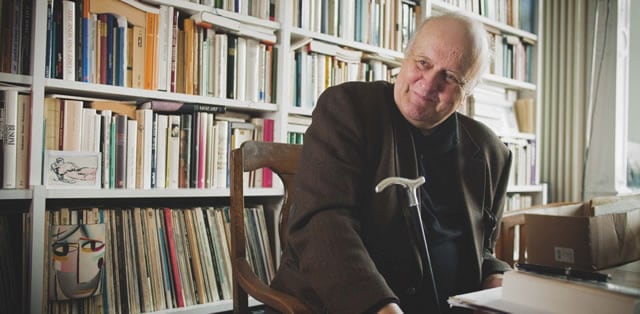 Wolfgang Rihm (1952-2024)[/caption] In 2009 I decided to make the Matinee season 2011-2012, which was still to be programmed, a tribute to the oeuvre of Wolfgang Rihm, which in my opinion received far too little recognition in the Netherlands. That oeuvre already counted more than 400 titles for the most diverse ensembles. I had my own favorites, but of course I also wanted to know which works Rihm himself would like to hear in Het Concertgebouw. I called him and was soon able to visit him at his home in Karlsruhe.
It was a meeting I would never forget. The house itself made a deep impression, with the endless rows of bookshelves reaching to the ceiling in every room I saw. The conversation soon turned to literature, visual arts, philosophy and everything that inspired him. But Rihm also had a Burgundian side and knew exactly where you could eat well. Meanwhile, I put one programmatic idea after another to him. He was all relief that his music would not be presented in a modernist reservation, but precisely in meaningful combinations with great masterworks from a more distant past. Thus, the wildly expressionistic monodrama Das Gehege found a place alongside the equally charged one-act opera Salome by Richard Strauss. An extremely demanding program for which I was able to enthuse Edo de Waart and the Radio Filharmonisch Orkest, and which is actually only conceivable in the Matinee in the Netherlands. But the combinations with Berg, Brahms, Schubert, Schumann or Schreker also came about in good consultation with the master himself. At the commission of the Matinee, Rihm composed Der Maler träumt, to a text by the German painter Max Beckmann (1884-1950) whom he so greatly admired. The fact that Beckmann lived and worked in Amsterdam for more than ten years made it in Rihm's eyes almost a duty that he would compose precisely this work for the Amsterdam Matinee series. After all, Rihm was of the opinion that the music of his star student Jörg Widmann could not be missing from the series either. And so the Matinee season 2011-2012 was created, which received the name Rihm-Resonanz. Rihm traveled to Amsterdam several times and enjoyed the warm response his music received from the Matinee audience. During rehearsals, he encouraged the musicians to give their best. He had no patience with the sterile approach that sometimes still automatically raises its head when contemporary music is on the music stands. "Singen, singen, singen, lange Linien!", I heard him call out to the musicians on stage.
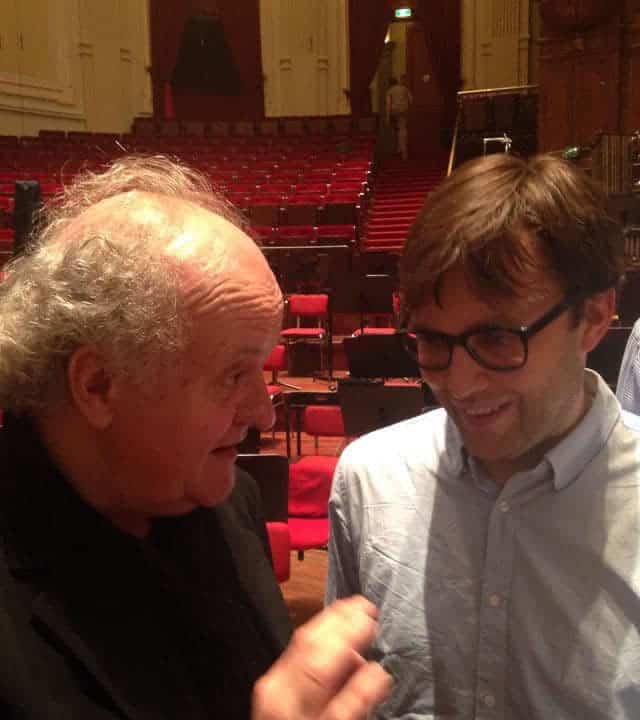 Wolfgang Rihm with Belgian conductor Karel Deseure in the Amsterdam Concertgebouw[/caption]
Rihm was convinced that a series like the Matinee would always retain its value. Whenever I sighed that art and culture seemed to matter less and less in the Netherlands, he looked at me intently and said to me: "Man darf nicht pessimistisch sein!" That's how he stood in professional and personal life. And so he fought without complaint against the illness that ultimately proved fatal to him. Wolfgang Rihm was only 72 years old. Everyone who knew him will miss him terribly. He lives on in his impressive oeuvre.
Kees Vlaardingerbroek Artistic director NTR ZaterdagMatinee from 2006 to 2023 (see here the interview I had with him in August 2021).