

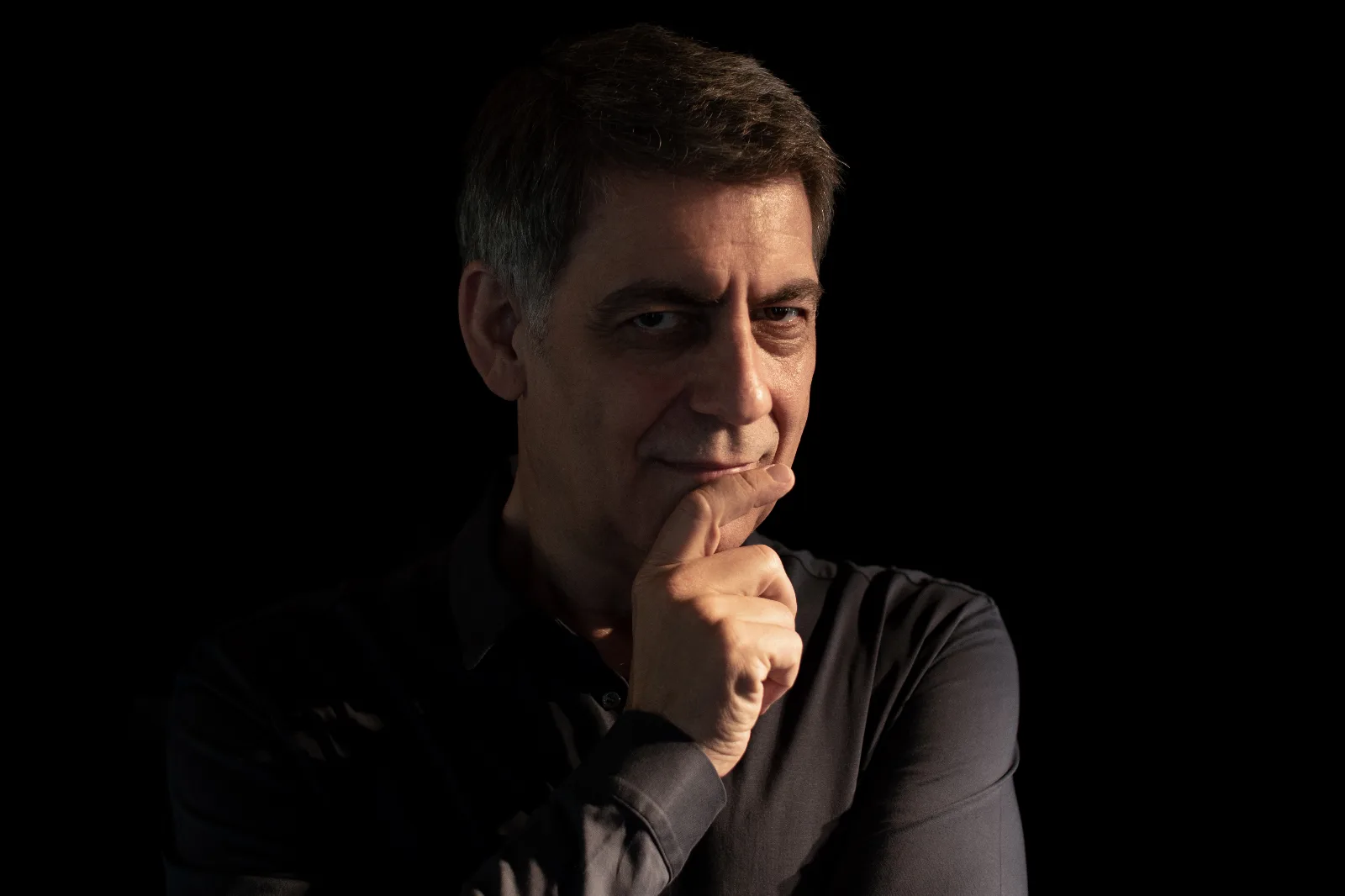
How do we relate to the beauty of the world of which we ourselves are a part? And how can we understand that we are able to perceive and admire that beauty, while at the same time threatening it through our own actions? That paradox forms an important starting point for Messe des Glaces, the new composition by Belgian composer and pianist Jean-Luc Fafchamps. The work, commissioned by the festival Ars Musica around the theme Arctic Fever, will receive its world premiere on 27 November at the Grand Manège in Namur. A day later, a second performance follows at the Sint-Augustinuskerk in Vorst. The polar regions are the concrete impetus, but Fafchamps does not want to write an ecological pamphlet.
A Mass without divine salvation
The title Messe des Glaces refers to the classical Mass, but Fafchamps gives that tradition an idiosyncratic interpretation. "I fear that no god will come to save us from our stupidity," he says. His Mass is therefore not addressed to God. He considers the work more a ritual: an awareness that arises from a gaze and a train of thought that gradually unfolds.
Fafchamps wrote the text at the same time as the music and deliberately kept it simple. He did not want the words to say everything. According to him, the essence of vastness, the cold, the white, our gaze, our testimony and our contradictions lies in the relationship between the few words and the music.
The classical structure of the Mass remains recognisable, but Fafchamps follows it very freely. The movements receive titles that break away from the traditional liturgy. Thus his "Credo", Si cela n'était plus, is rather a place of doubt. His "Communion", Un, evokes the sense of connectedness and solidarity that we must rediscover.
Behind that form lies a paradox that deeply moves Fafchamps. The consciousness that can perceive the beauty of the world and thus lets it exist for us, is according to him at the same time the place where that beauty is systematically appropriated and destroyed. Perhaps that consciousness is ours alone: "I have only tried, with precisely enough naivety, to remind us that we are part of the beauty we see. We depend on one another."
He did not want to write an ecological pamphlet. By his own account, he lacks both the legitimacy for this and the conviction that artistic creation, and music in particular, can be a valid substitute for direct accusation.
A house with a polar story
The personal impetus for Messe des Glaces lies in Fafchamps's living environment. For several years he has lived in a house designed by architect Philippe Samyn for polar explorer and glaciologist Alain Hubert. Samyn worked with Hubert on the Belgian polar station Princess Elisabeth in Antarctica. Fafchamps spoke several times with Hubert about his expeditions to the poles. Documentaries about those journeys formed the most important source of inspiration for his composition.
What stayed with him above all were the vastness, the instability and the inhospitality of the ice, but also the animals, which did not strike him as particularly sympathetic. In addition, the disastrous consequences of climate change and the bleak prospects left a lasting impression on him.
How has he translated the vastness, the cold and the silence of the icy world into music? "You will hear that," he replies with a wink. Asked what the audience should pay attention to during the world premiere, he also keeps it simple: "The most important thing for me is that there is no point in talking about it if it is not audible. So: listen!" About climate change and the role music can play in our relationship with nature, he prefers to let the music speak for itself.
A musical language without fixed boundaries
Fafchamps is a composer and pianist and was one of the co-founders of the Brussels ensemble Ictus, which specialises in contemporary music. He describes his own music as essentially written music, though "without radicalism". Musical notation makes it possible to think ahead, to steer the musical course and to interweave different voices. At the same time, the composer is limited by the possibilities of the written score. The time between writing and performance leaves room to develop a musical project, but that project must ultimately also be transmissible.
In this, the performer plays an essential role. "The first to read what will be heard is the performer, or the group of performers," Fafchamps stresses. At Ictus, and elsewhere, he learned that even the best music, contemporary or not, cannot sound well if it is not notated and composed in such a way that the musical intention comes across clearly. He finds direct contact with the latest work made within an ensemble for contemporary music more valuable than any formal training.
His work is not limited to the concert hall. He writes for dance, music theatre and film, and regards every commission as a new adventure that requires its own form. Sometimes he works alone at his desk, sometimes in close collaboration with a theatre company, a film director or musicians during the preparation of a concert. Each experience feeds the next. Depending on the commission, he always seeks the working method and aesthetic that best suit the project.
According to him, ideas can arise anywhere: in an image, a text, an encounter, a scientific observation, a forgotten sonata, a mathematical formula, an aphorism, a natural sound or a moving chord. What matters is that something sets metaphorical thinking in motion.
His experience as a pianist is a double-edged sword. Fafchamps puts it himself as follows: "My fingers also know things I can use, but in a sense that is a trap: what my fingers know is not always mine." He likes to bring diverse styles and aesthetics into contact with one another, but wants to retain his own musical voice in doing so. Music history may also be a playground for him, as long as he does not let himself be misled by it.
Fafchamps does not wish to give a watertight definition of his musical language. In his own mind, it changes with almost every new piece. He is open to a wide range of influences and does not want to be confined by any single style or tradition.
His musical universe ranges from Hildegard von Bingen, Lassus and Purcell to Wagner, Mahler, Stravinsky, Janáček and Bartók. The progressive rock of his youth – Yes, Pink Floyd, David Bowie, Robert Fripp and even Genesis – also left its mark, as did the film music of Nino Rota and Georges Delerue, French chanson and Miles Davis. He also names composers such as Ligeti, Nancarrow, Grisey, Harvey, Reich, Feldman, Romitelli and Saariaho, but also Barbra Streisand, Nina Simone, gamelan and Afro-Cuban music. Even the possibilities of the piano, prepared or not, remain a source of inspiration. His list is never finished.
What he seeks are not primarily new sound worlds as such, but new dimensions of time: moving spaces that reveal something of our being in a form of vulnerability. In this context he refers to the video works of Bill Viola and the large, rhythmically structured canvases of Julie Mehretu. Film, literature, dance and theatre are also inexhaustible sources for him.
An individual consciousness facing the ice
For Messe des Glaces, Fafchamps chose soprano, mixed choir and four trombones. Initially, the intention was to write a choral work. The Chœur de chambre de Namur under the direction of Gabriel Hollander was a dream partner for this. However, when his intuition for the piece took shape, a sharper dramaturgical structure proved necessary.
First came an individual consciousness. As soon as the name of soprano Sarah Defrise came up, with whom he had worked before, he knew he had found the right solution. Her voice and stage presence offered precisely what he was looking for. Then came the vastness, the bewilderment and the cold. He did not want to entrust that role to the choir alone: "I wanted it to fight against something more relentless than itself." The four trombones fulfil that function.
The qualities of the performers also played a major role. Without the high level of these musicians, Fafchamps says, he would have thought twice before writing such compact six-part choral parts and ethereal vocal lines. The ensemble's experience with early music is an advantage here. Vocal control and mastery of vibrato help prevent his writing from being overshadowed by performance habits that do not suit the music.
"For other performers I would have written differently," he emphasises. He therefore looks forward eagerly to the premiere and has every confidence that his musical intentions will be realised as fully as possible.
From a radical idea to a finished composition
The compositional process, as almost always, brought surprises. Fafchamps did not keep a diary of his changes of course, regrets and corrections. He does remember that he had started with something radical, but that the subject did not lend itself to that, unless he had remained stuck in the cold atmosphere of the ice.
The piece is now what it is. Despite its possible imperfections, he prefers this concrete reality to a work that had only remained in his imagination.
Meanwhile, Fafchamps is already looking ahead. He is working on a composition for amplified cello and four percussionists, at the initiative of a Portuguese ensemble. He then returns to the voice, with soprano Lore Binon in a Baroque project. In the longer term, a cello concerto and a cinematic opera are also on the programme.