*** What is it with opera directors and other leaders that they must bend every strong opera story to their will and thereby miss the composer's genius? And why must one always 'read into' and refer to contemporary issues that have nothing to do with the story?
Richard Wagner is and remains one of the greatest opera composers in history. Together with Mozart, Monteverdi and Verdi, he leads the top. Wagner went further than these three and all others because he was librettist, composer and director. For him it all belonged inextricably together. He didn't even want parts of any of his operas, such as the overture, to be performed separately in concerts. I don't follow him in that because it's simply unrealistic to always perform a complete opera in any venue or to introduce people to his work through concert excerpts. What should be possible, where a venue allows it, is to follow his stage direction and not only and exclusively the score. This is even more important than with the other composers because everything is so enormously interwoven.
In the reinterpretation we watched for you, the director chose to turn the weavers into (presumed) Muslim women with headscarves in long Oriental trousers who are not sitting weaving, but assembling and disassembling plastic trinkets with screwdrivers. They don't do that in the weaving workshop either, but on a beach near a beach umbrella and The Flying Dutchman's painting has become a book. The mere fact that these weavers are doing something completely different from weaving is actually ridiculous. What the statement is of turning these ladies into women with headscarves and dressing them orientally is not really clear and also has absolutely nothing to do with Wagner's story.
The hunter who sees his great love slip from his hands is portrayed as a sort of freedom fighter with a weapon of war in his hand. That doesn't fly as far as I'm concerned. Can we never just do things normally when it comes to staging? All other elements, however, are well to very good. The two sailors, the seamen, the ghost figures, the boats. There the director comes close to Wagner and that's how it should be. Completely literal as the megalomaniac composer wished is barely possible, but the approach is certainly skillful: the bow of the ship which actually serves for both ships, the ship's staircase, the enormous anchor, the beach, yes that works. In short, the staging by Àlex Ollé de la Fura dels Baus is, despite the praise to be read in the accompanying text, only partially adequate.
The imperishable music performed by top singers
Enough about the half-failed and half-successful staging, the music is ultimately what matters. I'm not entirely satisfied with the conductor. He is not the Wagner man I wish for, there is much more to be drawn from the score. Accentuations, depth, the way it goes through marrow and bone as only Wagner can do—it seems too superficial to me. Conductor Pablo Heras-Casado lacks the Wagnerian truth. He sticks with a clean performance, the notes and so forth that he has the Teatro Real de Madrid orchestra play, but it only becomes gripping through the interpretation of the singers.
Daland, the captain and father of Senta, is portrayed by Kwangchul Youn who not only has the ideal vocal color and carrying power, but also behaves completely like a father who offers his faithful virginal daughter for a bomb of money and glitter out of blindness to material possession. He has very beautiful German pronunciation that is completely understandable. Slightly less smooth is the German of Samuel Youn, who performs the role of the Dutchman as one of the best in history. Breathtaking acting talent, a rich broad tessitura, highly text-conscious, convincing throughout like Daland. A duo out of a thousand and Wagner at its finest.
The two tenors, Daland's helmsman sung by Benjamin Bruns and Erik, the hopelessly lovesick young man, sung by Nikolai Schukoff, are also two of those true Wagner tenors who use every color of their voice to fill in the emotions—in Erik's case more given the drama he experiences—and flowing lines perfectly.
Kai Rüütel embodies Mary in her entire being, the mistress of the workers. Rather mocking, encouraging attention to the work and not sinking into foolish infatuation. Does that help? Not at all, of course, but it urges Senta, in this Ingela Brimberg, to go even more for her dream image that comes true and leads to her death, which finally grants the Dutchman eternal rest. Brimberg also excels in her role in every respect. Interpretation, full voice, technique, empathy: it's all there.
The singers are supported by a very well-rehearsed choir, a choir that performs in the rich vocal parts in beautiful German as befits the better opera choirs. If you are less strict than I am (that's not difficult, I admit it), then this DVD is recommended, if only for the music in general and the magnificent singing performances in particular.
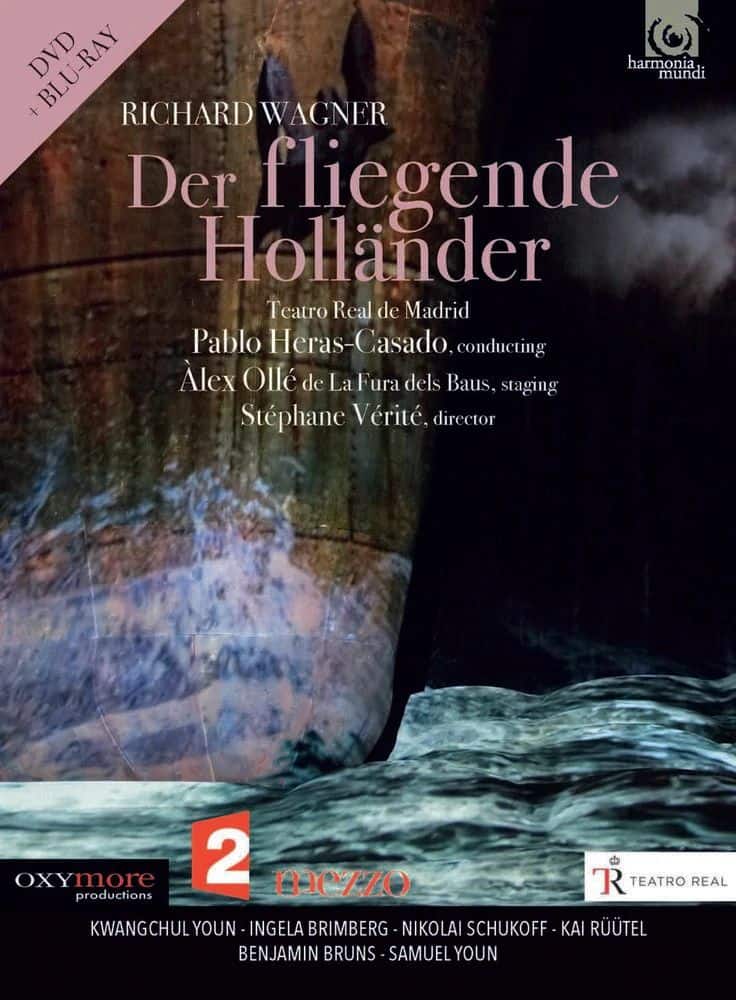
- WHAT: Der fliegende Holländer, Richard Wagner
- WHO: Choir and orchestra of the Teatro Real de Madrid, conductor Pablo Heras-Cavado, director Alex Ollé, Daland sung by bass Kwangchul Youn, the Dutchman is bass Samuel Youn, soprano Ingela Brimberg as Senta, soprano Kai Rüütel sings Mary, tenors Nikolai Schukoff as Erik and Benjamin Bruns as Helmsman
- RELEASE: Harmonia Mundi, HMD 9809060.61, cover © Harmonia Mundi
[embed]http://stephaneverite.com/portfolios/dvd-der-fliegende-hollander/[/embed]