

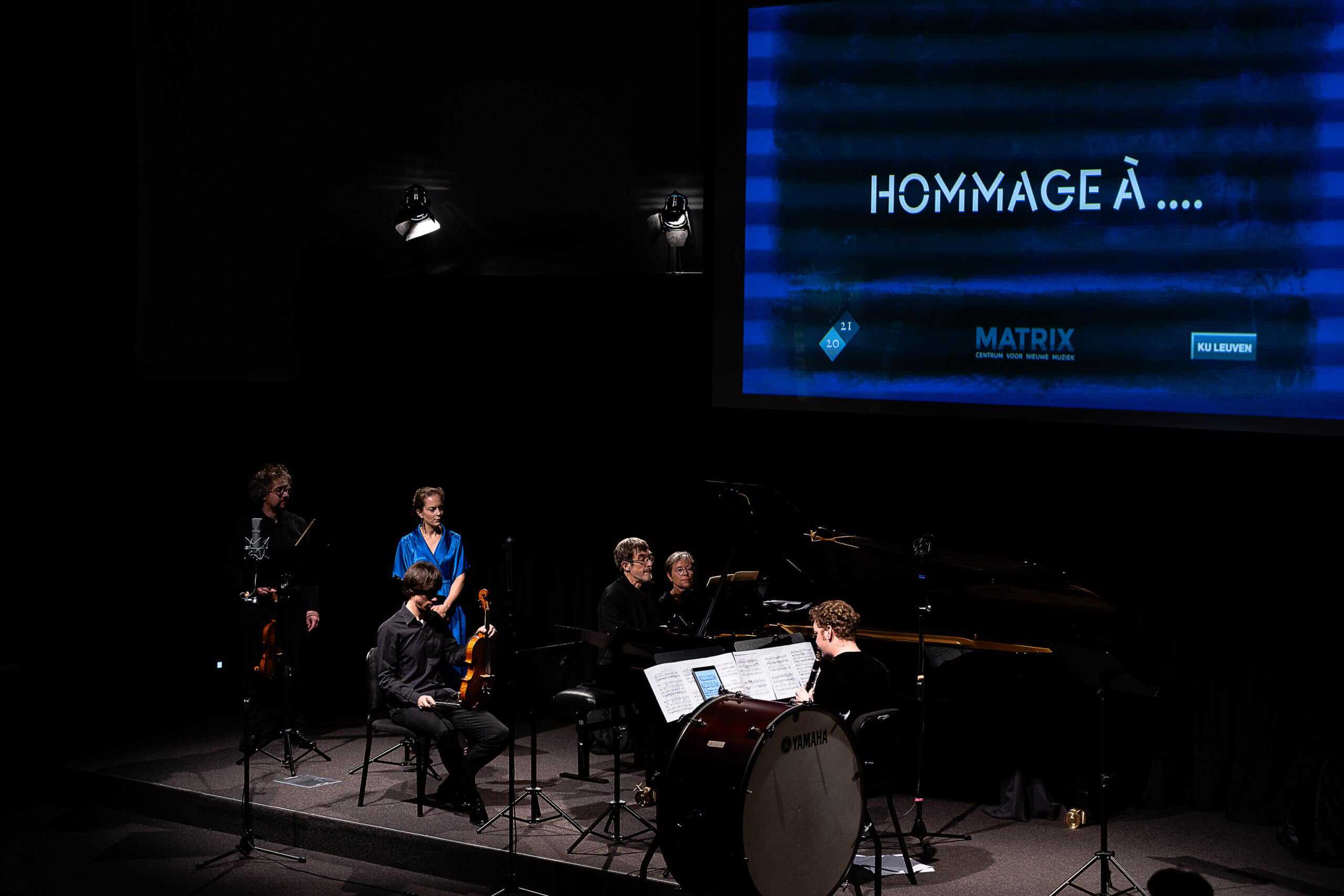
Calling this Festival 20·21 concert in the Great Hall of the Maria-Theresiacollege at KU Leuven by such a title sounds somewhat denigrating. But what a "motley crew" it was. They were all names that commanded great respect and came from both the 20th and 21st centuries, but also from much earlier. Even Bach got his place. The program was indeed well-balanced. Five sections with a prologue and an epilogue, as it were composed in mirror image like that very cerebral piece from Alban Berg's Kammerkonzert that we heard. And in all parts there was a place for György Kurtág. Then you know what this will be about and who it will be about. Homages developed into a veritable genre with him, you read in the program booklet. And his works were crammed between some German and Russian Romanticism, and we're talking about Robert Schumann, Johannes Brahms and Pjotr Tsjaikovski, also French and Russian modernism with Pierre Boulez and Igor Stravinsky and then centrally, two figures from the Second Viennese School: Alban Berg and Arnold Schönberg.
And who was supposed to give voice to all that? An occasional ensemble. Not a motley crew this time. How blessed we are in Flanders with a wealth of excellent interpreters of 20th and 21st century music, without wishing to detract from the many "older" masters who so often bring us brilliant other music. We could listen to 25 short, sometimes very short pieces. And the opener came from Kurtág's Kafka-Fragmente. "Es gibt ein Ziel, aber keinen Weg. Was wir Weg nennen, ist Zögern" sang an almost shivering frail Lore Binon with Pieter Jansen equally shy on violin. Even if there is a goal, what we call a path is actually our hesitation to take it. Short, powerful and especially beautiful.
Robert Schumann then, from Kreisleriana and his Davidsbündlertänze, with pianist Jan Michiels. The first violent, the other as if from afar. And you hear that in this hall as if you're almost sitting among those piano sounds. And let that last note fade away, don't dampen it. Your ear tries to catch the silence that comes. And between the two Schumanns you got a well-deserved homage to him from Kurtág, written for clarinet, viola and piano. The first part is called "Remarkable pirouettes". What the three musicians pull out of it together is indeed remarkable and delivered with such care. More than at a classical symphonic concert, you learn to listen to sounds at such a concert: how a clarinet is blown, how a bow draws across the strings. Thanks to Kurtág and the wonderful clarinetist Emile Souvagie and violist Diede Verpoest and a pianist who is boundlessly familiar with the work of this composer.
Then come three more "homage pieces" by Kurtág for Pierre Boulez, Stravinsky and Tsjaikovski. It's a relief to hear something other than Bach, Mozart or Beethoven: no schemas, no familiar patterns or predictability. Solitary notes sounding in such a compelling way and experiencing it live does good. And if there is structure, there is, as in the adagio of Alban Berg's Kammerkonzert, but it's so ingeniously constructed that only musicologists read or hear it. You can listen to music in many ways and not everyone hears the same thing, but for many this is still an introduction to an unprecedented, unheard sound world.
And in between always those piano pieces by Kurtág, Schumann, Brahms, and Bach, the latter even four-handed with Inge Spinette (who else!). As a finale, a dramatic Kafka fragment with Lore Binon and you think: it's the duo who conceived the concept, - Jan Michiels and Pieter Bergé - yet again managed to set people, albeit hesitantly, on the path toward that sometimes difficult-to-access 20th and 21st century music. Conclusion: Listening is the only thing that helps.
WHAT: "Hommage à…" - György Kurtág, Robert Schumann, Pjotr Tsjaikovski, Pierre Boulez, Igor Stravinsky, Alban Berg, Arnold Schönberg, Johannes Brahms, Johann Sebastian Bach. Within the framework of the Festival 20·21. WHO: Pieter Jansen [violin], Diede Verpoest [viola], Emile Souvagie, [clarinet], Lore Binon [soprano], Jan Michiels and Inge Spinette [piano] WHERE: Great Hall Maria-Theresiacollege, KU Leuven WHEN: 10 October 2023