

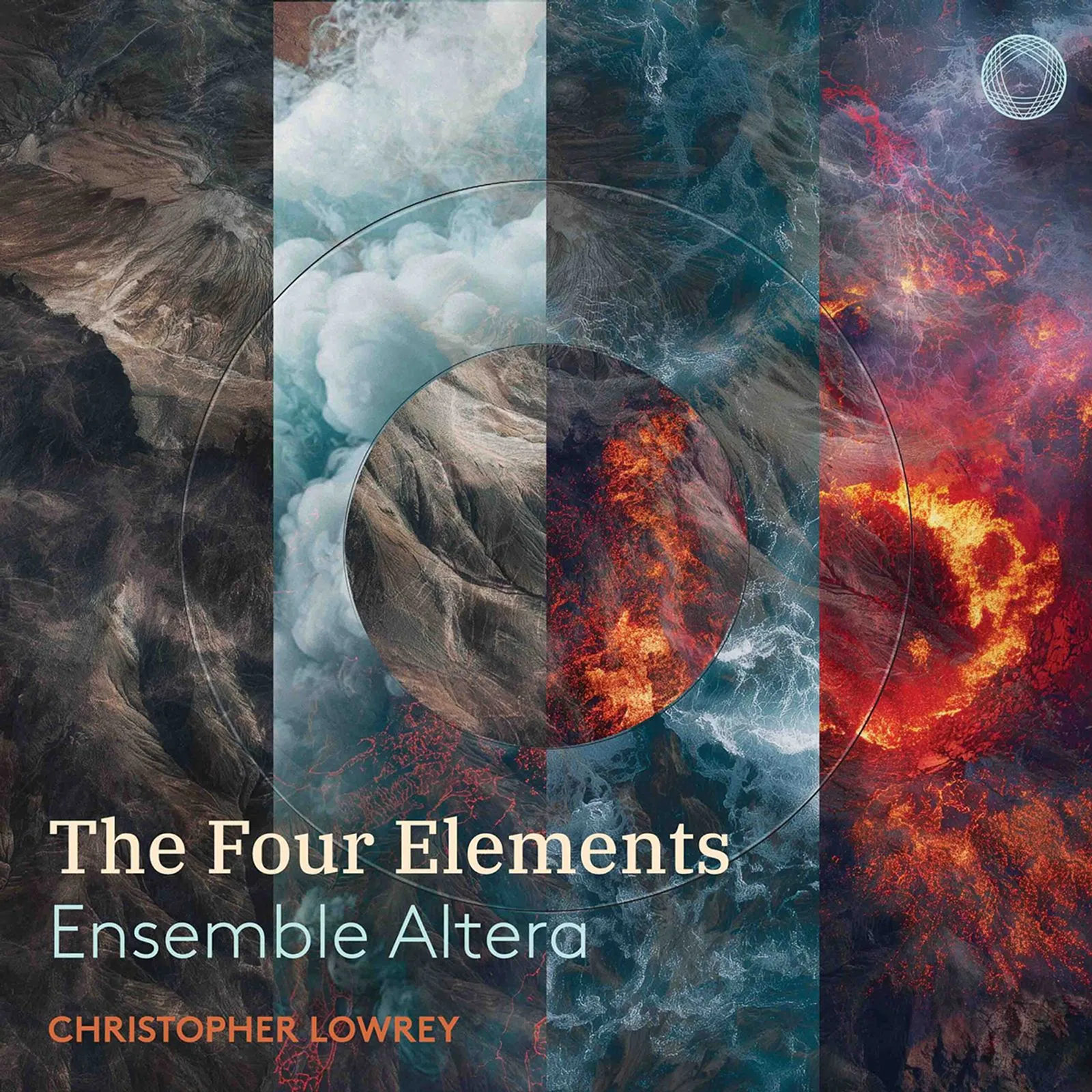
Wind, earth, water and fire form the starting point of The Four Elements, in which the American ensemble Altera brings together music from different centuries, from the Renaissance polyphony of William Byrd to contemporary choral music by Eric Whitacre and Ēriks Ešenvalds. The sixteen compositions are divided across the four elements, with Quintessence as a spiritually inspired concluding section.
Wind
The first section opens with The Wings of the Wind by Owain Park (b. 1993). The British composer, who is also active as a choral singer and conductor, skilfully interweaves the voices. The tone is set immediately: the performance is impeccably in tune, with graceful vocal lines, deep basses and a fine build-up of tension. Towards the end the music convincingly grows to a climax on the words ‘awaken’ and ‘flying’.
The sixteenth-century Westron wynde, in an arrangement by Michael Garrepy (b. 1990), shows a very different face of the wind. A lovely flute solo and the soulful tenor solo are carried by a softly humming choir, after which the flute, together with the ethereal choral sounds, brings a serene ending. The arrangement gives the melancholy and longing of the original song a new dimension.
Hope is the thing with feathers by Ivo Antognini (b. 1963), set to a poem by Emily Dickinson, also fits well in this chapter. The initially somewhat dark sound gradually gains light, as if the hope Dickinson writes about slowly gathers strength. The bird from the poem, which keeps singing and offers support to the human soul, thus receives a musical counterpart.
In Leonardo dreams of his flying machine by Eric Whitacre (b. 1970), the restless imagination of Leonardo da Vinci comes to life. The voices chase one another, with imitations and abrupt harmonic turns that make the music turbulent. The Renaissance touches contrast beautifully with the contemporary sound language. The emphatic stress on ‘Leonardo’ and the accentuation of ‘dream’ give the performance extra drama. At the end, the singers imitate the wind with wind-like sounds, a playful close that makes the dream of flying tangible.
Earth
In Earth, the focus shifts to solidity and calm. The brief Terra tremuit by William Byrd (c. 1540–1623) impresses with an atmospheric ‘Hallelujah’, sung clearly and solemnly. In Upheld by Stillness by Owain Park, a floating soundscape emerges in which the soprano and tenor solos come into their own. Unfortunately the text is not always sufficiently audible. Nevertheless, both works connect well: Park’s refined interweaving of the voices gives Byrd’s clear polyphony a contemporary resonance.
Bailey by Piers Connor Kennedy (b. 1991) then brings a very different energy, with a spellbinding opening on bodhrán and a choir singing with full commitment. For the beauty of the earth by Daniel Gledhill (b. 1984), recorded here for the first time, matches the wonder at the beauty of nature. Ensemble Altera sings the work with care, although this contemporary choral music sounded to me just a little too tame, and the composition lacks a distinctive profile of its own.
Water
The water section opens with the African-American spiritual Deep River, in an arrangement by Norman Luboff (1917–1987). The sustained melody forms a resting point after the stormy predecessors, but the tempo felt too slow to me. The performance sounds more like a carefully worked-out concert piece than a deeply lived spiritual, so too little of the original spirit is preserved.
In The Blue Bird by Charles Villiers Stanford (1852–1924), bird and water meet in a hushed soundscape. The tender soprano solo is intimately supported by the choir, which carefully preserves the fragile atmosphere. With There will come soft rains by Rebecca Dale (b. 1985) follows a particular highlight. The piercing performance deeply moved me, especially because of the powerful climax that gives way to stillness.
Fire and a fifth element
In Fire, the programme takes on a more dramatic character. In God’s Grandeur by Kenneth Leighton (1929–1988), set to a poem by Gerard Manley Hopkins, Ensemble Altera combines a powerful choral sound with clear, pure high notes. Io piango by Morten Lauridsen (b. 1943) forms a melancholy contrast, with a refined rendition and strikingly deep basses. In I saw eternity by Lucy Walker (b. 1998), both sound worlds come together in an expressive evocation of eternity.
A highlight is Flame of Love by Michael Garrepy (b. 1990), which appears on CD here for the first time. Inspired by the mystical poetry of John of the Cross, the work depicts love as a fire that at once soothes and consumes. The outstanding singers of Ensemble Altera lend this spiritual music a remarkable intensity through their tight ensemble singing and devotion.
With Salutation by Ēriks Ešenvalds (b. 1977), set to a text by the Indian poet Rabindranath Tagore, the programme ends at the quintessence: the fifth essence from ancient natural philosophy, which refers to what transcends the visible world. The ethereal choral sounds gradually lead the listener to another world. Afterwards, the feeling lingers that you have briefly stepped outside familiar reality.
A versatile choral portrait
Under the direction of founder Christopher Lowrey, Ensemble Altera moves with ease between Renaissance polyphony and contemporary choral music. The alternation between a cappella works and compositions with solo voice and instrumental accompaniment brings colour and variety. With a running time of just over 75 minutes, I preferred to listen to the CD in four sessions, so that each chapter could sink in at its own pace.
The strength of The Four Elements lies in the musical connections the programme reveals. Especially the kinship between Byrd and Park and the transition from Flame of Love to Salutation testify to a strong sense of dramaturgy. In this way the varied programme acquires a convincing coherence.
The only reservation concerns the absence of the sung texts in the CD booklet. The general introduction cannot fully make up for this omission, certainly when the text is difficult to make out. In a programme where poetry and music are so closely intertwined, the song texts would have considerably enriched the listening experience.
