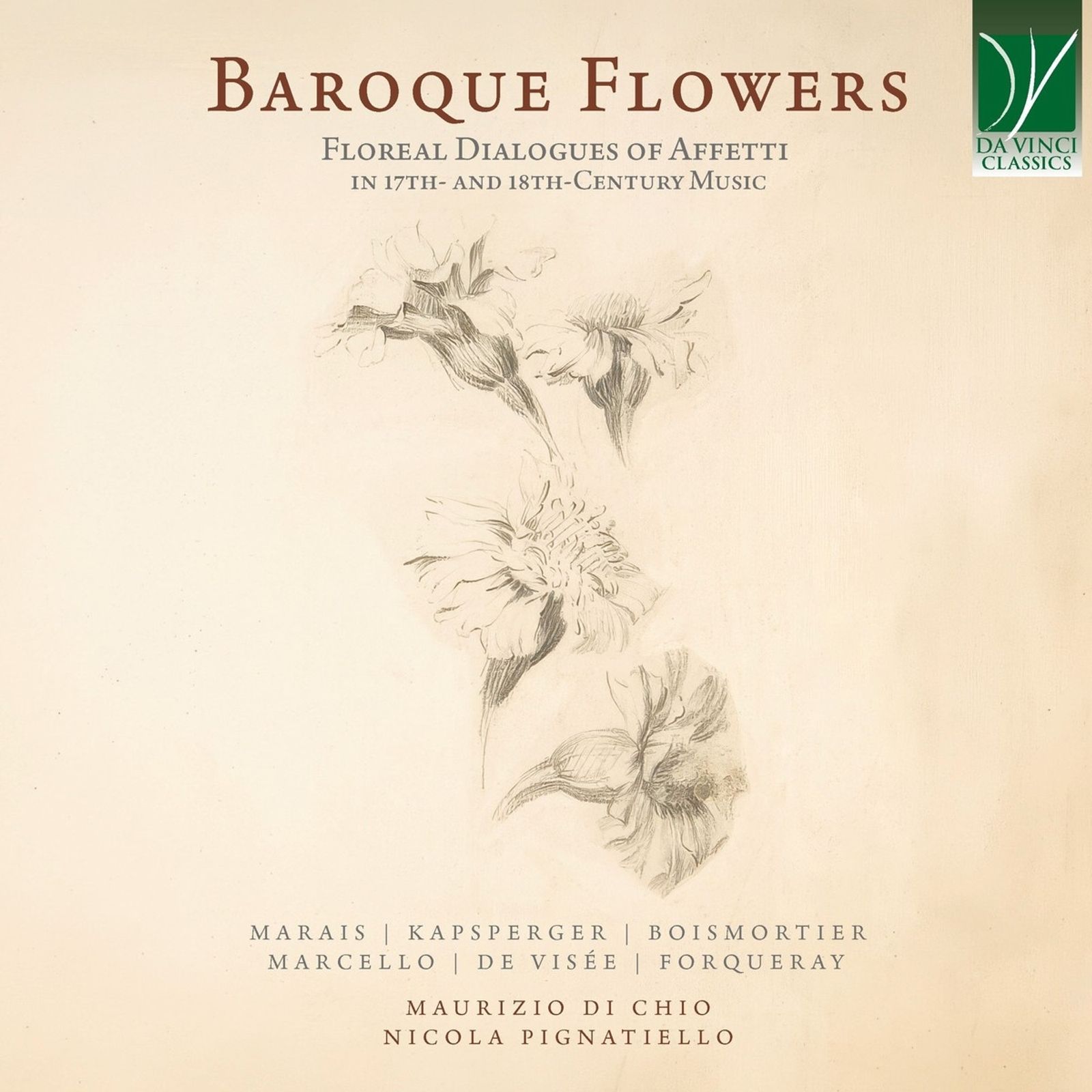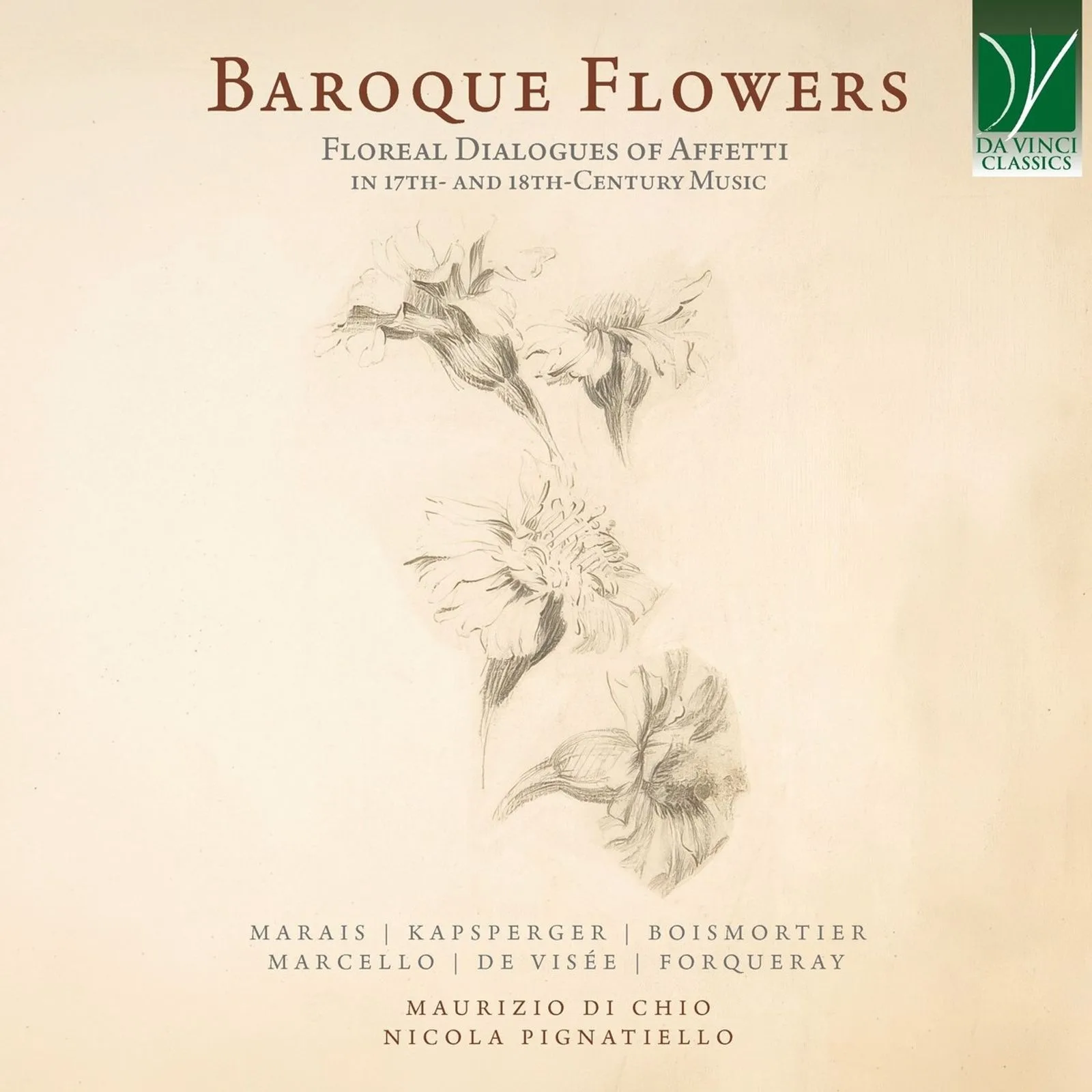
Flowers have often served more than a purely decorative function in seventeenth- and eighteenth-century painting: their beauty also points to the transience of life. That idea forms one of the starting points of Baroque Flowers, a CD on which gambist Maurizio Di Chio and theorbist Nicola Pignatiello combine baroque music with flower paintings. Each piece of music is linked in the beautifully designed booklet to a painting, creating a dialogue between two art forms that can evoke feelings and moods.
The title refers to Charles Baudelaire's Les Fleurs du Mal, more specifically to Correspondances, in which different sensory experiences complement and reinforce one another. The project originated as a concert and now receives a sequel on CD. The five thematic sections – from the transience and power of time, through dance and refined passions, to the many forms of love and the shifting moods of the heart – offer a guiding thread without tying the listener down. There remains room to draw your own connections between what you hear and see.
A baroque dialogue
The viola da gamba and theorbo suit the intimate character of the repertoire. The gamba moves between lyrical melodies and virtuosic passages, while the theorbo, with its chords and bass lines, provides a harmonic foundation. The two instruments complement each other and regularly engage in dialogue.
The CD opens with a suite in C major by Marin Marais (1656–1728). After a prélude and caprice, various dance forms follow, including an allemande, sarabande and gavotte. Di Chio gives the melodic lines extra colour with his ornamentation, while Pignatiello provides a firm musical foundation with his accompaniment. The Sarabande en rondeau in particular stayed with me. The performance has something lamenting about it, yet also a songful quality that gives this restrained music a distinctly expressive character.
In Giovanni Girolamo Kapsperger's (1580–1651) Toccata IX and Toccata X, Di Chio and Pignatiello show how versatile their interplay is. In the first toccata, the deep tones stand out, lending Di Chio's playing a searching character, while Pignatiello supports the musical line with his accompaniment. In the second, the mood shifts to a more intimate sound, without the dark undertone disappearing.
An anonymous Ciaccona forms the transition to the danceable music of Joseph Bodin de Boismortier (1689–1755). The recurring pattern and the infectious rhythm give the performance momentum and make one curious about the suite in G major that follows. With its allemande, sarabande, menuet, gavotte and rigaudons, that suite offers plenty of variety. Di Chio and Pignatiello play with the different dance characters, letting the music sound now cheerful and light-footed, now more restrained and introspective. Their interplay has so much schwung that you almost want to get out of your chair and try a few dance steps yourself.
The Sixth Sonata in G major by Benedetto Marcello (1686–1739), originally written for cello and basso continuo and here arranged for viola da gamba and theorbo, is one of the highlights of the CD. The Grave in particular stayed with me. Di Chio and Pignatiello lend the restrained music great expressive force; time seems to stand still for a moment. In the following Allegro the mood turns completely around. The lively, playful interplay pulls you out of the contemplation of the Grave and brings you firmly back down to earth. It is precisely this contrast that makes this sonata, for me, one of the most fascinating moments of the recording.
Robert de Visée (c. 1655–1732) is represented by Entrée d’Apollon, a short ceremonial piece that gives the programme a stately accent. The CD concludes with La Dubreuil and La Sainscy by Antoine Forqueray (1672–1745). His music for viola da gamba makes high technical demands and calls for a pronounced style of playing. Di Chio and Pignatiello meet this challenge convincingly. With these two pieces, after the more contemplative moments earlier on the CD, they once again raise the tempo and energy. The virtuosic passages give the music momentum and ensure a lively conclusion.
The beauty of the transient
The accompanying booklet includes works by, among others, Francisco de Zurbarán, Caravaggio, Mario de' Fiori, Margherita Caffi, Rachel Ruysch and Fede Galizia. Jan Brueghel the Elder is also represented, with compositions in which flowers from different seasons stand side by side. That abundance is not only an image of beauty but also refers to its transient nature. Sometimes this becomes visible in small details, such as a blemished leaf or a flower losing its freshness. In this way the still lifes acquire a deeper meaning and offer their own entry into the emotional world of the music.
The clear recording also contributes to the experience. The viola da gamba and theorbo sound so close that you almost feel you are in a dignified museum, strolling from one painting to the next. Baroque Flowers is, for me, one of the most fascinating CDs I have had the pleasure of reviewing in recent months. The combination of music and painting makes this release special: even after the last note, it continues to occupy my thoughts.