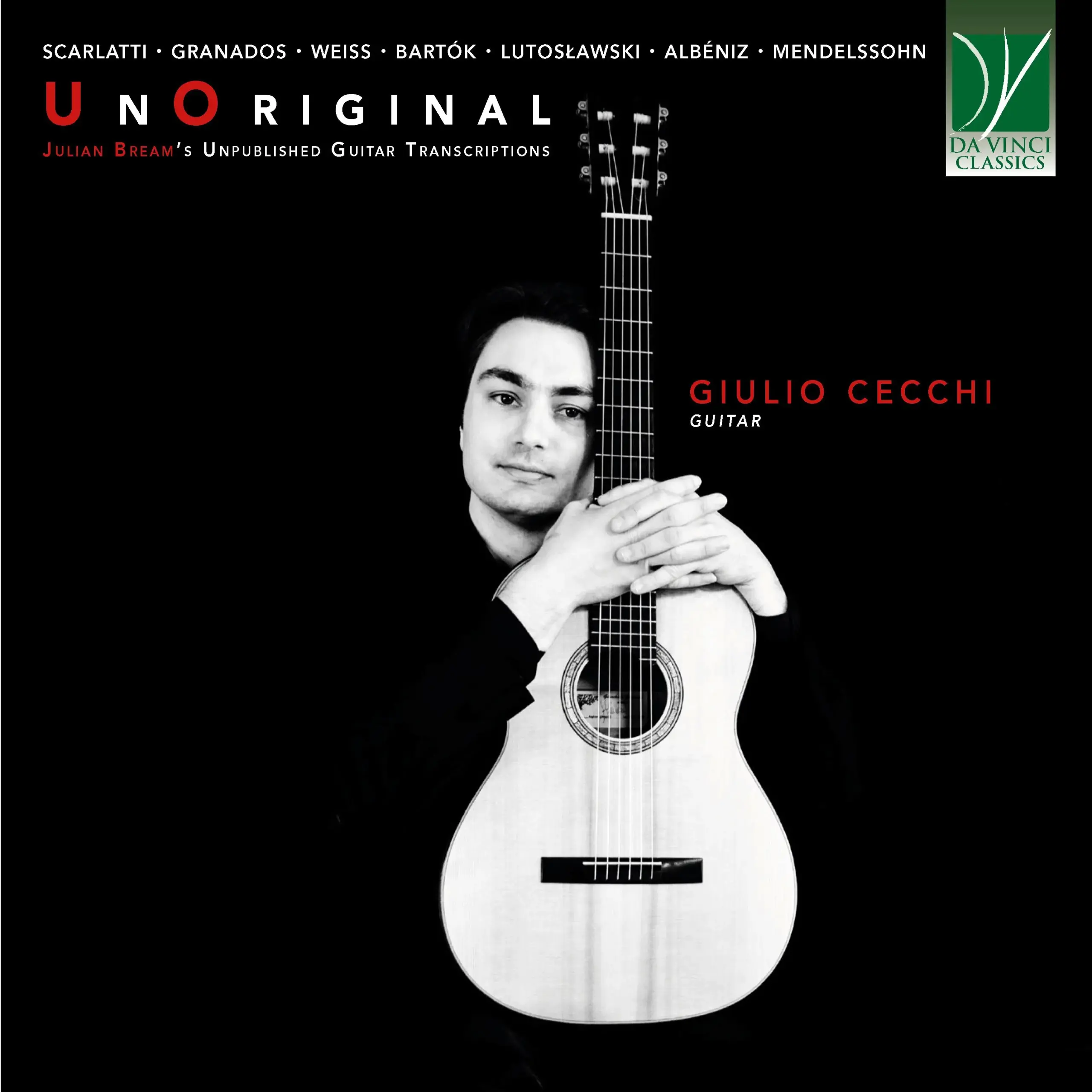
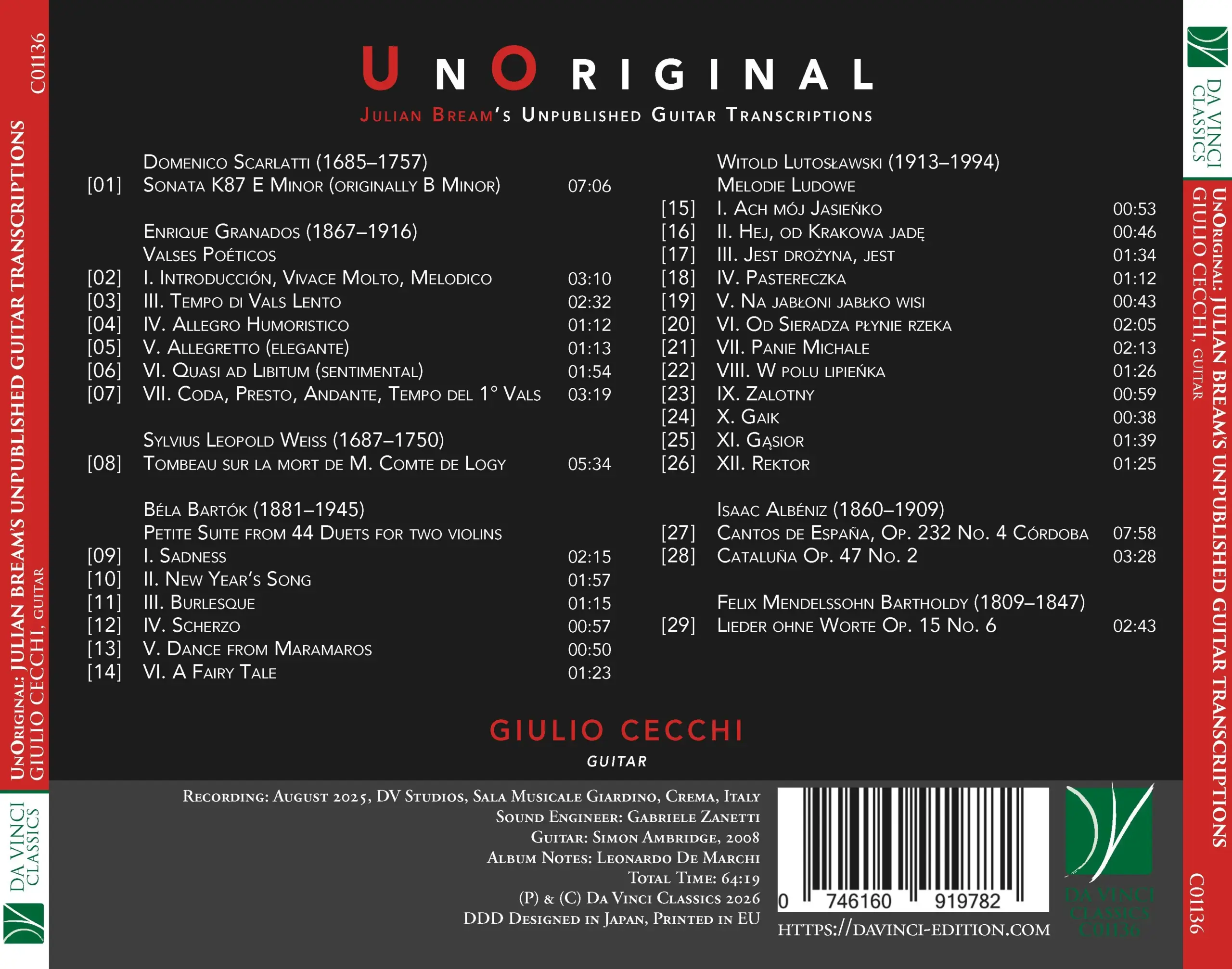
There are recordings that announce themselves as a curiosity and ultimately prove to be something far more essential: not lost masterworks, but a missing page from the history of a great musician. The title Unoriginal is almost ironic in this context: this music was not originally written for guitar, but Bream's art consisted precisely in finding a new identity for existing repertoire. That is exactly the paradox on which this release rests. Julian Bream (1933-2020), the English guitarist who spent decades trying to pull the instrument out of Segovia's shadow, left behind upon his death in 2020 an extensive collection of transcriptions that he played and recorded, but never published. They lay waiting in the Jerwood Library of the Trinity Laban Conservatoire in London, until the young Florentine guitarist Giulio Cecchi delved into them and lets us hear them on this record for the first time in sheet music form.
It is also immediately the heart of the story this album tells. In the transition from the nineteenth to the twentieth century, the guitar had to carve out a place among the great concert instruments, and it did so not only with newly composed works by its contemporaries, but equally by appropriating music intended for violin, cello, or especially piano. Whoever could master that repertoire proved that the instrument could do as much as the big boys. Tárrega, Llobet, and Segovia had done it before. Bream continued the line, but with a perspective that reached further than the Spanish-tinged aesthetic with which Segovia profiled the guitar internationally: alongside Britten, Walton, and Berkeley, he also programmed transcriptions of composers who had never had anything to do with the guitar.
This makes for a program with a remarkably broad sweep. There is the Tomb by Samuel Leopold Weiss (1687-1750), originally for Baroque lute and thus adapted to an instrument that must do without the deep, velvety basses of the lute – Cecchi compensates for this loss not by forcing matters, but lets the improvisatory, almost toccata-like breathing of the piece take its natural course, and thus gains in clarity what is lost in tonal volume. There is the Sonata K87 by Domenico Scarlatti (1685-1757), transposed by Bream from E minor to B minor to preserve the polyphonic structure and playability on guitar, here performed with a restrained, almost austere brilliance. There is the Venetian Gondola Song by Felix Mendelssohn (1809-1847), in which Bream – building on an earlier Tárrega version – lets the harmonics sing with an almost vocal delicacy; Cecchi brings out this effect beautifully without overdoing it.
The Spanish section, with Córdoba and Catalonia by Isaac Albéniz (1860-1909) and the Poetic Waltzes by Enrique Granados (1867-1916), is where the record comes closest to familiar territory, and also where Cecchi sounds most at ease: the rasgueos, those characteristic fanning chord strokes from the Spanish guitar tradition, have something theatrical about them without becoming caricatural, and in Córdoba , where Bream retunes the lowest strings to preserve the original key, he captures the somewhat wistful, insinuating tone perfectly. More interesting, because they lie further from home, are the two sections that form the heart of this record: CataloniaFolk Melody by Witold Lutosławski (1913-1994), twelve Polish folk songs heard here in their entirety on guitar for the first time, and the Petite Suite Little Suite by Béla Bartók (1881-1945), an idiosyncratic compilation from the 44 Duos that Bream himself never recorded. That last point is precisely what makes this album so intriguing: music deeply rooted in the violin world that Bream had to translate for a completely different instrument, drawing in part on Bartók's own piano arrangements. Cecchi plays it with a precision that never hides its origins – you can still hear that this music comes from the violin world, and it is precisely this friction that makes it compelling.
That this discovery hasn't become a mere musicological exercise is thanks to Giulio Cecchi himself. He approaches this material not as museum pieces, but as living music, and nowhere does he give the impression of doing archive work: there's something impatient, something curious in his playing, as if he himself is just as surprised by what he discovers as the listener. His playing testifies to a deep understanding of the instrument's possibilities: he knows how to draw a broad palette of colors, nuances, and emotions from the guitar and turns even the shorter pieces into little musical gems. His technique is completely controlled and entirely in service of the music – virtuosity is never an end in itself – but more interesting is that he resists the urge to sand everything down smooth: where the music calls for a certain austerity, as in the Weiss, he keeps that sparse sonic world intact rather than obscuring it with too much vibrato or resonance.
But it is precisely here that the weak point of this release comes to light: not in Cecchi's playing, but in the dramaturgy of the program itself. The individual pieces are without exception interesting, often even beautiful, but as a whole the CD remains too much within the same color spectrum. The majority of the chosen works primarily appeal to the guitar's most introspective side: meditative, lyrical, hushed. This yields moments of great beauty, but over time a certain uniformity emerges. The guitar is not only an instrument of memory and contemplation; it can also be rhythmically sharp, exuberant, virtuosic, and take on almost orchestral proportions. It is precisely these other facets that remain somewhat underlit here. A more strongly structured programmatic variety would not only have given more breathing room to this remarkable discovery, but would also have presented Bream's transcription art more convincingly.
A curious technical flaw concerns the recording: at each transition to new tracks there is an audible click or switch, as if a button is being pressed. It's not a major problem, but rather a noticeable imperfection that detracts from the otherwise polished presentation.
Is it an essential album? For anyone who knows something of the history of the guitar as a transcription instrument, this is without question an important release. Yet this CD transcends the level of a mere archival discovery: it shows once again how Julian Bream was not only a great guitarist, but also an artist who continuously pushed the boundaries of his instrument. Almost six years after his death, he can still add new material to his own legend – proof of how much he left behind and how much there apparently remains to be discovered.