
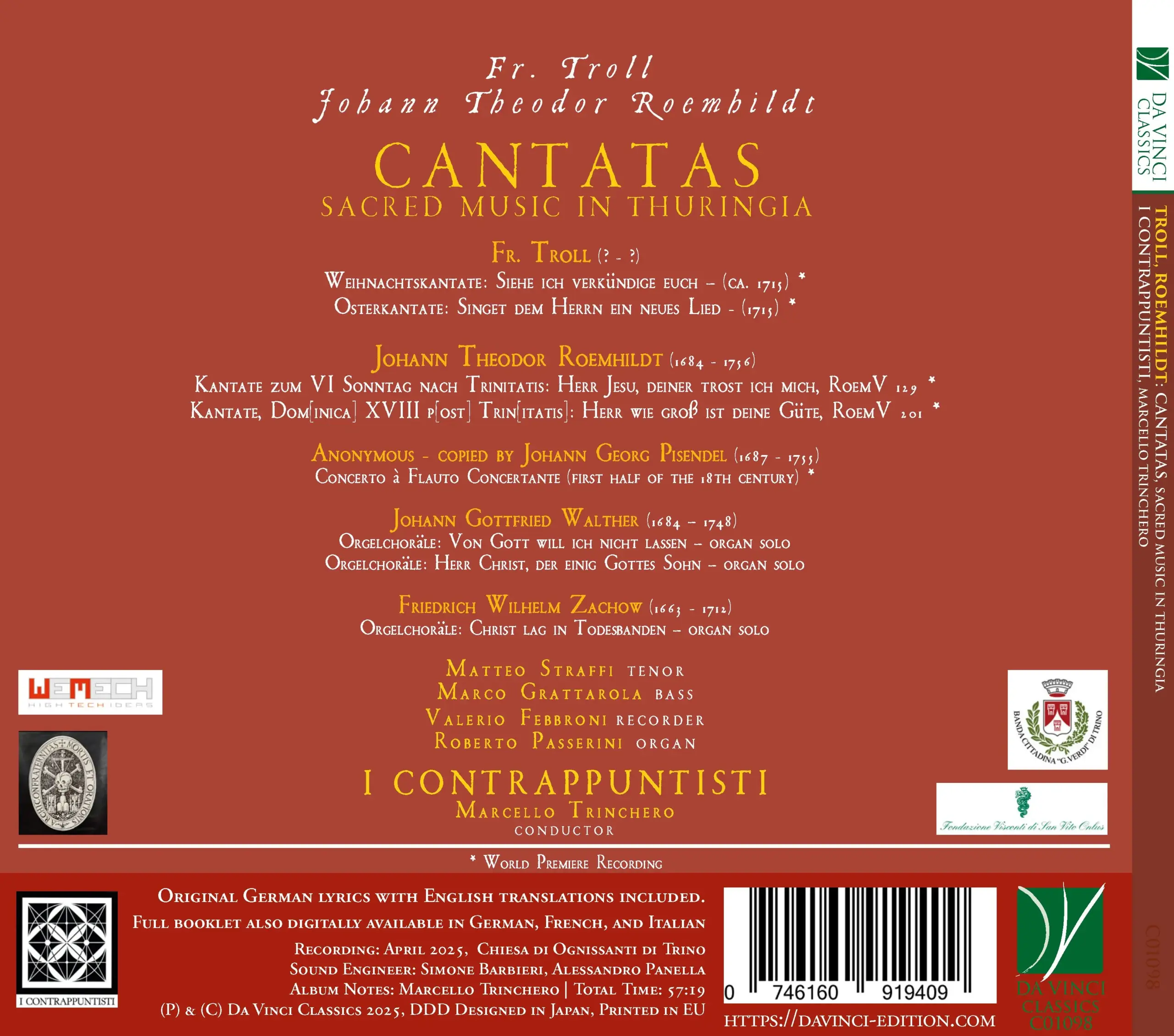
There are discoveries that don't happen in archives, but in places where no one expects to find music. In 1968, during restoration work on the church of Großfahner, 20 kilometers northwest of Erfurt, workers high in the roof timbers stumbled upon a sealed space behind a wooden partition. There lay nearly three hundred manuscripts of sacred music from the seventeenth and eighteenth centuries, for years exposed to moisture and dust, as if time had slowly wanted to erase them from memory. Yet the notes proved legible enough to sound again. This Da Vinci Classics release is therefore much more than a recording of unknown cantatas: it is a musical rehabilitation of voices that fell silent for centuries beneath the beams of a Thuringian village church, and simultaneously reveals how many musical worlds still await discovery.
Whoever tells the music history of Thuringia does so almost automatically from the perspective of Johann Sebastian Bach. Understandable, but incomplete: an entire network of church musicians wrote new music week after week for worship services. The compilers of this CD have not abandoned that liturgical context, but rather translated it into a carefully constructed dramaturgy. Cantatas, organ works, and an instrumental concerto alternate as they might have during an eighteenth-century Lutheran service. This makes the recording much more than a collection of unknown compositions: it brings back to life a musical world in which word, prayer, and sound are in continuous dialogue.
The program opens with music by the enigmatic "Herr Troll," a composer whose first name isn't even known to us and whose works survived only thanks to the manuscript copies of copyist Johann Christian Starckloff. Yet from the very first measures, it's clear this is no provincial imitator speaking. While the da capo aria had established itself everywhere in Germany, Troll remains true to an older North German tradition reminiscent of Buxtehude. His arias develop organically from the text, with each shift in affect receiving its own harmonic color, and the music seeming to breathe continuously with the words.
These qualities come immediately to the fore in the Christmas cantata "Siehe, ich verkündige euch".Starting from the words of the Gospel of Luke, Troll writes not superficial festive music but a musically profound meditation on the Incarnation of Christ. The melodic lines follow the meaning of the words themselves: wonder, joy, and worship each receive their own musical color. Particularly striking is the rich orchestration. The three trumpets and timpani never function as mere festive decoration, but continuously respond to the content of the text. At more contemplative moments, the brass withdraws to an almost bare continuo; when the words shift toward joy and praise, the full ensemble opens again in radiant splendor. Concepts such as Joy, Hope and the Incarnation of Christ thus receive not merely a musical frame, but an audible meaning. Troll proves himself here a composer who fully understands the rhetorical power of the Lutheran cantata and subordinates every musical choice to the service of the text.
I Contrappuntisti brings these qualities convincingly to life. Marcello Trinchero conducts with an effortless fluidity that avoids any hint of pompous monumentality. The natural trumpets shine brilliantly without ever sounding shrill or forced, while bass Marco Grattarola carries the cantata with a dark, warm voice in which authority and restraint continuously alternate. His careful German diction ensures that the words are not lost in the rich orchestration, but always remain the starting point of the musical development.
Following this first cantata, Johann Gottfried Walther (1684-1748) offers with his chorale setting for organ "Von Gott will ich nicht lassen" the first liturgical breathing space. Walther—cousin and intimate friend of Bach and later author of the influential "Musicalisches Lexicon" —represents the strictly contrapuntal tradition of Thuringian organ playing. The choice of precisely this chorale is moreover far from arbitrary: the text about God's enduring presence forms a natural continuation of the Christmas message from Troll's opening cantata. Roberto Passerini chooses a clear registration and a sober approach that doesn't weigh the music down romantically anywhere. This gives the listener exactly the rest that also had its place within an eighteenth-century Lutheran service between larger vocal works.
Next, the listener meets Johann Theodor Roemhildt (1684-1756), a composer who enjoyed a considerably greater reputation during his lifetime than his mysterious contemporary. His works were performed dozens of times in Danzig, but even that earlier fame proved ultimately no protection against oblivion. That even a composer who once enjoyed such esteem could ultimately disappear from collective musical memory says much about the capriciousness of music history. Where Troll continuously surprises the listener with rhetorical sharpness and unexpected harmonic turns, Roemhildt convinces through his natural balance, melodic elegance, and a subtle fusion of German seriousness with Italian lyricism.
This becomes evident immediately in "Herr Jesu, deiner Trost ich mich",a cantata that was preserved only in a photographic copy after the original manuscript was lost. It is perhaps the most restrained page of the entire recording. Roemhildt directs the gaze not toward grand gesture, but toward the individual believer who turns in confidence to Christ. The vocal line thus acquires an almost spoken character: not dramatically exaggerated, but sustained by a deep inner peace. Matteo Straffi aligns excellently with this. His lyrical tenor possesses sufficient warmth to give the long melodic arcs natural suppleness without ever falling into excessive sentiment. It is precisely this simplicity that makes this cantata particularly moving.
Between the two Roemhildt cantatas, a flute concerto then sounds, whose authorship remains uncertain, though Johann Georg Pisendel (1687-1755) is often cited as the most likely composer. The lively outer movements bubble with Vivaldian vitality, but especially the slow middle section lingers in the ear. Above a barely moving bass, recorder player Valerio Febbroni unfolds a long melodic line, played with refined sensitivity to breath, tension, and phrasing. The music seems to stop time for a moment and achieves an almost hushed intensity. I Contrappuntisti accompanies with great sensitivity, never overwhelming the soloist, so that the transparency of the score remains fully intact. Authorship may be uncertain, but there is little doubt about the quality of this music. Within the structure of the CD, this concerto thus occupies precisely the right place: not a casual intermezzo, but a moment of contemplation in which the words fall silent and instrumental expression continues the spiritual story.
After this instrumental reflection, the CD returns once more to the organ with a second chorale setting by Johann Gottfried Walther: "Herr Christ, der einig Gottes Sohn".Here too, the composer shows how a refined polyphony can emerge from a familiar chorale melody, with the counterpoint always serving the spiritual content of the text. Roberto Passerini again chooses a clear and transparent approach, allowing the individual lines to speak naturally to one another. After the virtuosity and color of the concerto, this work forms a restrained transition to the next vocal scene, in which Roemhildt again takes center stage.
Where his previous cantata let the restrained voice of the individual believer be heard, now unfolds Lord, how great is thy goodness like a festive hymn of praise in which choir, trumpets and kettledrums fill the space completely. Here Roemhildt displays his broad compositional range: German attention to text rhetoric combines effortlessly with a melodic suppleness that reveals clear Italian influences. Words such as Ruin receive a dark, almost threatening harmonic color, while Hope opens up in lighter, ascending lines that make the meaning of the text audible in a sense. This constant interplay between word and music gives the cantata its natural dramatic arc. When in the closing chorale trumpets, choir and continuo flow together in a hymn of praise to God's goodness, an impressive profession of faith emerges that sounds at once monumental and sincere. I Contrappuntisti succeeds in maintaining the right balance even in this larger ensemble: Marcello Trinchero lets the rich sound world of Roemhildt speak fully without losing the intelligibility of the text, while Matteo Straffi retains his lyrical clarity and choir and orchestra complement each other with natural musicality.
After Roemhildt's festive cantata comes another moment of hushed stillness at the organ. Friedrich Wilhelm Zachow (1663-1712) – known above all as the teacher of the young Händel in Halle – is represented here with his chorale arrangement of Christ Lay in Death's Bonds, a melody that Bach would also treat several times later. The choice of this work fits perfectly within the structure of the recording: after the exuberance of choir, trumpets and kettledrums, the music returns to the heart of Lutheran worship, the chorale as a collective testimony of faith. Roberto Passerini plays once again with a sober elegance and a clear sense of line, bringing out the contrapuntal richness without the work ever becoming heavy.
But the final word belongs once again to Troll. That is a particularly thoughtful programmatic choice. With the Easter cantata Sing unto the Lord a new song , the composer returns to the qualities that made him so convincing earlier: a sharp sense of musical rhetoric and the ability to translate the theological meaning of a text directly into sound. Where "Siehe, ich verkündige euch". voices the wonder surrounding the incarnation of Christ, this cantata directs the gaze toward the joy and victory of Easter.
The Easter idea takes particular shape in the setting of the word Up , where Troll's music seems to make an upward movement. The rising lines and jubilant energy evoke the feeling of musical resurrection: as if the sound itself breaks free from the earth and is drawn toward the light. Trumpets and kettledrums function thereby not merely as festive ornament, but as active participants in the musical discourse. The festive passages thereby acquire not superficial splendor, but become the expression of hope and faith. Marcello Trinchero carefully builds the dramatic arcs: restrained moments retain their inner power, while jubilant outbursts never descend into mere effect-seeking. Marco Grattarola closes here the circle that was opened at the Christmas cantata: the same voice that there carried the intimacy of the incarnation now sounds with undiminished conviction in the jubilation of the resurrection. The ability to connect convincingly both extremes – the hushed expectation of Christmas and the overwhelming joy of Easter – in a single recording makes his contribution one of the highlights of this edition.
Thus ultimately not only the beauty of the individual works remains memorable, but also the larger story that this CD tells. Troll and Roemhildt prove to be not insignificant footnotes in the shadow of Bach, but composers with their own voice, their own idiom, and a meaningful place within the Lutheran church music of their time.
Will this edition therefore rewrite the Baroque canon? Probably not. But it doesn't need to. Its value lies precisely in making visible – and audible – the wealth that remained hidden beyond the familiar names. When the final notes of Troll fade away, the thought inevitably returns to that sealed roof truss in Großfahner, where these manuscripts waited for their rediscovery for centuries. If the hundreds of still unexamined pages possess the same quality as the music on this recording, then there may well be many more voices there waiting to be heard again. Let this impressive edition therefore be not only the result of an exceptional discovery, but hopefully also the beginning of a further musical rediscovery.