
The MIM and the Maison Luxembourgeoise des Instruments d'Exception captivate viewers and listeners alike with historical cellos…
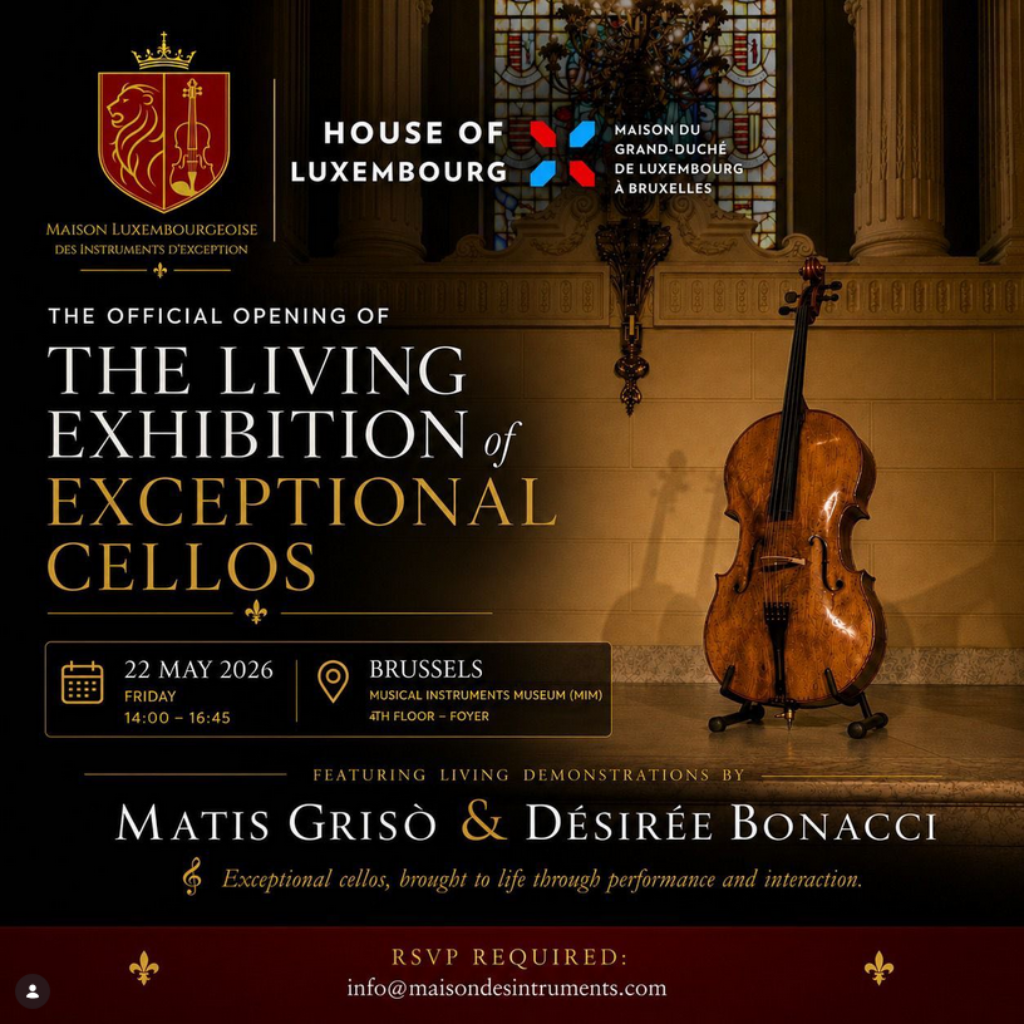
We watch with great admiration what passion for superb sound, instrument making, and heritage preservation can accomplish at its finest. Experts in this field were brought together for an opening event that garnered significant attention in the musical world. We felt privileged to witness a live demonstration: performances on historically exceptional cellos from the collection of the Maison Luxembourgeoise des Instruments d'Exception (MLIE), at the launch of the "Living Exhibition of Exceptional Cellos" at the MIM in Brussels. This noble initiative embodies the organizers' desire to bring these exceptional pieces out of private collections and vaults, where they remain hidden, and restore them to their original purpose so they can continue to resonate as living artistic voices. This is the hope of MLIE director Rodrique Tournel. The project is unique in its concept, with the instruments actually being played during the exhibition.
In this way, the historical cultural ties between Belgium and Luxembourg are once again honored and reaffirmed. This meeting takes place on the occasion of the Queen Elisabeth Competition for cello. During the finals, the MLIE, with the support of the House of Luxembourg, offers the opportunity to visit and experience this exhibition for several days, from May 26 to 30. The whole is a presentation of a selection of very rare instruments, built in the 17th–19th centuries by prestigious Italian and French makersThe crown jewel of the collection is a cello by.
Francesco Goffriller , from Venice and built around 1720-1730. It belongs to the legendary Venetian tradition that also produced the cello of Pablo Casals.This instrument will be loaned to the first laureate of the Queen Elisabeth Competition, who will have the use of the instrument for four years, a gesture in support of the development of young talent. The collection
(1691-1742), great Italian master of the Venetian violin-making school; these instruments were later played by Jacqueline du Pré, Pablo Casals, and Ophelie Gaillard.
- , from Venice and built around 1720-1730. It belongs to the legendary Venetian tradition that also produced the cello of Pablo Casals. Carlo Tononi
- (1675-1730), violin maker born in Bologna, a great Venetian master, collaborated with Guarnieri, made precise copies of Stainer and Cremona models, outstanding craftsmanship, beautiful lacquer finishes on his cellos. Tononi School – founder and mentor of multiple generations of violin makers.
- Tononi School – founder and shaper of multiple generations of violin makers.
- Giuseppe Guarnierius filius Andreae (1666-1740), heir to his father's mastery and workshop, developed his own style in Cremona.
- Tomaso Balestrieri (1713-1796), grand master of the Italian school, born in Viuistino in the Cremona-Parma region, moved to Mantua, inspired by Guarnieri, influenced by Stradivarius, creator of extremely rare cellos.
- Georges Panormo (1776-1852), son of the renowned Neapolitan violin maker Vincenzo Truisiano, was born in England and worked in London and Liverpool. His cellos are distinguished by a radiant golden-yellow varnish.
- Giacomo Zanoli, great Venetian master, working in the Montagnana style, remarkable for precision, excellent cellos, less vaulted, richly golden-yellow lacquered.
- Antonio Gibertini (1797-1866), workshops in Parma and Genoa, highly regarded as a restorer, worked for Paganini, following Stradivarius and Guarneri models.
- Jacques Boquay (1680-1730) First Parisian School, powerful and warm-sounding cellos, with a dark, magnificent varnish, specific to this Parisian lutherie period.
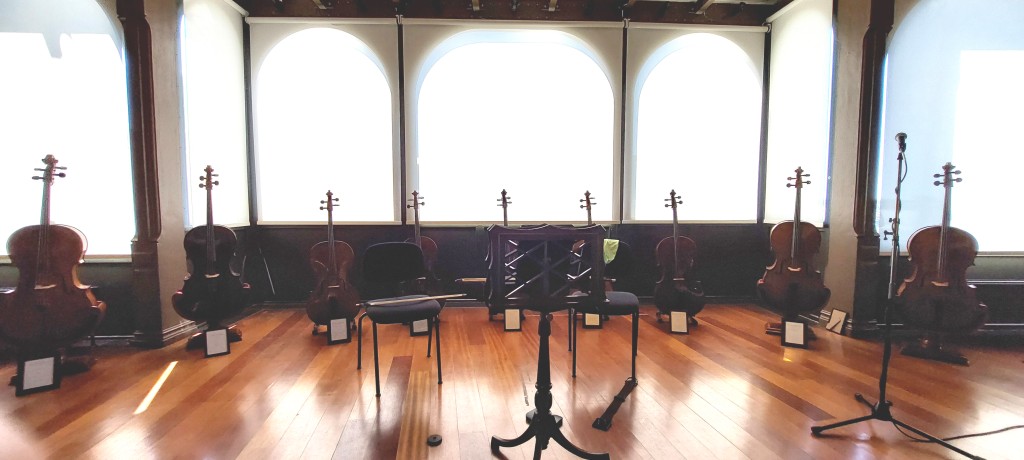
We discovered that all cellos are fitted with Larsen strings. Remarkably, the Balestrieri has a perforation on the back of the sound box, intended for attaching a cord by which the cello could be carried during the religious processions in which the musicians participated. This occurred during the Baroque period.
Velvet and silk bow tone color
The musicians Matis Grisó and Désirée Bonacci are Luxembourg students pursuing advanced musical training in Belgium at the Royal Conservatory in Brussels. They explore the expressive possibilities of historical instruments, the refined tone quality, and the relationship between instrument, musical sound, and interpretation. During their micro-recital with two Bach suites no. 2 and 4 and a piece in G major for two cellos from the Jean-Baptiste Barrière repertoire, alternating between high and low registers, they gave the audience an insight into the chromaticism and universe of these historical cellos. The musicians vied with each other to showcase the exceptional sound of different instruments. In an interactive exercise, presented and explained by master luthier Gert Schrijvers, listeners could compare the specific qualities of the cellos and express their preference. For example, one of the cellos was experienced as an instrument with a very powerful voice in the high register that immediately draws the listener into its dynamic, while another cello sounds enveloping and restrained, evoking a dreamy atmosphere. In the low register, the first sounded very dramatic, while the second was more melancholic, nostalgic, and sweeter. We felt elevated by the gift that this entire event represents and believe it will evoke an appropriate response from the audience visiting in the coming days.
His Excellency Mr. Jen-Louis Thill, Luxembourg's ambassador to Belgium, again referred to the symbolic encounter between the two countries. The Belgian tradition of musical excellence, violin-making, and the prestige of the KEW meet Luxembourg's expertise in innovative structures for cultural heritage and exceptional objects. MLIE is a foundation dedicated to the preservation, development, and transmission of extraordinary historical string instruments and bows. The foundation maintains a structural partnership with the Philharmonie Luxembourg.