

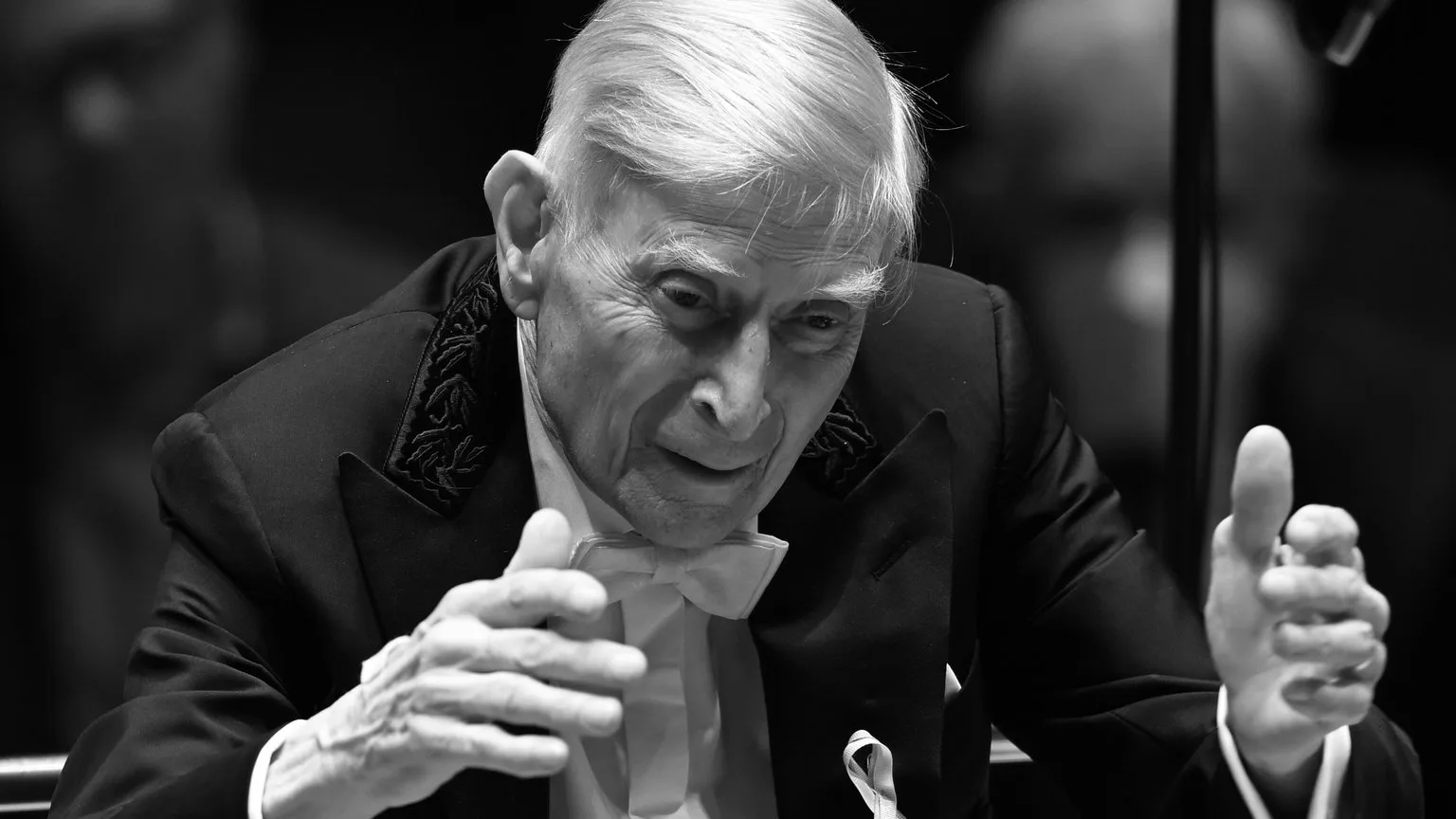
Some musicians leave an impression that reaches beyond their performances. Herbert Blomstedt was one of them. The Swedish conductor, born on 11 July 1927 in Springfield, Massachusetts, died today at the age of 99. For more than seven decades he contributed to international musical life. Yet a career filled with concerts, recordings and honours barely suffices to describe what he meant to music.
Those who saw him at work remember his presence: a tall, slender man, without any show. He needed no grand gestures to convince an orchestra. His authority came from knowledge, experience and insight. Behind his seemingly simple movements was a conductor who knew down to the smallest detail what he wanted, yet at the same time gave the musicians room to add colour and meaning to their playing.
After several concerts I had the opportunity to speak with him briefly, including in Amsterdam, Brussels, Hamburg, Paris and Vienna. What always stayed with me was his sincere interest and the matter-of-factness with which he talked about music. He liked to tell about the works he had conducted, about his approach to a score and about what continued to fascinate him in it. Despite his international fame, he took the time for a conversation and did so with disarming simplicity. I recognised that same openness each time I saw him standing before an orchestra.
A musical journey
Blomstedt was born to Swedish parents who returned to Sweden in 1929. He grew up in Sweden and Finland and studied, among other places, in Stockholm, Uppsala, New York and Basel. In 1954 he made his debut with the Stockholm Philharmonic Orchestra. Important appointments followed with the Oslo Philharmonic Orchestra, the Danish Radio Symphony Orchestra and the Swedish Radio Symphony Orchestra.
For German musical life, his period with the Staatskapelle Dresden was of great importance. From 1975 to 1985 he headed this historic orchestra. In those years his affinity with the German and Austrian repertoire fully blossomed. The recordings from that period still testify to his ability to combine the rich sound culture of the orchestra with a clear, transparent interpretation.
From 1985 to 1995 he led the San Francisco Symphony Orchestra. He then moved to the NDR Symphony Orchestra in Hamburg, where he was chief conductor from 1996 to 1998. In 1998 he moved to Leipzig as Gewandhauskapellmeister. Until 2005 he headed the Gewandhausorchester. The bond remained close even after his departure: he was appointed honorary conductor and remained a welcome guest into his advanced years.
The score as starting point
Blomstedt's interpretations combined analytical precision with human warmth. He took the score seriously without turning it into an academic exercise. He had an eye for the great architecture of a work, but never lost sight of the individual voices and details. His performances therefore rarely sounded forced; everything seemed to arise from the music itself.
This applied to Beethoven, Brahms and Bruckner, but also to the Scandinavian symphonists Sibelius and Nielsen, for whom he had a special affinity. He approached their sound world without reducing it to a mood picture of the northern landscape.
In Bruckner his sense of proportion was particularly impressive. The monumental structure was given all the space it needed, but never became an end in itself. He understood that behind the imposing masses of sound lies a great vulnerability. His Bruckner combined structural coherence with a deep, almost spiritual intensity.
That I was able to hear him at work so recently makes his death all the more poignant. On 16 April he conducted Bruckner's Fourth Symphony with the Gewandhausorchester in Leipzig, a concert I reviewed for Klassiek Centraal. He was 98 at the time. The image of the slender, almost fragile man who settled into his seat in the hall before the concert has stayed with me. In front of him lay a new edition of the score. But as soon as the music carried him away, his gaze changed too: concentrated, alert and wholly absorbed in what unfolded before him. The performance breathed a beneficent calm and depth. It moved me that at that age he was still so intensely engaged with the music. It was as if he still discovered something new in it every time. Less than a month later he would give his last concert.
A conductor who kept searching
What perhaps made Blomstedt most remarkable was his ability to remain amazed. At an age when most conductors had long since stopped, he still stood before orchestras. Not to confirm his reputation, but because he still discovered so much in the music himself.
His faith as a Seventh-day Adventist and his profound modesty played a role in this. For him conducting was a form of service: the composer and the composer's music stood central, not the conductor. This was no pose, but a way of life that was palpable in his dealings with musicians and audiences.
His final appearance took place on 15 May in San Francisco, where he conducted Mahler's Ninth Symphony with the San Francisco Symphony Orchestra. Although the performance had to be briefly interrupted during the third movement, he brought the symphony to an end. On medical advice he had to cancel the two following concerts. It became his farewell from the stage, after a life he had devoted with great dedication to music.
A lasting memory
Seine Diskografie ist umfangreich, und seine Jahre in Dresden, San Francisco und Leipzig haben einen festen Platz in der Musikgeschichte. Doch seine Bedeutung lässt sich nicht allein an Aufnahmen, Auszeichnungen oder Dienstjahren ablesen.
Was mir persönlich in Erinnerung bleibt, ist, wie selbstverständlich sich seine große musikalische Persönlichkeit mit menschlicher Schlichtheit verbindet. Er blieb neugierig auf die Musik und aufrichtig interessiert an den Menschen, mit denen er sie teilen konnte. Ich bin dankbar, dass ich ihn so oft bei der Arbeit erleben durfte und nach Konzerten kurz mit ihm sprechen konnte.
Danke, Herbert Blomstedt, für die Musik und die Begegnungen, die mir in Erinnerung bleiben werden.