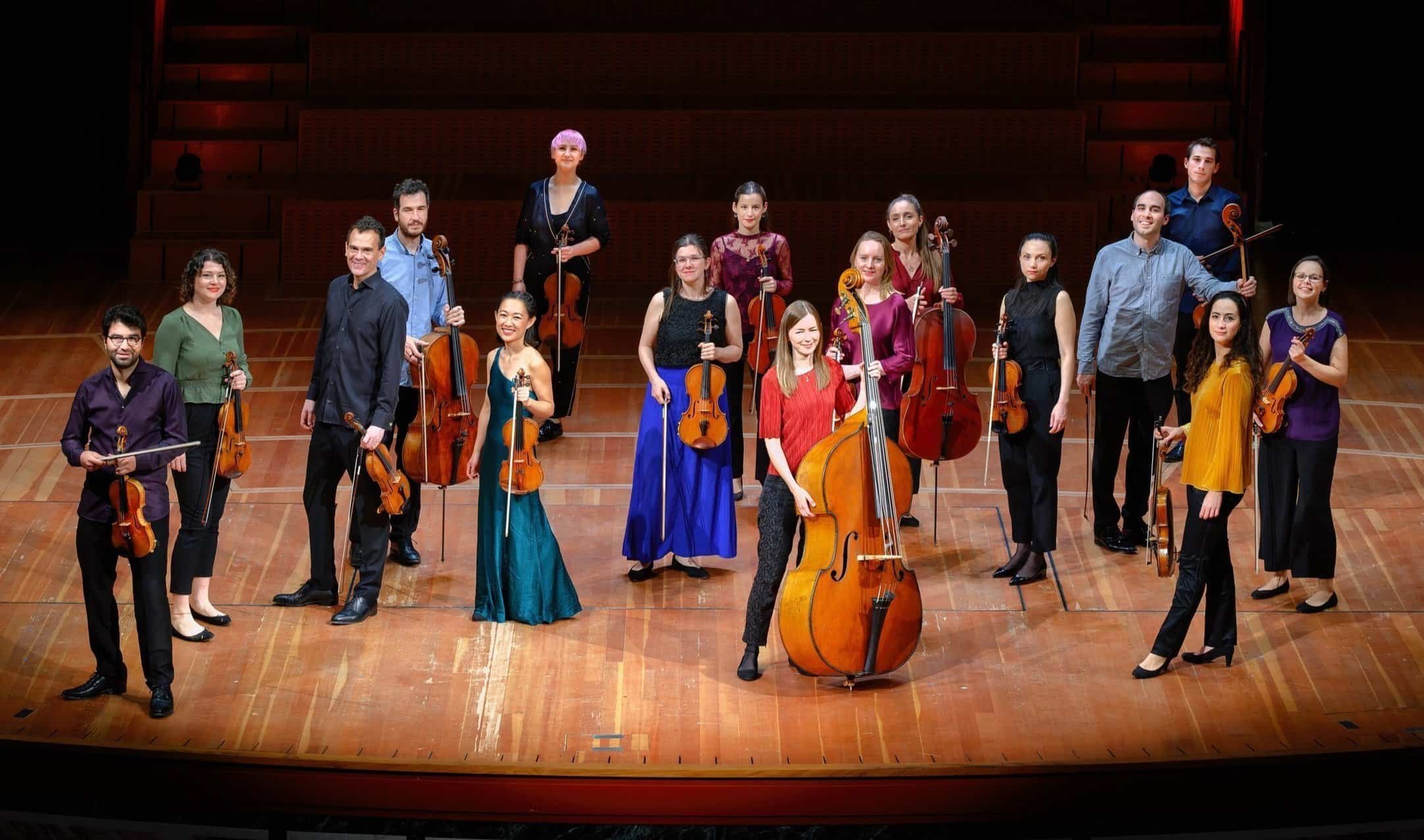
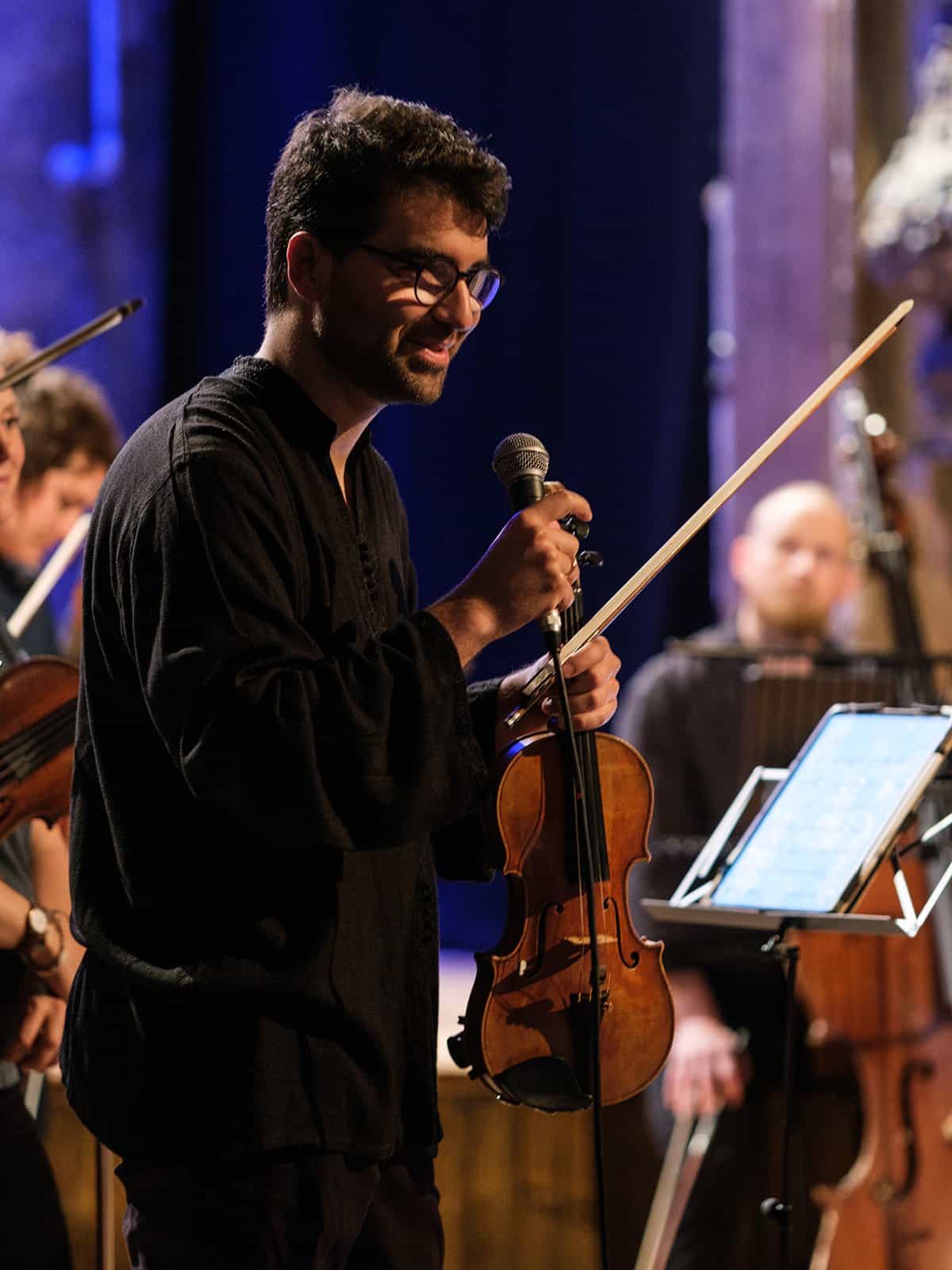
Introducing Julian Azkoul, the British-Lebanese artistic director of United Strings of Europe audience development is anything but an empty concept. Azkoul and his string ensemble will be guests next week, on Friday, March 1st, at DE SINGEL, as part of the RE/BIRTH festival.
What does United Strings of Europe stand for and what does it aim to achieve with its music?
Julian Azkoul: The ensemble's goal is to present new and familiar music in innovative ways and sometimes even in unconventional settings. For example, we performed with the Gandini Jugglers, which was an adaptation of Stravinsky's Apollo Musagète: a ballet originally written for four dancers and string orchestra. I received permission from the Stravinsky family to create a chamber music reduction of the score, so we became a sextet that collaborated with four jugglers, a choreographer and a director who created a new story adapted to our time and which we combined with contemporary music. We had an opening piece by Osvaldo Golijov, whose songs we'll also be performing at DE SINGEL, and we commissioned a new work from Joanna Marsh, Another Eden called. Apollo Resurrected is just one example of how we approach things differently: by taking a fresh look at repertoire from the past and trying to connect it with today's issues.
What does the process look like for putting together an engaging and original concert or album program?
 It's interesting that many people increasingly seem to be programming the way we do, and I think that's a good thing. When we compile our programs, we try to have variety in both musical periods and music from different places around the world. We think about connections between works that support themes and that the audience might appreciate. Renewal is a perfect example of this because you have a repertoire spanning two hundred years. These works from different musical styles and periods illuminate each other. Hearing Mendelssohn in the context of 21st-century music means we listen to it differently than we would if it were in a program with Haydn and Brahms. It's also important to us that a program has a wide range of moods, from the contemplative to the more rousing. The songs by Golijov are a great example of these extremes: from the gypsy-like and wild ending of the first song to the incredibly peaceful and pure second song.stWhat's your favorite piece from the Renewal program and why exactly?
To be honest, I'd like to champion every piece in this program. The sheer beauty of the Golijov song "Lúa Descolorida" and the way Ruby Hughes sings it makes your heart melt. It's so pure and speaks so directly, even though it's in Galician. The Mendelssohn is a phenomenal work for string quartet, but I think—if I may say so—that the version for string orchestra works particularly well. It accentuates even more the extremes in that piece. And then there's the "Entr'acte" by Caroline Shaw, which is a brilliant work. It's become something of a modern classic: people seem to play it everywhere, both on their own initiative and at the request of concert organizers.
What are the challenges in arranging music, such as with Mendelssohn's string quartet opus 80? It's a delicate process. There are many challenges and it naturally depends on which medium you start with and what you arrange it for. It's harder to adapt vocal works for strings. The voice leading in a choir is often different from what you'd do for strings. In other words, if you simply transcribed it, it probably wouldn't sound as good. You have to make decisions about redistributing the parts. In the case of Mendelssohn's opus 80, the original is already so well written for strings that it's almost just a matter of orchestration: which passages does everyone play, which passages do we use a quartet or quartet with bass to retain the original intimacy. My arrangement plays with that a bit. So sometimes everyone plays, sometimes it's just a few of us trying to emphasize the extremes in the piece. Adding a bass line requires craftsmanship. You have to do it in a way that brings enough punch where it's needed, without making the piece too heavy.How is United Strings of Europe organized; how do you bring your musicians together? The core of United Strings of Europe is a group of very good and longstanding friends, and that's something very clear to the audience when they see us perform. We simply love playing together. We're not a full-time ensemble, so coming together for projects is always a wonderful opportunity for us. We're a charity with a board of trustees that oversees the ensemble's activities, helps raise funds, and ensures we have the resources to do what we set out to do. As for my role as artistic director, I bring together musicians I know and respect, but also new players I meet as part of my other musical work as a freelance violinist. I'm always looking for players who I think have something to say, who I think fit the ensemble's ethos. We're all freelancers, nobody has a permanent position or works on a salary basis. I feel very privileged that so many fantastic musicians want to join me for these projects.
United Strings of Europe has developed an innovative educational program to reach new audiences. Can you tell us more about that?
We are indeed quite active in the community, working with charities and foundations in the UK and beyond, and trying to find ways to connect with people from all walks of life, and especially with people who may not have much experience with classical music or who have no idea what it's like to be a musician. In our workshops, we often talk about how we as players communicate with each other and how that approach can be a model for collaboration in other work environments, when solving problems and disagreements. From 2017 to 2020, we did a lot of this kind of workshop in Lebanon, working with NGOs and visiting refugee camps. A key theme that emerged was that of respect: how we must respect each other in a working relationship, to take each other's perspective into account and find consensus. To create something together, whether that's a musical performance or a joint project, we all need to foster understanding and appreciation for where each of us comes from. We believe that music and artistry can contribute to society in ways that go beyond producing beautiful concerts or a beautiful album. We always think about ways to be more inclusive, by reaching out to audiences with disabilities, low-income groups, minorities, and so on. Performing together with amateurs is a great way to build confidence, build bridges, and forge friendships.
What are the ensemble's future plans?
We have quite a few recording projects in the pipeline, together with our label {{NOTRANSLATE_1}}. In early 2024 we're recording a program called {{NOTRANSLATE_2}}, featuring among other things my arrangement of the Stravinsky ballet, a new piece by Finnish composer Olli Mustonen and a Nonet by Golijov. We also have a project with Israeli flautist Sharon Bezaly, called {{NOTRANSLATE_3}}. Essentially it's Vivaldi's Four Seasons that she'll be recording on flute, together with four new seasons written by different composers such as British jazz pianist Gwilym Simcock, French composer Nicolas Bacri and Iranian composer Gity Razaz. We're also doing a project with my brother, who's a rap musician. The idea is to set to music the hundred-year-old book {{NOTRANSLATE_4}} by Lebanese poet Khalil Gibran. And we also have plans for the premiere of a new work for harp and strings by American-Syrian composer Saad Haddad.
Julian Azkoul, violist and artistic director of the string ensemble United Strings of Europe
United Strings of Europe has developed an innovative educational program to reach new audiences. Could you tell us more about that?
We are indeed quite active in the community, working with charities and foundations in the United Kingdom and beyond, and trying to find ways to connect with people from all walks of life, and especially with those who may not have much experience with classical music or have no idea what it's like to be a musician. In our workshops, we often discuss how we as players communicate with each other and how that approach can be a model for collaboration in other work environments, in solving problems and disagreements. From 2017 to 2020, we did a lot of this kind of work in Lebanon, collaborating with NGOs and visiting refugee camps. A core theme that emerged was that of respect: how we must respect each other in a working relationship, to take into account each other's perspective and find consensus. To create something together, whether it's a musical performance or a shared project, we all need to cultivate understanding and appreciation for where each of us comes from. We believe that music and artistry can contribute to society in ways that go beyond producing beautiful concerts or a beautiful album. We are always thinking about ways to be more inclusive, by reaching out to audiences with disabilities, low-income groups, minorities, and so on. Performing together with amateurs is a great way to build confidence, bridge divides, and forge friendships.
What are the ensemble's future plans?
We have quite a few recording projects in the pipeline, together with our label BIS Records. In early 2024, we are recording a program called Tributes, featuring, among others, the Stravinsky ballet arranged by me, a new piece by Finnish composer Olli Mustonen, and a Nonet by Golijov. We also have a project with Israeli flutist Sharon Bezaly, called Climate change. Essentially, it's Vivaldi's Four Seasons that she will record on flute, together with four new seasons written by different composers such as British jazz pianist Gwilym Simcock, French composer Nicolas Bacri, and Iranian composer Gity Razaz. We're also doing a project with my brother, who is a rap musician. The idea is to set to music the hundred-year-old book The Prophet by Lebanese poet Khalil Gibran. And we also have plans for the premiere of a new work for harp and strings by American-Syrian composer Saad Haddad.
WHO: Julian Azkoul, violist and artistic director of the string ensemble United Strings of Europe
WHATInterview following a concert by United Strings of Europe in Antwerp
WHERE & WHEN: DE SINGEL, Friday March 1, 2024 (as part of the RE/BIRTH festival)
PHOTOSⓒ Dimitri Djuric