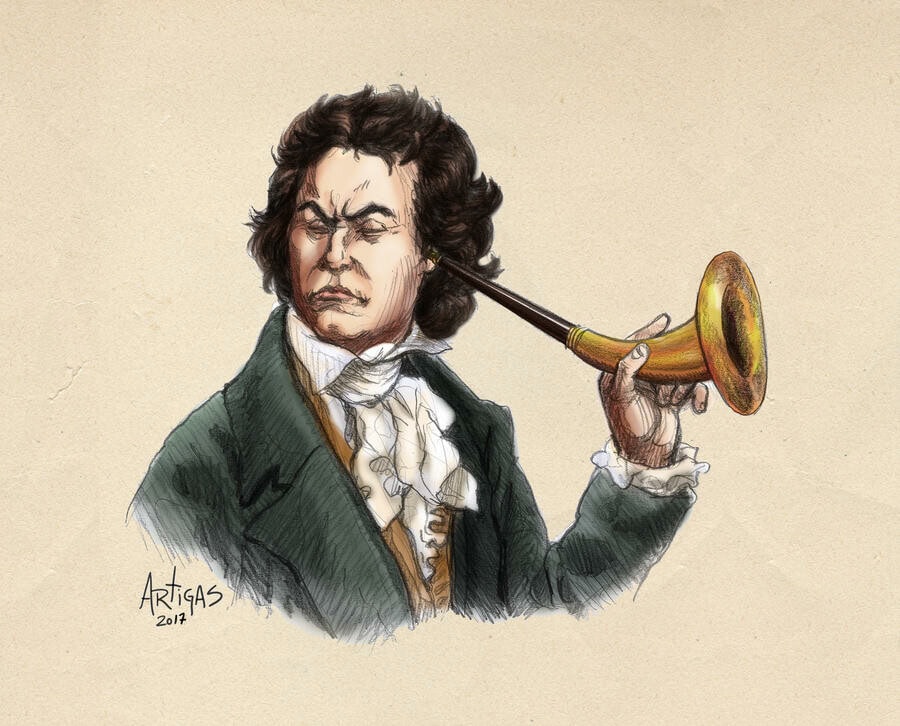
At the Ghent University's Audiology Unit, an audiovestibular research unit, students Anaïs Behaeghel and Amber Lauwereyns investigated the hearing disorder that plagued Ludwig Van Beethoven for years and disrupted his life: tinnitus. Many musicians, as well as lovers of classical music among others, suffer to varying degrees from this condition, which can seriously disrupt patients' daily lives. Their thesis, under the supervision of Professor Dr. Bart Vinck, addresses the underexplored topic of tinnitus. Every corner of the room was thoroughly examined. Klassiek Centraal sat down with both young women, and this led us to find them willing to write a series for Klassiek Centraal about tinnitus, particularly in the world of (classical) music. We are happy to give our moral support to this research and hope that Klassiek Centraal can be a resource to raise awareness of the issue, the research, and how to address it.

Anaïs Behaeghel is the author of this contribution.
In today's society, tinnitus, also known as ringing in the ears, is an increasingly common phenomenon in the general population. That it can have a major impact on the lives of those who suffer from it is no surprise to anyone, yet many questions about this symptom persist. Tinnitus is essentially a phantom sound—a sound that no one else can hear. But how does tinnitus actually develop, and why does one person suffer more than another?
In audiology, we distinguish between both objective and subjective tinnitus. According to many explanatory models, subjective tinnitus often arises from hearing damage. However, this is not necessarily the same as hearing loss: hearing damage can be present without hearing loss being detected on a standard hearing test (audiometry). Hearing damage can result from various causes: regular exposure to excessive sound intensities, age-related factors, genetic factors, or trauma. When certain regions in our auditory system are damaged, less sound reaches our brain than before. The brain, accustomed to receiving this input, compensates for this loss of stimulation by increasing activity in the auditory system: this is how the tinnitus tone develops.1
However, subjective tinnitus can also arise as a result of certain pathologies, such as Ménière's disease and acoustic neuroma (a benign tumor on the hearing nerve), or from sensorineural hearing loss, which is a type of hearing loss where there is damage to the inner ear or hearing nerve. This can occur, for example, through age-related hearing loss, genetic factors, or the pathologies mentioned above.
It is important in clinical practice to determine the source of tinnitus. First, it is examined whether the symptom is associated with a pathology, as described above. These factors must be ruled out through audiological testing, such as audiometry, and when certain conditions are suspected, also through imaging. Emphasis is placed on this when a patient has suffered from persistent tinnitus for more than 6 months, has associated hearing loss, or hears the tinnitus in only one ear. To make a diagnosis, the characteristics of the tinnitus are also explored: whether the tinnitus sounds pulsating, whether certain neurological problems have emerged in combination with the tinnitus, or if there is asymmetric hearing loss. It is also determined whether the patient experiences unilateral or bilateral tinnitus, hearing changes that accompanied the tinnitus, and the impact of the tinnitus complaint on the patient's life. To assess the impact of the symptoms, the Tinnitus Handicap Inventory (THI) is often used, a questionnaire that examines the impact on specific daily life situations.2
One might wonder why tinnitus doesn't develop in everyone with hearing damage or hearing loss. The awareness and persistence of tinnitus depends on various underlying factors, including attention and emotional experience of the symptoms. There are tinnitus patients who experience the symptoms but don't suffer from them. Other patients suffer greatly, and this can be due to how they (unconsciously) respond to it. This can, for example, trigger anxiety in certain patients, causing them to pay more attention to the symptoms. As a result, the symptoms become more prominent and persist. However, in many people, the symptoms fluctuate in intensity, or the tone is sometimes present and sometimes absent. This can be due to individual factors: if there is significant stress, sleep problems, etc., the symptoms can increase at certain times. Jaw and neck problems, or even past trauma, can also influence the symptoms and their worsening.
Based on this, it can be stated that tinnitus has no single cause and that treatment must be tailored to each individual patient. A treatment method often used with tinnitus patients who do not suffer from one of the mentioned pathologies (Ménière's, acoustic neuroma, etc.) is cognitive behavioral therapy. This teaches patients to cope with the symptoms and the negative, sometimes anxious feelings surrounding them, to reduce their impact. Furthermore, any sleep problems are addressed, and when hearing loss is present, this is also treated. This is done through hearing aids, which compensate for the hearing loss, allowing the brain to be optimally stimulated again, and the tinnitus tone decreases in many patients.3
A thorough understanding of the complex interaction of hearing-related, psychological, and physical factors that lead to these symptoms is an important step in developing a good treatment plan for patients with tinnitus.
1 Auerbach, B. D., Rodrigues, P. V., & Salvi, R. J. (2014). Central Gain Control in Tinnitus and Hyperacusis. Frontiers in Neurology, 5, 206. https://doi.org/10.3389/fneur.2014.00206
2 Dalrymple, S. N., Lewis, S. H., & Philman, S. (2021, June 1). Tinnitus: Diagnosis and Management. AAFP. https://www.aafp.org/pubs/afp/issues/2021/0601/p663.html