Last Tuesday, June 24th, the Ghent-based Shapovalov initiative presented a stellar double recital. Two pianists, Bert Lasseel and Brecht Valckenaers, each performing their favorite repertoire. Bert Lasseel is currently studying at the conservatory in Ghent, while Valckenaers continues his studies in Basel with Claudio Martínez Mehner and at the Scuola di Musica di Fiesole with the renowned Eliso Virsaladze. In Antwerp, he studied for eight years with Nikolaas Kende. Both Lasseel and Valckenaers have a strong passion for eccentric and interesting 20th-century piano repertoire.
Lasseel opened his recital with a Prelude by O. Messiaen. This Prelude, from 1964, was oddly never published by Messiaen himself and was later released posthumously by his wife Yvonne Loriod. Thank goodness, because it's an enormously interesting little gem with expressive character. It begins right away with the opening statement, a majestic motif alternating with striking colorful chords. This is followed by several characteristic Messiaen touches—interesting rhythms, quartal harmonies, and outbursts in the upper register. Later in the work, the main theme returns, but Messiaen colors everything further with dissonant chord alternations in the upper register. The piece develops steadily toward a climax where all the thematic material beautifully converges. The final chords are the most important; the pedal opens fully and Messiaen stacks wrenching chords on top of each other, creating an interesting, colorful palette.
When you mention Messiaen, you also speak of birdsong. As his second work, Lasseel performed Le Traquet Stapazin (the Western Black-eared Wheatear). In this phenomenal work from the Catalogue d'oiseaux, the music revolves not only around the impressions evoked by birdsong, but also the landscape in which the scene unfolds, even the sunrise and sunset. Each element receives its own musical character. Not only does the wheatear play a prominent role, but the ortolan bunting, spectacled warbler, herring gull, raven, and goldfinch also make their appearance on stage. Lasseel performed this work with utmost care and refined taste. It is not only a true pleasure to listen to, but also a joy to watch how deeply Lasseel immerses himself in the music, sacrificing himself so that the music can come fully into its own.
One of Messiaen's talented analysis students was the young Flemish composer Karel Goeyvaerts. Messiaen made a profound impact on Goeyvaerts, who quickly converted his assimilated knowledge into several groundbreaking works. Lasseel concluded his recital with Litanie 1 (from 1979), a work from Goeyvaerts' late period that draws on the repetitive ideas of the then-emerging minimalism movement. In the litany (a type of prayer) for piano, and in the subsequent litanies that follow, the music develops from repeated cells that are continuously reworked and transformed. Goeyvaerts builds the work step by step by adding notes and then gradually 'erasing' them one by one. In this way, the litany forms a closed musical circle. This work is anything but minimalist and moreover fiendishly difficult, but Lasseel managed to navigate this musical maze brilliantly—a demonic performance that here too pushed the pianist to the absolute limit.
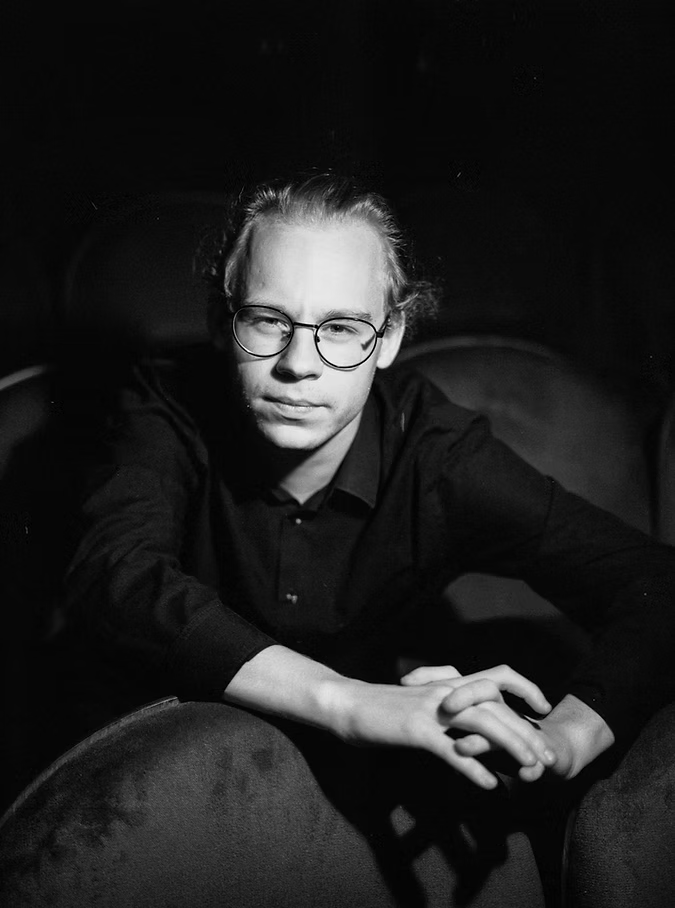
In October last year, pianist-composer Brecht Valckenaers made an enormous impression with his Ex Nihilo program at Festival 20'21. This cycle, which centers on Ligeti's Musica Ricercata, will soon be recorded and released on CD, and in that context he performed an integral version once more in Ghent. Ex Nihilo is one continuous whole consisting of three layers. The first and most important layer is György Ligeti's Musica Ricercata, a series of eleven short compositions in which the composer literally experiments note by note with different compositional techniques and styles. Between these pieces, Valckenaers weaves two other complementary threads: one featuring works by 20th-century composers that resonate with pieces from Musica Ricercata, such as works by Lachenmann, Kurtag, Crumb, Cowell, and Bartók; and one with five rhythmic studies that pianist-composer Valckenaers himself composed.
Ex Nihilo, or 'from nothing,' forms the central theme that binds everything in this cycle together. The works of Lachenmann, Cowell, Bartók, Kurtág, and Crumb approach the piano as an instrument 'Ex Nihilo,' as if using the piano for the first time and exploring what is possible with this instrument. This results in unconventional textures and playing techniques. Valckenaers' pieces, on the other hand, are a form of exploration in the rhythmic realm, where he expands and challenges his own rhythmic boundaries.
An exceptionally beautiful, interesting, and impressive recital in which everything seems to work perfectly—the structure, the musical connections, and moreover Valckenaers' own work. With complete dedication and utmost musical sophistication, Valckenaers knows how to captivate his audience. It's incredible that all these masterpieces were performed entirely without a score, and for a good hour at that!
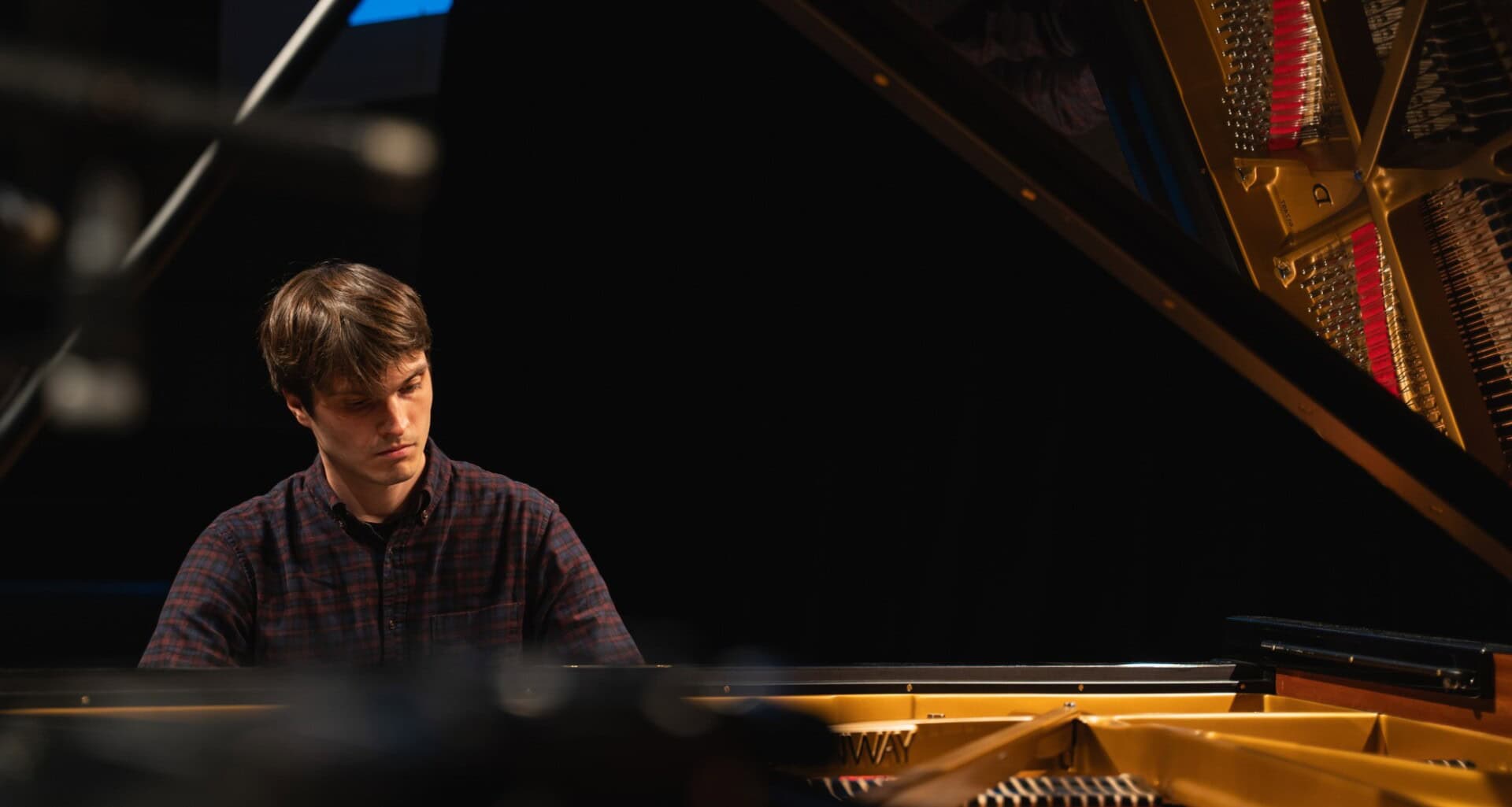
His own rhythmic studies resounded here and are briefly explained once more:I. Distorting Time, II. A Bit Drunk, III. Distorting Mirror, IV. Mixed Feelings, V. Chaconne des Cloches. Each of these studies departs from a central and original rhythmic idea that unfolds into one organic musical narrative. In Distorting Time , quintuplets and polyrhythm are explored in a transforming ABA structure. In A Bit Drunk , the music seemingly falters, but nothing could be further from the truth—the rhythm is actually very tightly prescribed and is shifted slightly, causing the pianist's playing to sound lightly inebriated. In Distorting Mirror , there is renewed experimentation with exotic time signatures and subdivisions, as well as polyrhythm. The structure of the piece is like a mirror, with the mirror axis appearing in the middle. From that point on, the preceding sections return in reverse order, and moreover those sections are somewhat distorted: the time signatures are also mirrored. A distorted mirror image, as it were. One of the subthemes in the recital is bell sounds, which can be heard in different layers of the concert: in Ligeti's homage to Bartók, in Ein Kinderspiel fromby Helmut Lachenmann and in György Kurtág's homage (Ligeti's closest friend) to their shared composition teacher Sándor Veress. But also in my final etude and in Ligeti's homage to Bartók, the bells ring." by Helmut Lachenmann, and in György Kurtag's homage (Ligeti's close friend) to their shared composition teacher Sándor Veress. Valckenaers makes his own addition here, and not just any addition—the fifth rhythmic study is the very majestic and impressive Chaconne des Cloches.
Soon you can watch Bert Lasseel at work together with Quirijn De Bosscher (violin) at the Ghent Festivities, where they perform as Duo Obscura.
If you missed Ex Nihilo, you can listen to the complete live version from Festival 20'21 here: