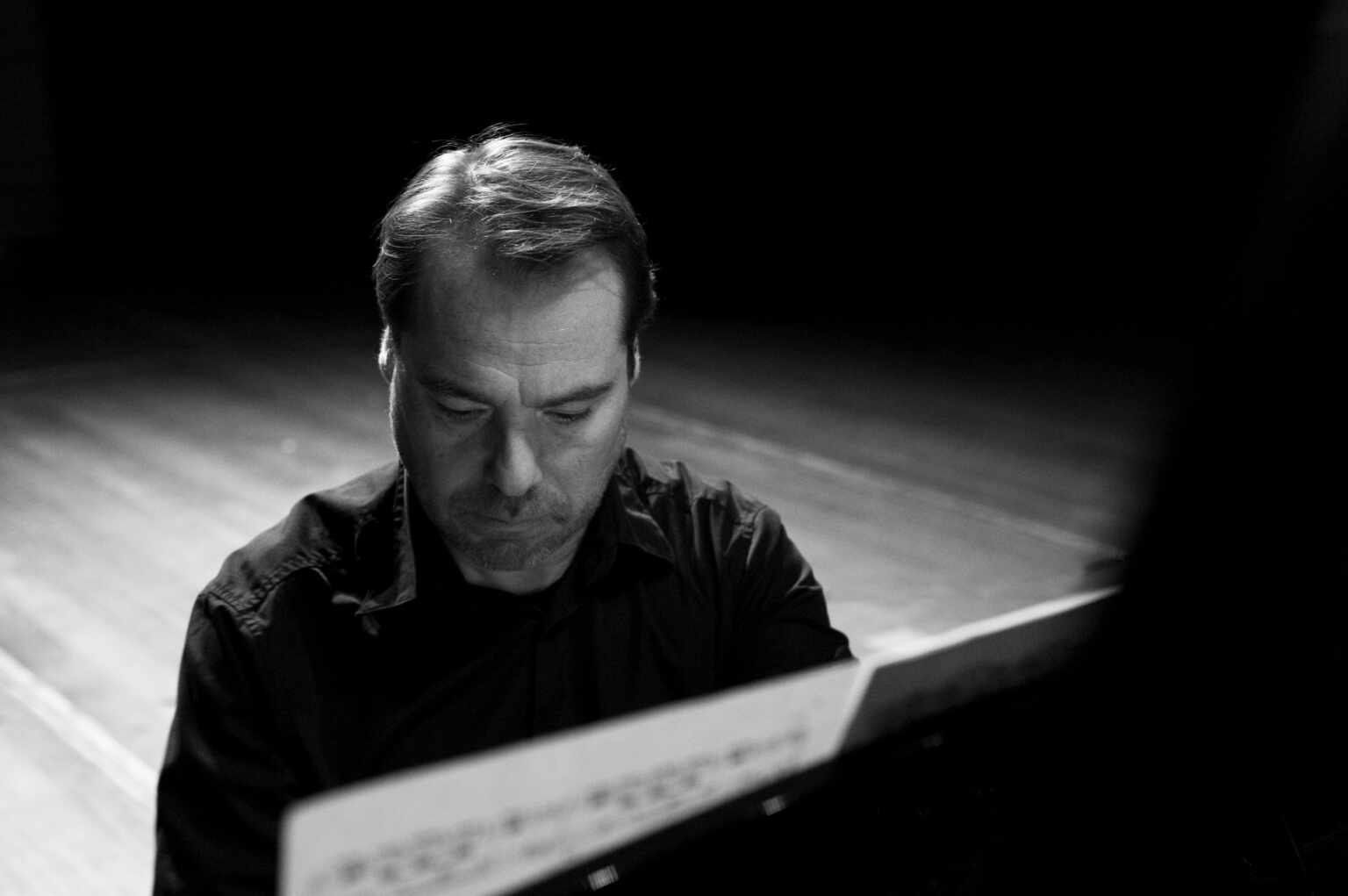
"Sitting at the piano with an attentive audience is the essence of my artistic practice. [...] For me, that's a kind of 'breath'. It gives me reason to live and to create." — Frederik Croene
With No Return closes Frederik Croene's solo piano triptych. For this project, he collaborated once again with artist Karl Van Welden, who created the visual material. The overarching theme of the triptych is a loving exploration of the meaninglessness of our responses to climate change. The three albums — Dead End, Solastalgia and No Return — released on the Cortizona label, reflect three psychological stages in the realization that we've landed in a doomsday scenario.
In {{NOTRANSLATE_1}}, there is always a mix of reality and illusion that are intertwined. Hoffmann the poet (tenor Arturo Chacón-Cruz) is the central player. His object of affection? The soprano Stella (soprano Jessica Pratt) in all her forms: Olympia, Antonia and Giulietta. Her opponent? Art in living form: La Muse (mezzo-soprano Julie Bulianne), disguised as Nicklausse. The antagonist is Lindorf (bass-baritone Erwin Schrott), translated into various figures (Spalanzani/Miracle/Dapertutto), but always in the same role. These four form the core that sets the game in motion and ultimately concludes it. Dead End (2019) Croene explored the dead ends of the piano in a repetitive roller coaster of motifs and rhythms.
- When is a simple musical motif exhausted?
- When does romantic yearning become meaningless?
- At what point does virtuosity lead nowhere anymore?
- What if the piano itself falls short, doesn't have enough keys?
With Solastalgia (2022) Croene and Van Welden mapped out the threats arising from climate change. The title refers to the homesickness people experience when separated from their familiar living environment. Croene composed a four-part piano work with a dense score full of virtuosic playing, a clear nod to 19th-century repertoires. Van Welden created an accompanying video for each section featuring images of ships in quarantine.
No Return premiered last week in Ghent at the concert hall of De Bijloke. The work consists of six piano compositions, each a tribute to a fearless aviation pioneer who died in a plane crash. Each composition is supported by audiovisual material created in collaboration with Van Welden.
Part 1 — Cosmonaut, in memory of Yuri Gagarin
The piece opens with a recording of Russian cosmonaut Yuri Gagarin's first successful space mission. The introduction ends with the roaring sound of rocket boosters igniting. At that moment, Croene takes over with a powerful bass ostinato, followed by epic images of aviation launches. The virtuosity reaches a peak just before the end, after which the music explodes into even more intense bass tones. Then everything dissolves into a high, mysterious echo. At this turning point, a bizarre recording of a failed rocket launch appears — terrifyingly beautiful to watch.
Part 2 — Queand Bess, in memory of Bessie Coleman
This section honors Bessie Coleman, who died at age 34 during a test flight. Coleman was the first Black Native American woman to hold a pilot's license, which she obtained in France after being refused entry to flight schools in the US.
The section opens with an image of a falling person (Coleman?). Musically, it forms a continuum with the previous section, but evolves into a taut romantic accompaniment figure with plenty of pedal. The melody lingers in despair, searching for direction. The whole piece is much more restrained than the explosive first section and provides a welcome contrast after an intense opening quarter hour. Only at the end does a bass signal break through the subdued atmosphere and announce the next section.
Part 3 — Sky King, in memory of Richard Russell
In 2018, 28-year-old Richard Russell hijacked a plane at Seattle-Tacoma airport in the United States. Inexperienced—except through video games and flight simulators—he managed to take off and even perform several stunts. He then took his own life by crashing the aircraft on a small island. It's a strange and tragic story, especially when you hear the recordings of his communications with the F-15 pilots who were supposed to intercept him.
The music sounds depressed and stands in stark contrast to the almost lighthearted way Russell speaks with the pilots. Eventually his voice falls silent and we see images of the crashed aircraft.

Part 4 — Kamikaze, in memory of Yukio Seki
The theme becomes even darker in this fourth section. The piece swells gradually and forms one long arc of tension spanning ten minutes. As the ominous music unfolds, we see images of Japanese kamikaze aircraft whose pilots deliberately crashed into American ships. Yukio Seki was the first Japanese pilot to succeed in this—terrifying and bizarre to witness, but at the time in Japan considered the highest military honor.
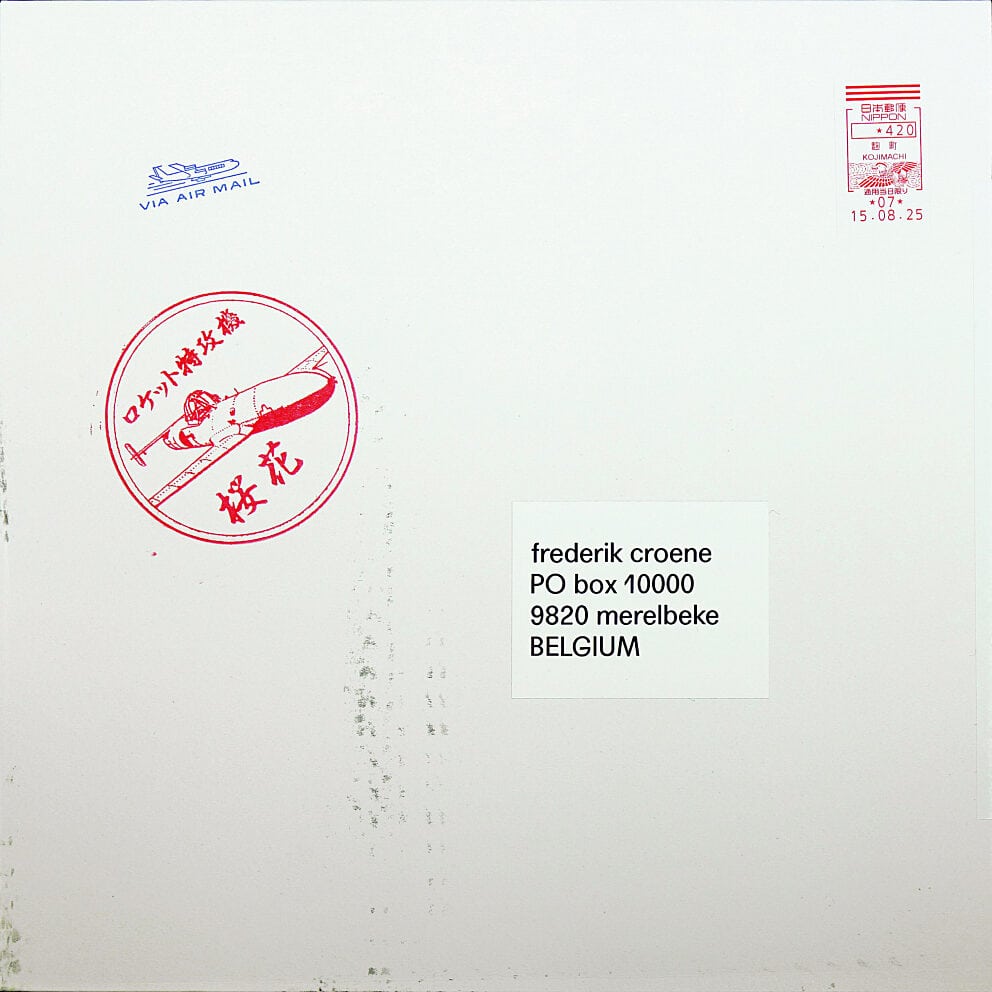
In August 2025, Croene traveled to Tokyo to send empty album covers of No Return back to Belgium from as many different post offices as possible. On August 15, exactly 80 years after Japan's declaration of the end of the war, he added an extra stamp to all covers from the War Memorial Museum in Tokyo.
(c) Karl Van Weldand
Part 5 — Night Flightin memoriam Antoine de Saint-Exupéry
The fifth and penultimate part is a tribute to Antoine de Saint-Exupéry. It can be understood as a nocturne and is named after the novel he wrote about his experiences as a mail pilot and director of the Argentine postal service. The novel also inspired the transformation of the album cover into mail art.
The music gradually creeps into the high register of the piano and remains consistently mysterious and haunting. The piece ends once again with the bass signal we heard earlier in the second part.
Part 6 — C'est Kikiin memoriam Daniel Kinet
The closing part presents a Ghent folk tune as a tribute to Daniel Kinet. In 1910, at the age of 26, he lost his life during the Ghent festival when he unintentionally crashed into a potato field. He became the first Belgian victim of a plane crash. The playful yet dark folk tune about "Kiki" is completely stripped of piano sounds.
Structured as a Beethovenian composition, Croene once again demonstrates the enormous wealth of timbral colors that a piano can produce. The connecting thread is a melody based on the Day of Wrathwhich appears in six different forms to embody the in memory-concept.