Verona Opera Festival
Opera performances in the arena of Verona are the most famous and celebrated in Italy, perhaps in all of Europe. The amphitheater was built in the first century for gladiatorial combat and public games. The prefix 'amphi' indicates its round or oval shape, much like its more famous cousin, the Colosseum in Rome. Beyond that, there are hundreds of Roman theaters throughout Europe, North Africa, and the Middle East—not amphitheaters, but built in a semicircular design. Many of these are still used today for theater, opera, and concerts. Notable examples include Arles, Naples, and Plovdiv in Bulgaria.
On June 13, there was the grand opening of the Verona Opera Festival 2025 with Verdi's Nabucco. This is no ordinary premiere, but a major society event with distinguished guests on the red carpet. All around the arena, banners proclaim "The most Italian place on Earth." Ladies and gentlemen in their gowns and tuxedos are surrounded by security. Ministers, officials, diplomats, business leaders from Confindustria, and other prominent Italians from the arts and media are in attendance. Famous foreign guests are also present. I spotted former German Chancellor and opera enthusiast Angela Merkel in the VIP section of the sold-out arena.
Prestige
The festival opening is more than just a musical event—Nabucco is leveraged to convey ideological, political, and social messages. For the city of Verona, this event is an opportunity to raise its cultural profile. "Culture is an integral part of society and economy; it's actually the engine of both," proclaimed the headlines the next day on the front page of l'Arena, Verona's local newspaper. Beyond boosting the city's image, the festival has an international dimension—through the Arena di Verona, Italy presents itself as a leading cultural nation. After some welcomes and speeches, the audience stands for Il Canto degli Italiani, the Italian national anthem.
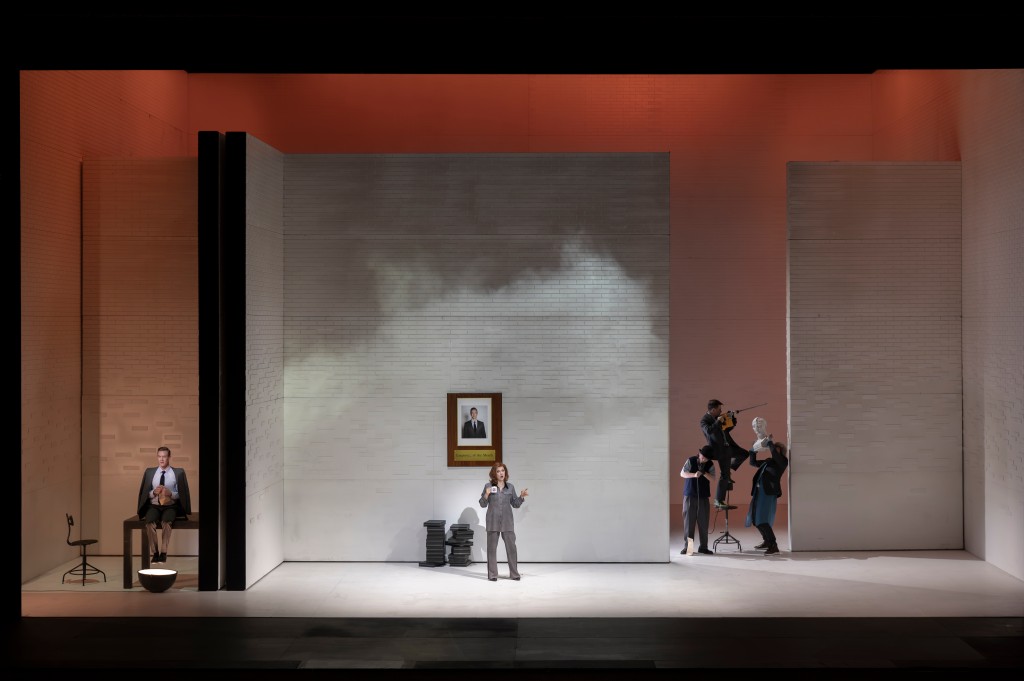
It's become customary for contemporary opera directors to transport a libretto from two hundred years ago into a modern context. This very contemporary approach earned La Monnaie/De Munt the title of world's best opera house earlier this year in February. By the way, La Monnaie/De Munt hasn't only been a mirror of contemporary society. Our society itself was spurred on in 1830 by the opera La Muette de Portici at La Monnaie/De Munt to spark a revolution. Speaking of the political importance of opera...
Nabucco 2.0
The opera Nabucco is set in the Middle East and concerns the struggle of the Babylonians against the Jews. King Nebuchadnezzar has enslaved the Jews. In the song "Va Pensiero," they call upon God's help. Nabucco eventually recognizes their God and frees the Jews. The opera begins with exile and damnation and ends with peace and reconciliation. It takes little imagination to translate the current tensions in the region to the staging of Nabucco. Director Stefano Poda did exactly that. First conflict and struggle, then reconciliation and peace.
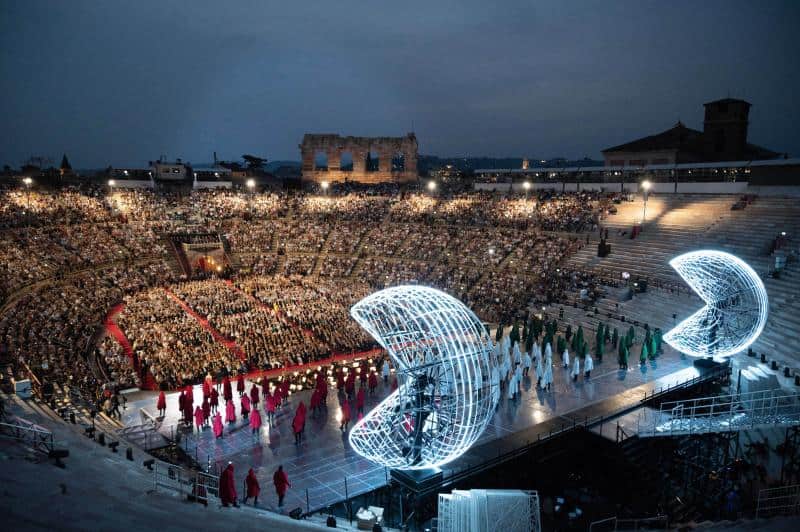
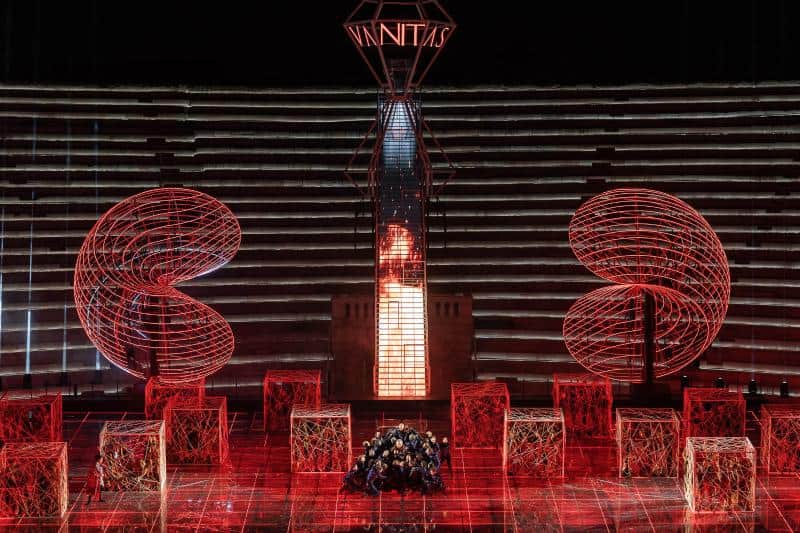
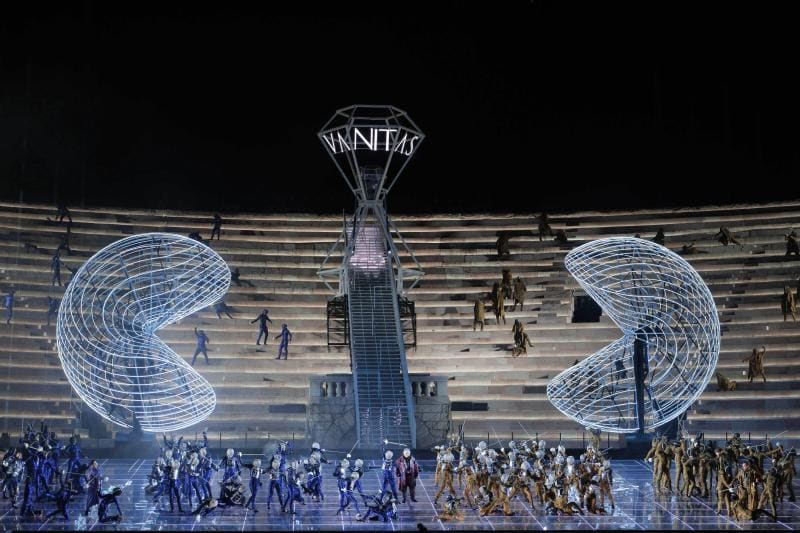
This is also evident in the sparse elements on stage. The Babylonians and Jews face each other with drawn swords, and the raw sound of iron clashing with iron from the fencing dancers cuts through the music. In the background, two hemispheres hang—two glowing giant croissants, two blue half-moons that turn red in the third act and eventually merge completely to form a whole sphere.
One day before the premiere in Verona, Israel attacked Iran, and tensions between the two arch-enemies escalated into outright war. As if the devil himself had a hand in it. Nabucco is interpreted here as a catalyst for reflection, tolerance, and reconciliation. In the arena, in this colossal amphitheater, we all become humble and small; time stands still here, as do hubris and hatred.
Five hundred musicians, singers and dancers
In this performance of Nabucco, Amartuvshin Enkhbat (Nabucco), Anna Pirozzi (Abigail), Vasilisa Bershanskaya (Fenene), Francesco Meli (Ismaele) and Roberto Tagliavini (Zaccaria) were absolutely stellar. One by one, they delivered voices that filled the arena to the rafters. The Orchestra of the Arena di Verona was also top-notch, conducted by Pinchas Steinberg. With choir and dancers, more than five hundred performers took the stage and occupied the orchestra pit. Throughout the entire performance, a drone flies above the audience, orchestra and stage. The complete opera will be broadcast on RAI on June 21, International Music Day.
Experiencing an opera in the Verona Arena is an unforgettable event in any case. The amphitheater is almost 2000 years old, and the acoustics are impressive, even though the building wasn't originally designed as a theater. That's different for other Roman theaters where summer opera festivals are held today. I'm thinking of, for example, the Roman theater in the Bulgarian city of Plovdiv and the annual Opera Open festival of the State Opera Plovdiv. This Roman theater from the ancient metropolis of Philippopolis, as Plovdiv was called in the first century, is smaller and more intimate than the enormous Arena di Verona. The marble seats are steeper, which helps project sound throughout the semicircle.
Opera as a political gesture
The opera is not merely a moment of reflection and reconciliation; it is also an indictment against hatred and fanaticism. An indictment against demagoguery and the temptation to see terrorists as liberators. An indictment against totalitarian seduction, which Hannah Arendt and many others have opened our eyes to. An indictment against the simplistic solutions of populists, an invitation to embrace democracy and tolerance. It is also an invitation to view today's conflicts in a broader historical perspective. What is happening today in the Middle East is a consequence of forced displacement and ethnic cleansing over the past hundred years, which are barely mentioned or explained in the media and public discourse. This understanding can help reinforce a message of peace and hope.
Next year, Opera Ballet Vlaanderen will stage Nabucco directed by the acclaimed Brazilian director Christiane Jatahy. "Opera as a political gesture" is what you'll read on the Opera Ballet Vlaanderen website. Opera isn't just there for enjoying music, drama and dance. Opera exists "to provoke reflection on the connection between present and past," explains Jatahy. Opera is there to turn our backs on hatred, demagoguery and xenophobia and offer hope for a democratic, multicultural and tolerant society.