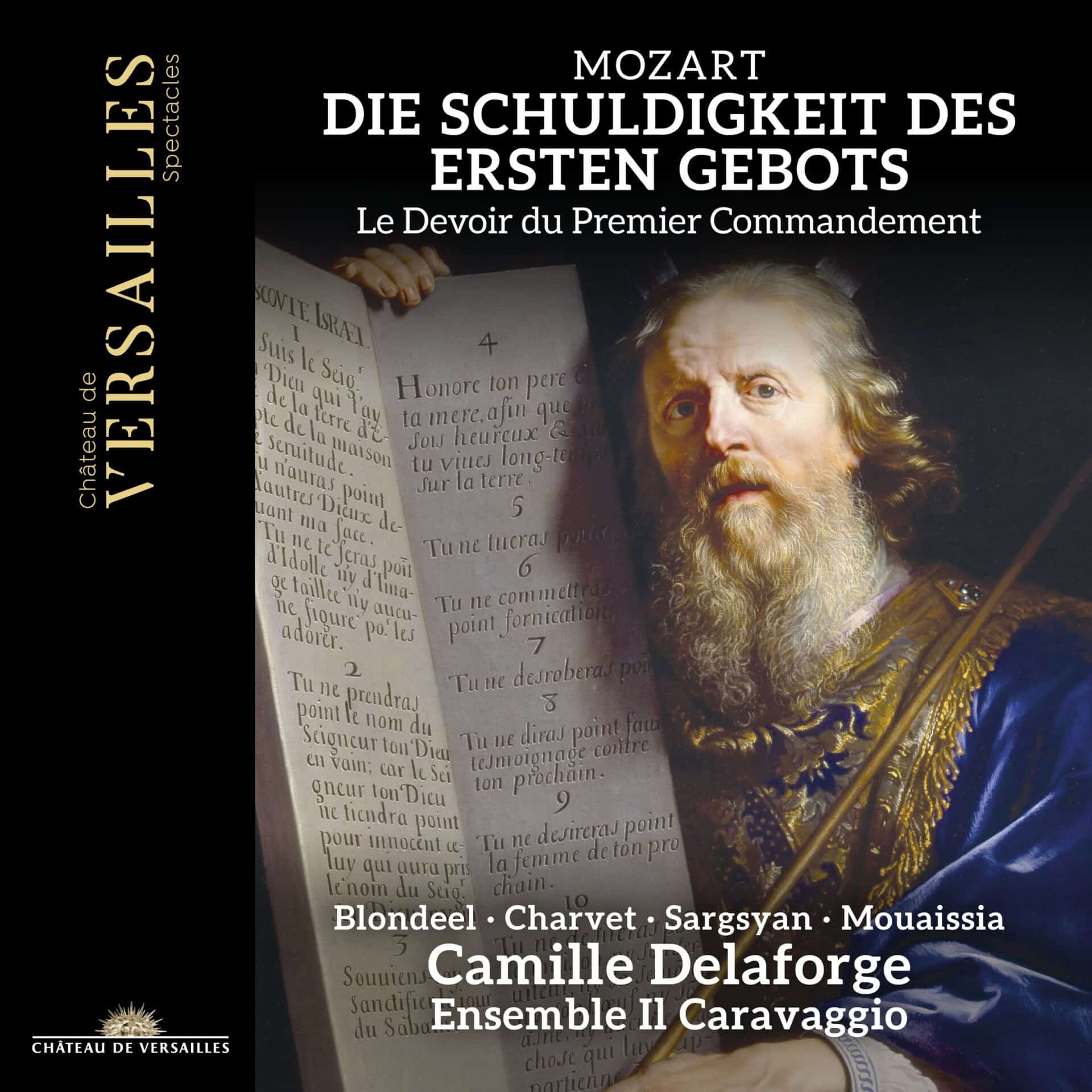

A thorough commentary, as provided in this edition by Camille Delaforge (who wrote the introduction) and Hervé Audéon, once again confirms its importance, especially when it comes to a little-known work, as is the case with Mozart'sDie Schuldigkeit des ersten GebotsKV 35. I've enjoyed drawing from it.
The first part of this oratorio had its premiere on March 12, 1767 in one of the elegant rooms of the residence ('Residenz') of the patron, Prince-Archbishop Hieronymus Colloredo in Salzburg. The remaining two parts, not composed by Mozart, followed on March 19 and March 26 respectively, each exactly one week later.
Musicologists have debated the precise year of completion for quite some time, prompted by what Wolfgang's father Leopold Mozart had noted in his own hand on his son's manuscript: 'Oratorium di Wolfgango Mozart composto nel Messe di Marzo 1766'. This date may have been an error, possibly connected to Wolfgang's age as mentioned on the title page of the libretto, published in Salzburg in 1767 by Johann Joseph Mayr Erben: 'Erster Theil in Musik gebracht von Herrn Wolfgang Mozard, alt 10. Jahr'. Mozart was, however, eleven years old at the time.
A letter from Leopold survives, dated December 12, 1765, sent from The Hague to his friend Lorenz Hagenauer in Salzburg. It mentions 'poetry' that was described as 'sehr gut ausgefahlen'. The author of that 'poetry' was textile merchant and successive city councilman and mayor of Salzburg, Ignaz Anton von Weiser (1701-1785), who had written the libretto for the oratorio. If this was indeed the text in question (there is now little doubt about it), it is more than likely that young Wolfgang worked on his contribution to the three-part work in or around March 1766 during his stay in The Hague (the family made a long journey between 1763 and 1766 that took them to France, England, and the Netherlands).
That the oratorio was first performed a year later, in March 1767, in Salzburg, can be explained by the fact that it was customary during Lent (the period ending with Easter), with all theaters closed, to perform an oratorio or 'sacred singspiel' in the German language every Sunday. The latter is also reflected in the 104-page manuscript and the original score of twice that length, set as an 'oratio' for five vocalists and orchestra. The manuscript came into the hands of music publisher Johann Anton André, until it came into the possession of the British Royal Library in 1841.
The manuscript of the first part does not provide a clear answer to the question of who wrote what exactly. However, it shows that Wolfgang notated the first part almost entirely himself (which of course is something different from composing it). The second and third parts are the work of Michael Haydn and Anton Cajetan Adlgasser respectively, two renowned composers.
The title of the 'oratio' traces back to the preface of the libretto:
'For the hoped-for spiritual benefit, the various reminders contained therein will provide occasion to consider above all that for the improvement of spiritual apathy and for the quicker recognition of the so harmful false doctrine of worldly spirit, there is required, above all, besides the always necessary divine grace, a humble disposition, and therefore a sincere fulfillment of the indispensable duty: to love God, according to the first and foremost commandment, with all your heart, mind, soul, and strength.'
Leopold's influence on his son's first oratorio is thus impossible to determine with reliable accuracy (although his handwriting can be recognized in a number of places), but others may well have contributed. That Leopold was allotted a role in the oratorio is obvious, since he was not only known as a violinist and composer of some reputation, but also as the author of the still-consulted textbookAttempt at a Thorough Violin Method, which was completed in 1756.
Such reflections naturally do not diminish Wolfgang's musical talent, about which Friedrich Melchior Baron von Grimm, a renowned German writer who also made notable contributions in the field of the encyclopedia, remarked in his Literary Correspondenceof July 15, 1766 (when the Mozart family was staying in Paris) that Wolfgang 'is one of the most amiable creatures one could see, bringing wit and soul to everything he says and does with the grace and kindness befitting his age.' 'His cheerfulness even reassures us against the fear that such a precocious fruit might fall before reaching maturity.' And then about the father: 'The father is not only a skilled musician, but a man of sense and good judgment, and I have never seen a man of his profession combine such merit with his talent.'
Leopold had every reason to present not only his son but also his five-year-old sister Maria Anna (nicknamed Nannerl), an accomplished pianist and violinist, as a prodigy to the European courts and in the most varied aristocratic circles. This was the primary goal of their 'family tours.'
In September 1766 they were in Lausanne. A certain Doctor Tissot wrote in response, among other things, that '[...] it would be greatly to be wished that fathers whose children have distinguished talents would imitate Mr. Mozart, who far from pushing his son, has always been careful to moderate his ardor and prevent him from giving himself over to it; conduct to the contrary stifles the finest geniuses every day and can cause the most superior talents to miscarry.' An observation that is also quite telling about the father!
Does Leopold's (possible) involvement also say something about the conceptual characteristics of the oratorio? In any case, the introductory Sinfonia is brimming with youthful spirit and genuine 'Sturm und Drang'; in its most directly compelling form. Yet the underlying theme seems rather heavy fare for an eleven-year-old. That of the First Commandment: 'Thou shalt have no other gods before My face.' In Matthew 22:27-40 we read: 'And Jesus said unto him, Thou shalt love the Lord thy God with all thy heart, and with all thy soul, and with all thy mind. This is the first and great commandment. And the second is like unto it, Thou shalt love thy neighbour as thyself. On these two commandments hang all the law and the prophets.'
The concept of 'Schuldigkeit' was part of the prolonged struggle between the Jansenists and the Jesuits, until the former had to yield the field in 1773 and were expelled from Austria.
When the (first) performance of Die Schuldigkeit des ersten Gebotstook place in Salzburg in March 1767, in that same year the breach between the (Viennese) Archbishop Christoph Migazzi and Empress Maria Theresa had become a fait accompli. The main cause was the unbridgeable gulf between the Empress's tolerant attitude toward the Jansenists and their condemnation by the Pope, as expressed in, among other documents, Cum occasione(1653), Vineam Domini(1705) and Unigenitus(1713). Not only in and around the Archbishop's palace in Vienna and thus throughout Austria was a fierce struggle waged against Jansenism: in the Southern Netherlands too, the movement against Jansenism, supported by (arch)bishops and other clergy, had become a force to be seriously reckoned with.
Under Archbishop Migazzi's rule, the emotionally intense religious experience of the Jesuits, the Habsburgs' most important missionaries, was firmly curtailed. The restraining activities were directed by Ignaz Parhamer, the former confessor of Emperor Franz I. He succeeded brilliantly in his mission, as by 1768 all Jesuit schools were officially banned.
What influence could the troubles connected with this have had on Mozart's oratorio? The real prelude lay, of course, with the librettist, Anton von Weiser, who in his oratorio text had established the connection—from that perspective—between divine grace, which is indispensable for mankind, and the equally indispensable will of that same mankind to make this grace a reality.
The eleven-year-old Wolfgang could not have understood all of that, quite apart from the fact that the far-reaching implications and decidedly unusual subject matter were far from easily suited to any musical rhetoric whatsoever. This makes the involvement of at least father Leopold all the more likely. A question that, albeit in a completely different context, also arises with another substantial work from around the same period, the opera Apollo and HyacinthusKV 38 (mistakenly listed as KV 37 in the CD booklet), which took place on May 13, 1767, thus two months after The Obligation of the First Commandmentalso performed for the first time in Salzburg, in the university hall of the Benedictines. We simply don't know. What we do know is that Wolfgang must have been still quite far removed from his independence as a person and thus also as an artist.
Apollo and Hyacinthusdoes bring us closer to the possible orchestral arrangement of the oratorio, as we know with certainty what it consisted of in 1767: two oboes, bassoon, two horns, twelve violins, two violas, cello and two double basses (violoni), making a total of twenty-two musicians. Although a considerably more expanded later version has been handed down, including eight woodwinds (two flutes, two oboes, two bassoons, two horns). The number of musicians on this album is twenty-four: nine violins, three violas, four cellos, double bass, two oboes, two bassoons, two horns and harpsichord.
In the setup of this oratorio chosen by Mozart, the solistic role of the alto trombone in the accompanied recitative 'Was Rechenschaft? Was Tod?' (track 12) is particularly striking, as is the aria 'Schildre einen Philosophen' (track 15). Mozart undoubtedly had Thomas Gschlatt in mind, the virtuoso trombonist who was part of the court chapel in Salzburg between 1756 and 1769 and as such was 'served' by several composers, including Johann Ernst Eberlin in his church cantata Die gläubische Seele and in Leopold's Litaniae Lauretanae. On the recording made in Versailles, the trombonist Lucas Perruchon inexplicably shines by his absence (though he was to be heard in a live performance by the same ensemble at the same location).
That trumpets and timpani found no place in the oratorio can be easily explained by what Pope Benedict XIV explicitly stipulated in his encyclical Annus qui (1749): that in church works there was no place for these instruments, as was also the case for flutes, oboes, horns, harps and other instruments that were counted as part of the domain of 'theatrical' music. Here we see that Mozart, by deploying oboes and horns, did not strictly adhere to this papal edict, apparently with the (fore)knowledge that it would not meet with criticism, let alone resistance in the bishop's palace.
The design of Die Schuldigkeit des ersten Gebotsis not remarkable, as Mozart followed the rules that had been established by tradition, properly following the pattern of the 'dramma per musica' designed by Pietro Metastasio (arias in da capo form, A-B-A, as we also know from Apollo and Hyacinthus). The arias are connected to one another within the given narrative framework (the simply accompanied recitatives guide the listeners toward understanding the text). The second, central and modulating section of the aria, however, has a pronounced expressive dynamic, while the repetition (da capo) – and this applies to all arias – is newly conceived. Thanks to the inserted pedal points, the singers have ample opportunity to improvise as they see fit. Just as the instrumental ensemble should not hold back when it comes to characterization, with one of the many striking examples being the accompanied recitative that connects to the aria 'Ein ergrimmter Löwe brüllet' notated in E-flat major, where the violent crescendo gives the resonant contribution of both horns extra relief in the portrayal of the enraged, roaring lion searching for its prey, to the fright of all the animals in the forest (but not of the hunter who doesn't want to be disturbed from his nap ...) Mozart became fully accomplished and mature in this: taking drama to great heights with only modest means, culminating in Don Giovanni (about which even Wagner remarked that it was impossible to find a more perfect example).
Some will characterize Die Schuldigkeit des ersten Gebotsmore as opera than oratorio, the first especially driven by what indeed unmistakably emerges from the work and serves as a red thread in it: the musically strongly contrasting, but also spiritual struggle of man against the relentless temptation to turn away from God, with all the allegorical characteristics that go with it. Virtue and vice, righteousness, charity, sin and repentance – these are still the familiar themes that are particularly suited to virtually all art forms.
It is a shame that with regard to the performance of Mozart's oeuvre, the oratorio hardly appears on the ranking of the current concert repertoire. Possibly with regard to The Obligation of the First Commandment there is a second obstacle: that the piece was intended as part of a project in which several composers participated (Mozart composed only the first part). That many are thereby deprived of the opportunity to see the early development of Wolfgang Amadeus Mozart as a composer in this domain and, moreover, the way in which he was already able to give form and substance to what became far more than merely a vague character sketch, should be clear.
This new album was created in the Palace of Versailles, a location with which the Mozarts were also acquainted. Leopold arrived in Paris together with his then seven-year-old son and twelve-year-old daughter on November 18, 1763. Their ultimate destination was Versailles, to perform there at the court of Louis XV and his wife, Mme de Pompadour. The necessary groundwork had already been done by the aforementioned Baron von Grimm.
By mid-December it was time and the performance could take place. There is not much to report, but Leopold did note that according to him the Marchioness was certainly not lacking in external beauty, that she showed herself to be quite proud in their presence and moreover regarded herself as an empress. Wolfgang, on the other hand, thought she resembled Threzel, the housemaid. He wanted to kiss the Marquise goodbye, but she did not allow it, which he took as an insult. For was it not the Austrian Empress Maria Theresa whom he had kissed? The stiff French court life was certainly not well received by the Mozarts ...
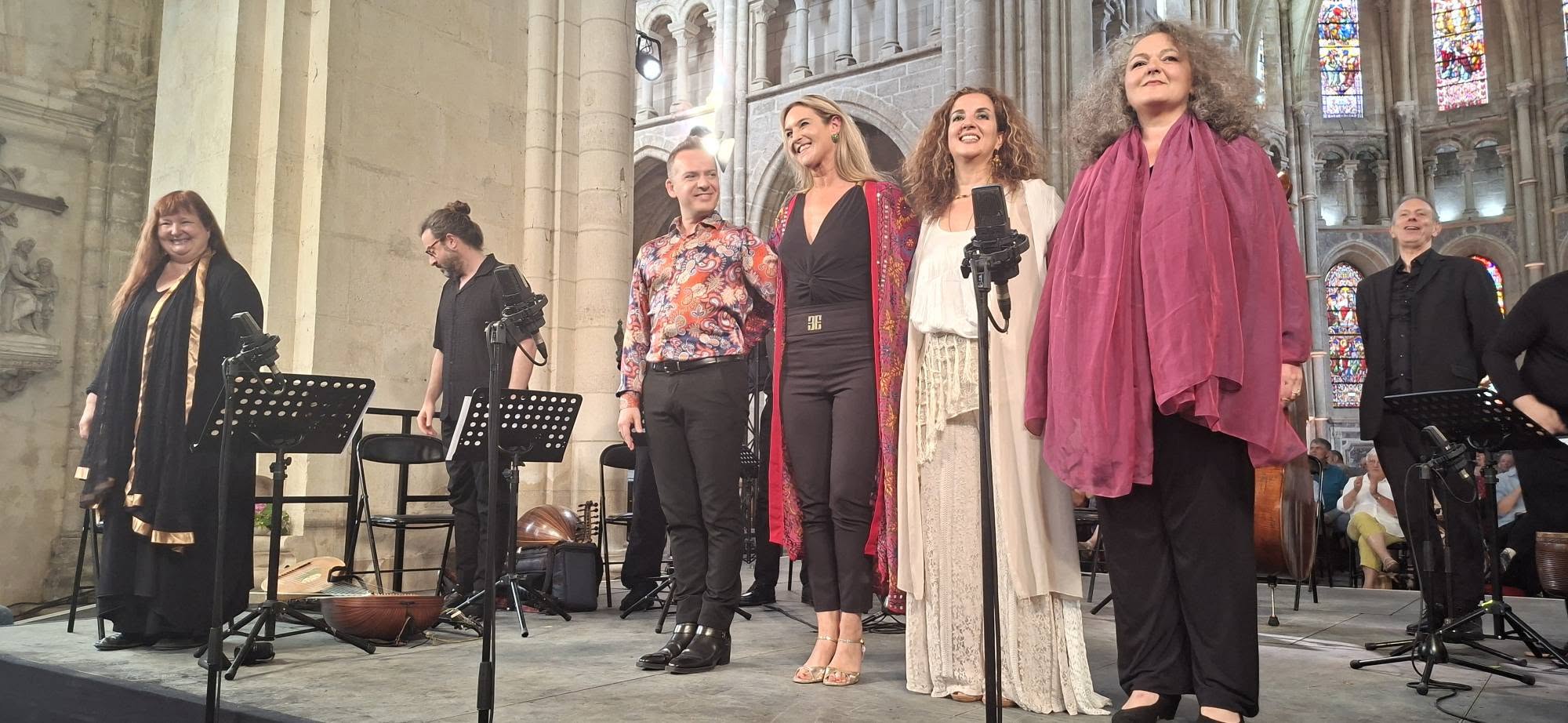
In this same palace, to be precise in the 'Salle des Croisades', the four vocal soloists and the Ensemble Il Caravaggio gathered under the direction of Camille Delaforge in June 2023 for the recording of Die Schuldigkeit des ersten Gebots(in French The Duty of the First Commandment).