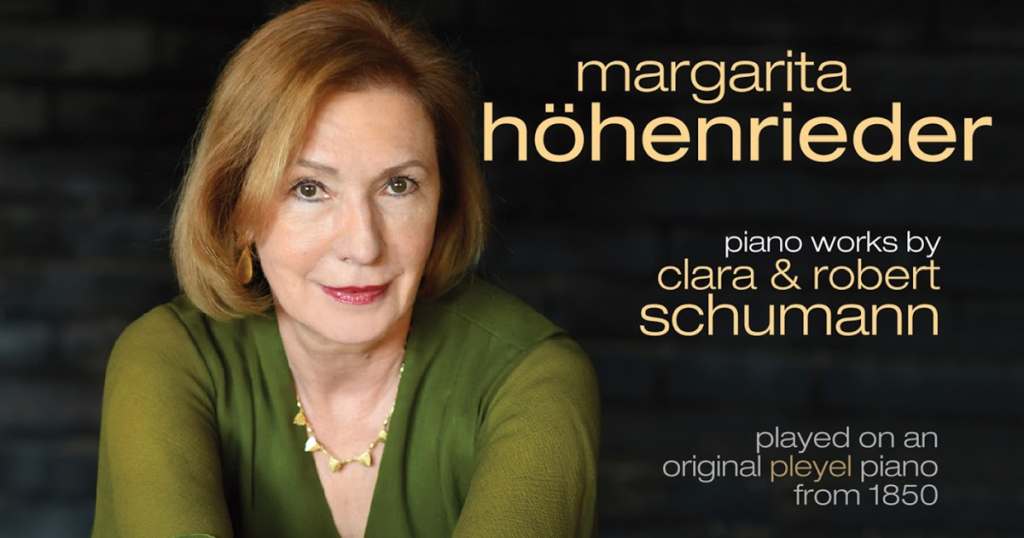
*** Munich pianist Margarita Höhenrieder takes us on a journey back to the 1840s with her 1850 Pleyel grand piano, whisking us directly to Leipzig, where we encounter the then still-happy couple Robert and Clara Schumann. Clara with her firstborn in her arms, Robert still awkward as a newlywed, having won his bride only after a court battle to free her from his possessive father-in-law's grip.
It cost him sleepless nights and a nervous breakdown. For Clara's father, Friedrich Wieck, had not only been his piano teacher for a few years—he had trained his talented darling into a concert pianist celebrated across Europe while still in her youth. He had no intention whatsoever of throwing away his investment by marrying her off to a washed-up concert pianist who, as a composer, had yet to reach his potential and besides gave the impression of being rather unstable.
But love conquers all. During the sixteen years their marriage lasted, it was the rational Clara who kept the tormented, unstable Robert on the right track. She admired her husband and was a passionate advocate for his work. In doing so, she made an essential contribution to his growing fame. But this came at the cost of her own development as a composer, which came to a standstill after her husband's death in 1856. As a composer, she faded into obscurity.
It is therefore hardly surprising that Clara Schumann's work has appeared on CD only sporadically. However, this does a disservice to a woman who was one of the musical game-changers of her time. Fortunately, the tide is turning and Clara is slowly but surely stepping out of Robert's shadow.
It is regrettable that Clara did not continue her career as a composer after her husband's death in 1856. Composing was men's work, she believed, and women had no business dabbling in it. After all, there had never been a woman who had composed anything worthwhile—would she really be the first?
Yet as a composer she earned such a good reputation that a celebrity like Johannes Brahms sought her advice. We should therefore be grateful for the few compositions we have from her.
Fortunately, she was able to assert her influence as a pianist—and how! She became one of Europe's most famous pianists. Her career was driven by practical necessity. As a breadwinner, she supported her eight children through her concert fees. She became the most important 'classical' pianist of the nineteenth century, the antithesis of the Romantic virtuoso Franz Liszt, whom she detested.
And finally, she was a celebrated pedagogue, although she left far less of a lasting legacy than her arch-rival Liszt, whose influence can still be felt today in the wonderful world of the piano.
By combining the work of the couple on this CD, Margarita Höhenrieder chooses confrontation and contrast. She has chosen relatively unknown youthful works. This works brilliantly. We are transported directly into the intimate atmosphere of the Schumanns' salon, where you immediately hear that Clara as a composer was perhaps not quite Robert's equal. The Sonata in G and three Romances presented here pale in quality compared to Robert's Papillons and Sonata in G.
The lovestruck Clara wrote the outer movements of her Sonata in G as a Christmas gift for her husband in 1841, shortly after they were married. He certainly appreciated the gift. No wonder, for it is an accessible piece, full of passionate tenderness. But Clara does not dig very deep; this is pure salon music.
The three Romances are also a clear declaration of love to her husband. And again Clara demonstrates her competence, though it never quite becomes gripping.
But where Clara expresses her love in an almost rational manner, with Robert there is unbridled passion and never far from madness. A greater contrast is hardly imaginable.
His Papillons, a dozen highly original, brief sketches inspired by Jean Paul's novel Flegeljahre, offer insight into his mind tormented by violent mood swings. Sometimes some very heavy butterflies flutter about! Yet Robert managed to cast his capriciousness and multitude of ideas into a clear form, something his wife sometimes struggled with, as evidenced by the final movement of her Sonata.
In his seldom-performed Sonata in G, the listener is taken on a kind of emotional rollercoaster. This is Robert Schumann as we know him—exultant one moment and devastated the next—but not always accessible, impatiently stumbling over his ideas.
Margarita Höhenrieder, our guide to this turbulent past, is a revelation. She has been performing at the highest level in Germany for years, but is unjustly unknown in our parts. With this CD, she makes an important contribution to the current Clara Schumann revival. But by setting her work against that of her husband, she also makes clear that Robert was undoubtedly the greater composer and rightly achieved eternal fame.
Höhenrieder has completely inhabited the composers' skins. She unerringly captures all the moods of Clara and Robert with the rich musical palette her original instrument offers her. Clara's lovesickness, Robert's tormented capriciousness, and everything in between—it is presented to the listener unfiltered. Impressive too is how, despite the great emotions, she manages to conjure up an intimate drawing-room atmosphere. You feel as though you're taking tea with the Schumanns.
These may not be masterpieces of the piano repertoire, but she defends them with verve. Her dedication and love for the Schumanns more than compensates for any shortcomings. As a result, this is a CD you'll want to play again and one I can warmly recommend.
The Pleyel heard here also contributes to the listening pleasure. It fits her "like a glove"! In my view, Höhenrieder makes a compelling case here for the use of "period instruments."
Longing, passion and drama in the parlor—it doesn't get better than this!
- WHO: F
- WHAT: Piano Works by Clara & Robert Schumann on an Original 1850 Pleyel
- EDITIONSolo Musica 312