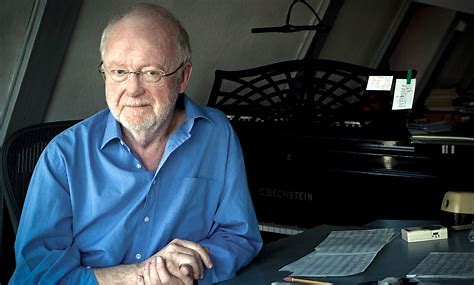
Composer Louis Andriessen passed away Thursday at the age of 82 in a nursing home in Weesp, the Netherlands. He had been ill for some time.
Louis Andriessen (Utrecht, ca. 1939) is regarded as the leading composer of his generation. Iconic for his stubborn openness, his refusal to compromise or be confined by convention, all conveyed through an unmistakably Dutch sensibility.
He is primarily known for his outspoken views on the relationship between music and social context. The collective memory holds the Aktie Notenkraker (1969). Andriessen and fellow artists disrupted a performance by the Concertgebouw Orchestra under Bernard Haitink's direction. They felt the repertoire selection at the time was too elitist. From then on, he had a contentious relationship with the traditional symphony orchestra's instrumentation. In addition to strictly limiting the number of strings, he added parts from every corner of the instrumental palette: electric guitar, bass guitar, Hammond organ, saxophone, marimba, and robust percussion became Andriessen's trademarks.
A classic is The State, in which the relationship between music and politics takes center stage. This work marked his international breakthrough. In 1977 he received both the Matthijs Vermeulen Prize and the first prize at the International Rostrum of Composers. But that wasn't all. His resistance to the narrow-mindedness of the previous era also manifested itself in his openness to other non-musical influences such as Mondrian (The Style) and Dante (The Comedy).
Furthermore, Andriessen played an important role in importing the minimalist style from the United States. Of course, he added his own personal twist to it. His version was less refined than that of Steve Reich and Terry Riley – Andriessen served up a generous helping of Dutch directness. This provoked considerable controversy. After the American premiere of The Matter in 2004, Anglo-Saxon critics accused him of trying to rough up the elegance of American minimalism. Others, meanwhile, felt deeply moved by it.
Open mind
Andriessen grew up in Utrecht and was steeped in music from childhood. His father Hendrik, brother Jurriaan, and uncle Wim were composers; his sisters played piano and flute. But he found his compositional foundation with Kees van Baaren (The Hague) and Luciano Berio (Milan). That grounding led him to classical sources of inspiration such as Stravinsky (rhythm) and Johann Sebastian Bach (precision). For Andriessen, it was then but a small step to open himself up to Count Basie, Charlie Parker, Motown, and Chaka Khan.
His final composition May, based on the poem May by Herman Gorter, premiered last December. In March of this year, his song cycle The Only One was released on CD, a synthesis of Andriessen's compositional journey. He shares the rebellious spirit with Flemish poet Delphine Lecompte, musical and theatrical stunts with soprano Nora Fischer, while keeping reflection and contemplation for himself, albeit cautiously. This work too is innovative and consistent in that regard.
In late 2019, it became known that he suffered from Alzheimer's disease. Yet he sat at the piano every day to improvise. In doing so, Louis Andriessen underscored that he is 'the only one' and will remain so.