The Opéra Royal de Wallonie does it again: staging a little-known and rarely performed work with great skill: Ambroise Thomas by Ambroise Thomas (1811-1896). This time with a decidedly contemporary twist as director Cyril Teste combines the possibilities of theater with film in his production. The performances of the two protagonists Lionel Lhote and Jodie Devos certainly ensure a brilliant show.
Like his slightly younger contemporary Charles Gounod, Ambroise Thomas achieved his greatest operatic success with an opera based on Goethe, Mignon. His adaptation of the Shakespeare play Ambroise Thomas was successfully premiered in Paris in 1868 but disappeared from the standard repertoire in the twentieth century, except for two fragments: Hamlet's drinking song in the second act and Ophelia's mad scene. Thomas devotes almost the entire fourth act to Ophelia. He made sweeping changes to Shakespeare's original without hesitation. For example, he had Hamlet crowned King of Denmark and made Gertrude complicit in the king's murder, but that wasn't a stumbling block in nineteenth-century French opera. The important thing was to produce a romantic drama, and Thomas certainly succeeded in that. Perhaps the greatest betrayal of Shakespeare is a "happy ending," in which Hamlet finally takes revenge on Claudius and is proclaimed king: "Long live King Hamlet". For later performances in London, Thomas himself changed that ending to a tragic conclusion with Hamlet's suicide. Cyril Teste chooses the original ending in which Hamlet is visited once more by the Ghost, who withdraws among the people and leaves Hamlet alone with his task as the new king.
© V. Bianchi / ORW Liège
Lionel Lhote and Shadi Torbey
© V. Bianchi / ORW Liège
Lionel Lhote and Jodie Devos
Focus on intimacy

Claudius has become king of Denmark after murdering his brother. He marries the widow. Hamlet, the son of the deceased king, is visited by the Ghost of his father, who orders him to avenge his father's death. Ophelia and Hamlet are in love with each other. Through a theatrical performance "The Death of Gonzague," Hamlet gains certainty about Claudius's guilt as a murderer. He reproaches himself for not killing him immediately. Hamlet overhears a conversation between Polonius and Claudius and learns that Polonius, Ophelia's father, was complicit in the murder. He now brutally rejects Ophelia's love. The Ghost repeats that Hamlet must avenge his father, but must spare his mother. Ophelia has gone mad and in her madness she drowns. As she is laid to rest, Hamlet is in despair, and after a final visit from the Ghost, he finally has the strength to kill Claudius. He is proclaimed king.
The political intrigue of the king's murder is of course the red thread of the story and the driving force behind Hamlet's thirst for revenge. But the direction unmistakably emphasizes the inner journey of the characters. Combined with the romantic score by Ambroise Thomas, it creates a diversity of emotions that keeps the (lengthy!) performance continuously engaging and moving. The use of film images makes an important contribution to this. They repeatedly show close-ups of the characters and especially their facial expressions, so that as a spectator you are drawn into their emotions. The pride of Claudius, the despair of the mother Gertrude, who is torn between her pride as a queen and fear and pain as a mother. The emotional rollercoaster of Hamlet, from revenge and helplessness, through love and hate. The tenderness of Ophelia and the sorrow that leads to madness. The images are sometimes shown on a strip at the top of the stage, but more often—and certainly more effectively—distributed across three panels as the background of the scene. The cinematic projection in the fourth act with Ophelia's drowning is also very beautiful. Less successful (and unnecessary) are the short segments introducing an act with backstage preparation like, for example, the makeup of a face. But that's nitpicking. The presence of cameramen on stage is sometimes distracting, but unavoidable for the concept.
Simplicity yields expression
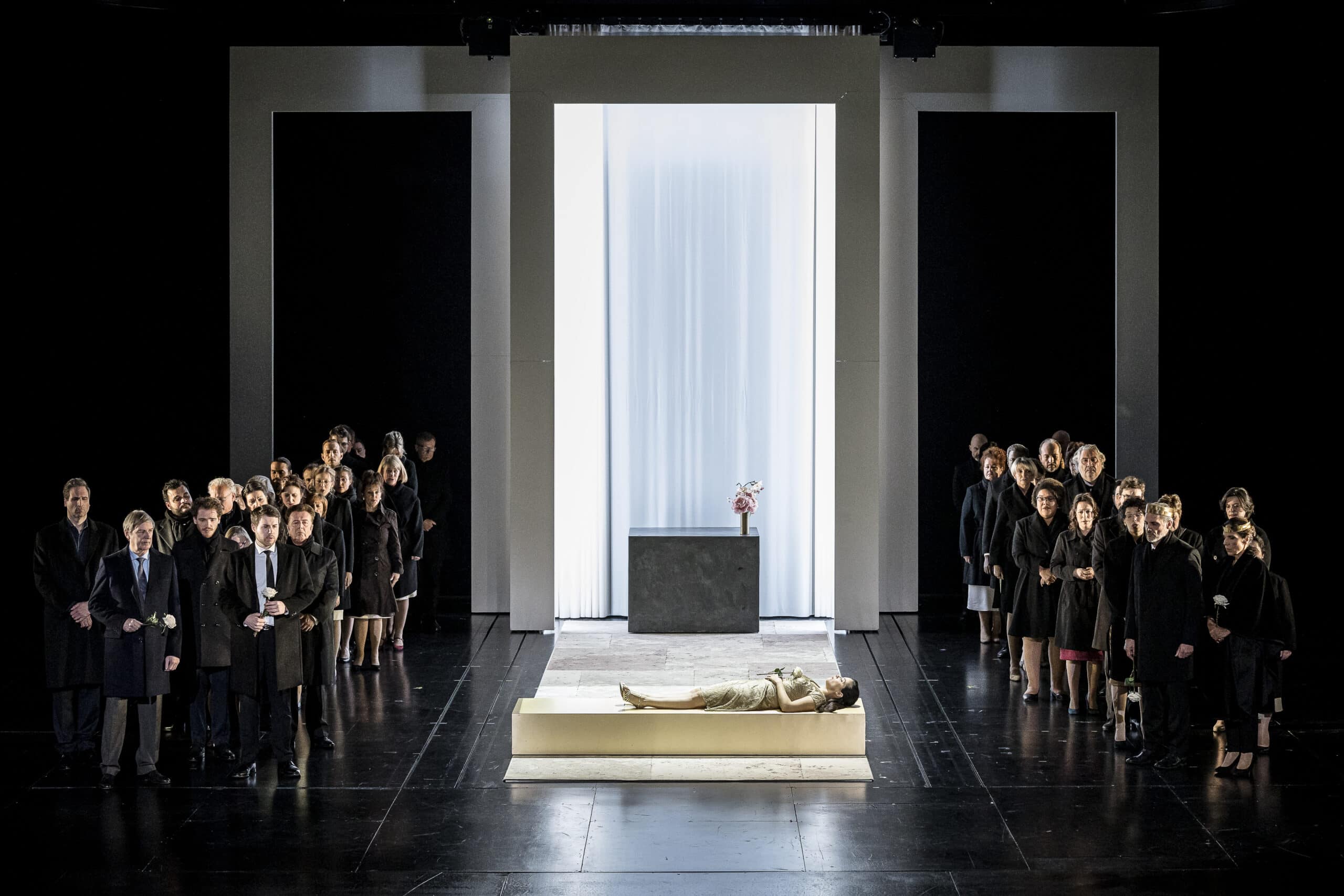
The set itself is remarkably austere and consists solely of a play with a few white frames that are moved or removed, and a carpet that is rolled or unrolled. As the only props, a bed (e.g., during the love aria between Hamlet and Ophelia) or a sort of altar with flowers ("maiden palm" according to the libretto) for the celebration of the wedding between Ophelia and Hamlet. Meaningfully, the exact same stage setup is repeated at Ophelia's burial, which immediately emphasizes the poignancy of the failed love between Hamlet and Ophelia. With the "set" we might also count that the direction repeatedly has characters enter from the audience. For instance, at his first appearance, the "Ghost" literally emerges from among the spectators, which of course makes an impression, especially with the beautifully resonant bass voice of Shadi Torbey. The appearances of the choir and a couple of times of the soloists Hamlet and Ophelia from the audience don't miss their effect in drawing the spectator closer to the action.
Musical tension
Thomas's music in this opera breathes nostalgia and fear from every pore. The will for revenge dominates Hamlet, and releases him only—and then barely—in a few love scenes with Ophelia. Lionel Lhote embodies his character in a remarkably skillful way, both vocally and as an actor. He is locked in his own world and literally embodies the feelings of revenge, longing, despair, disappointment, anger. He also flawlessly masters the difficult vocal part. The voice is smooth, powerful, colorful. The drinking song and especially his monologue at the beginning of the third act certainly rank him among the top Hamlet baritones! Jodie Devos is—as expected—his female counterpart. Ophelia appears as purity itself, playing with white and light colors even in her costume. Her soprano voice is silky soft but can easily handle the coloraturas of the bel canto-inspired mad scene. She sings even the highest notes as pure magic. Shadi Torbey's interpretation as the Ghost of the father is remarkable. The mother Gertrude is a torn woman, on the one hand guilt-ridden, on the other denying guilt. Béatrice Uria-Monzon plays the doubt that possesses her, but vocally the voice lacks brilliance and certainly luster. Nicolas Testé made a faltering start and was excused for illness at the intermission, but he sang through the performance. The smaller roles of Polonius and Laertes were also nicely cast.
The orchestra made a somewhat sloppy start—especially with the imprecise horns—but as the performance got going, conductor Guillaume Tourniaire brought the orchestra into the right dramatic atmosphere and provided the proper tension of the romantic score. While Ophelia's mad scene clearly recalls the influence of Italian bel canto, the orchestration is rather indebted to French Romanticism à la Berlioz. Of course, a novelty in the opera is the use of the—then newly invented—saxophone, and the saxophonist had the privilege of performing his passage on stage.
The performance certainly deserved the enthusiastic applause it received. It can be seen until March 7.
WHAT: Ambroise Thomas Ambroise Thomas
WHO: Cyril Teste [direction], Choir and Orchestra of the Royal Opera of Wallonia conducted by Guillaume Tourniaire
Singers: Lionel Lhote, Jodie Devos, Nicolas Testé, Béatrice Uria-Monzon, Shadi Torbey
WHEN: Sunday, February 26, 2023 (premiere)
WHERE: Royal Opera of Wallonia, Liège
- Title: Joseph Haydn: The Seasons
- Artist: Yoav Levanon
- Label: Warner, DDD, 2021
- Artist: CD