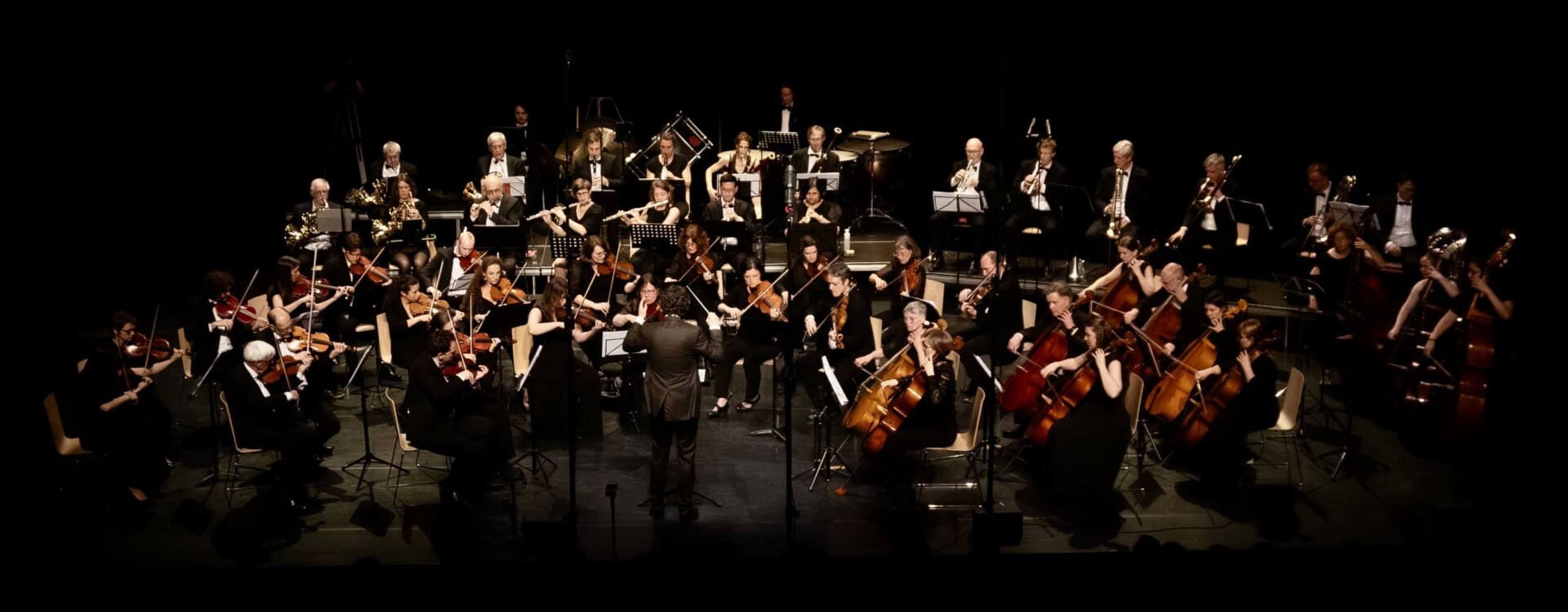
Klassiek Centraal recently had the opportunity to interview Chris Gossye, performing member and board member of the Sonores Symphony Orchestra Ghent. Sonores is Ghent's oldest symphonic amateur orchestra. Over time, they've evolved into a mixed professional-amateur ensemble (one in four is professional). They perform two concerts a year, each with sold-out venues. Additionally, they have been working closely with the Musica Mundi School for the past three years. On June 21, they will be the first symphonic orchestra to feature violinist Oliva Dora Devoghel on stage. Oliva graduated from the Yehudi Menuhin School and is currently studying with Donald Weilerstein in Boston.
Experiences and Origins
How did you come together as an ensemble and what brought you together in the first place?
Most orchestra members have been playing together in a symphonic orchestra since 2005, which was then called Akademos. After the dismissal of its conductor, Marc Sierens, in 2018, the orchestra was relaunched as 'Sonores Symphony Orchestra Ghent' under the direction of Joeri Van hove.
Which classical composer has inspired you the most in shaping your ensemble?The orchestra primarily performs repertoire from the 19th and 20th centuries.There's no turning point, but rather several important milestones such as our collaboration with the international Musica Mundi School. This allowed us to program concertos that fall outside the budget of the average amateur orchestra. Our partnership with the Academy for Performing Arts Ghent and conductor Joeri Van hove was also an important boost organizationally. Not only is the orchestra strengthened by talented students, but with J. Van hove we can count on one of the finest conducting teachers.
Our repertoire selection is done by a programming committee. We perform the classics (Beethoven, Dvorak, Schubert, Brahms, Tchaikovsky), but we also want to surprise our audience with Shostakovich, Korngold and Gershwin, contemporary music (Pichal), and lesser-known works (de Falla, Turina).
Polyhymnia Caduceatrix & Panegyrica
The repertoire is indeed evolving from 19th-century to 20th and 21st-century works, less familiar to audiences and often more challenging for the orchestra.
Career and Repertoire
How do you decide which repertoire to perform? Is there a specific reason why you choose certain pieces?
We certainly try to keep Beethoven in our repertoire, but focusing on his lesser-performed works. For example, next year we're programming Beethoven's Triple Concerto with soloists from the Musica Mundi School.
Are there specific composers or works that continually challenge or inspire you?
How do you approach the interpretation of classical pieces?
Collaboration and Dynamics
We make sure to keep Beethoven in our repertoire, but with less frequently performed works. For example, next year we're programming Beethoven's Triple Concerto with soloists from the Musica Mundi School.
How do you approach the interpretation of classical pieces? Do you have a shared vision, or do discussions take place?
The conductor's vision plays an important role here. He has a good sparring partner in our orchestra manager Sebastiaan Mindreau.
Besides Christine Lejeune and myself, the other members of the ensemble have mainly a performing role. We always have a listening ear and take into account as much as possible the feedback we receive from the group. In projects with a smaller number of musicians, the input of each musician is more important.
How would you describe the dynamics within the ensemble? How does this dynamic influence your music?The orchestra primarily performs repertoire from the 19th and 20th centuries.The dynamics are aimed at the most perfect possible performance, both technically and musically. Each instrumental section consults internally about how to make the best of it. Weekly rehearsals allow us to analyze each work in detail.
How do you ensure that everyone's voice is heard in the creative processes of the ensemble?
Both during rehearsals and during breaks, we discuss how to achieve better results. As a non-profit organization, we also organize general meetings.
We organize an annual rehearsal weekend at a venue—this year in Kemmel from May 9-11.
What do you do to strengthen the bond between you, both musically and personally?
There is indeed a de facto division of tasks in organizing concerts, such as the program booklet, venue, sponsorship acquisition, and publicity.
Do each of you have a specific role within the ensemble, aside from playing your instrument?
The unexpected and sudden departure of the previous conductor was a crisis moment. We then held a few internal meetings and decided to move forward on our own strength, find a new conductor, find a new name, establish a new non-profit organization, and seek new sponsors. All members also made financial contributions to keep the orchestra afloat. Of course, the COVID period also hurt us both financially and musically.
Challenges and Success Stories
It remains a constant financial challenge to stage projects of this scale, especially when we do it independently. Then we have to find creative solutions to make the financial picture work.
What was one of your most memorable performances, and why does it stand out in your memory?
Sonores Symfonieorkest Gent presented on June 10, 2023, with Kristina Georgieva (Bulgaria) and Liav Kerbel (Israel) the Concerto for Violin and Cello by Brahms (Op. 102). For both the orchestra and the soloists, this is an extreme challenge. The audience was thrilled. The performances of Rachmaninov's second and third piano concertos were also highlights that moved the audience.
We want to provide a platform for young Belgian virtuosos who want to gain experience with an orchestra. In June, for example, we are presenting Tchaikovsky's violin concerto performed by Dora Oliva Devoghel, an 'emerging' violin talent. She studies at the New England Conservatory Boston. We hope to do more of that.
What are your musical goals for the coming years?
The Polyhymnia comprises 40 works, totaling about 6 hours of music. We feel that this music is so beautiful yet so little known. That's why we want to explore the work further, and we also intend to release the Polyhymnia in its entirety on CD.
Are there any unrealized dreams or projects you would like to accomplish?
We would like to put together a program that appeals to young people as well.
Classical music has proven to be timeless. The way it is presented (the 'format') can certainly be adapted to the current 'attention span' of the audience. In a world where quality performances in image and sound have become 'streamable,' a concert performance must offer added value as an 'experience.' That's why we try to make each performance 'unique.'
We believe there will always be demand for performances by an ensemble that brings music without amplification.
What new directions or collaborations would you like to explore in the future?
We would like to perform a work with choir (the 9th, Verdi, ...), a sequel to our January program 'film music,' and a collaboration with a theater company.
How do you think your music touches the audience?
How do you think your music touches the audience? Do you often receive feedback from listeners, and how does it influence you?
Do you often receive feedback from listeners, and how does that influence you? We often get reactions on Facebook after the concerts... Usually they're positive.The orchestra primarily performs repertoire from the 19th and 20th centuries.What influence do you hope to have as an ensemble on the classical music world?
We recruit about 15 professional musicians per production. We want to improve the cross-pollination between the world of the 'professional' musician and the world of the 'amateur musician.' In a world where professional musicians are increasingly deployed on a project basis by professional orchestras, the sharp distinction between professional and amateur orchestras is disappearing. The opposite also happens: musicians who work permanently for professional orchestras also play with us. It's a win-win situation for all parties and it increases the accessibility of classical music to the broader public: venues of the 'cultural center' type (capacity approximately 400 people) can thus also offer symphonic works.
Playing in or with an orchestra is an exercise in listening. You also learn a lot from other musicians. It teaches you to succeed as a team. An orchestra is a transparent and authentic environment: you can't 'fake' anything.
For each production, we recruit around 15 professional musicians. We want to improve the cross-pollination between the world of the 'professional' musician and the world of the 'amateur musician'. In a world where professional musicians are increasingly hired on a project basis by professional orchestras, the sharp distinction between professional and amateur orchestras is disappearing. The reverse is also happening: musicians who are permanently employed by professional orchestras also play in our orchestra. It's a win-win situation for all parties and it increases the accessibility of classical music to the wider public: venues of the 'cultural center' type (capacity approximately 400 people) can also offer symphonic works in this way.
How has working in an ensemble shaped you personally and musically?
Playing in or with an orchestra is an exercise in listening. You also learn a lot from the other musicians. It teaches you to succeed as a team. An orchestra is a transparent and authentic environment: you can't 'fake' anything.
Musica Fura is an ensemble that works on a project basis. The lineup therefore depends on what the project requires. In its largest configuration, the ensemble consists of:
Playing in an orchestra is a collective effort that demands dedication from every member. We learn an enormous amount musically from the professional players who strengthen the orchestra, and from the conductor.
Looking back on your careers, what are the moments or achievements you're most proud of?
We're proud of the compliments we sometimes receive from professional musicians. They inspire us to keep getting better.
Sonores Elgar Cello Concerto highlights with Liav Kerbel:
© arco-music © Studio89 (Clos des Essarts 7 1410 Waterloo)
Orchestra lineup:
Conductor: Joeri Van hove
Violin 1:
Sebastiaan Mindreau (concertmaster)
Melanie Desegher
Chris Gossye
Martin Leube
Irmgard Van Driessche
Ni Luh Made Vikhanaswari
Leen Hauspie
Anthony Pil
Viola:
Christiaan Beyaert
Nancy Feys
Melanie Denolf
Noor Porrez
Eakarach Jansang
Kaatje Strauven
Violin 2:
Sara Talloen
Swantje Peirs
Muriel Musschoot
Nele Van Hoey
Pieterjan Schatteman
Mauro Agreda de Ro
Ruth Lambert
Lara Spruit
Irinja Schurmans
Monique Moorthamer
Edith Haesendonckx
Siewald Degraeve
Double Bass:
Eline Dewilde
Anke Bastiaensen
Hilde Jonckheere
Cello:
Lore Stevens
Barbara Vlieghe
An Baeten
Kobbe Peirs
Lies De Mol
Helena Andrea Bosch Berth
Lisa Goethals
Roland Lambert
Harp:
Olga Madrennes
Guitar:
Matthias De Smet
Flute:
Charlotte Van Bockstael
Lieve Wouters
Igor Derycke
Oboe:
Stijn Devolder
Jialiang Cai
Ellen Cardoen
Clarinet:
An Beazar
Martine Verberckmoes
Jan Porrez
Bassoon:
Renate Spelmans
Gert van Kerckhove
Febe Sioen
Horn:
Lies Witteman
Paul Pichal
Daniel Reunes
Marc Bulteel
Trumpet:
Thomas Dekeyser
René Dewaele
Alexander Ballegeer
Tuba:
Jeroen Verleden
Trombone:
René Van Herreweghe
Peter Blanckaert
Stefaan Dochy
Saxophone:
Louisa Declercq
Liesa Van de Voorde
Percussion:
Kris Mampaey
Sven Beerens
Donovan Eggermont
Piano:
Kristof Tessitore