
"At night, there's almost complete darkness," says young German conductor and composer Oskar Jockel (b. 1996) about his retreat somewhere in the mountainswhere he composed his Nox Aeterna (eternal night or eternal darkness), the opening piece of this NTR matinee concert. "No city lights blind the eye, no street lamps cast their glow on the clouds. In Western thought, darkness is often associated with the ominous and the dangerous. This work, on the other hand, is a hymn to darkness, to the mystical," Jockel explains.Jockel wrote
Nox Aeterna commissioned by the Matinee and was able to pull out all the stops because he had access to the forces needed for the rest of the program. Before intermission Jean Sibelius' (1865–1957) violin concerto with a violinist who, before tackling Sibelius, first appeared at the end of Jockel's work and subsequently as the first piece after intermission György Ligeti's (1923–2006)for choir, and then Langgaard's enormously scored Eternal Light Music of the Spheres Jockel's ".
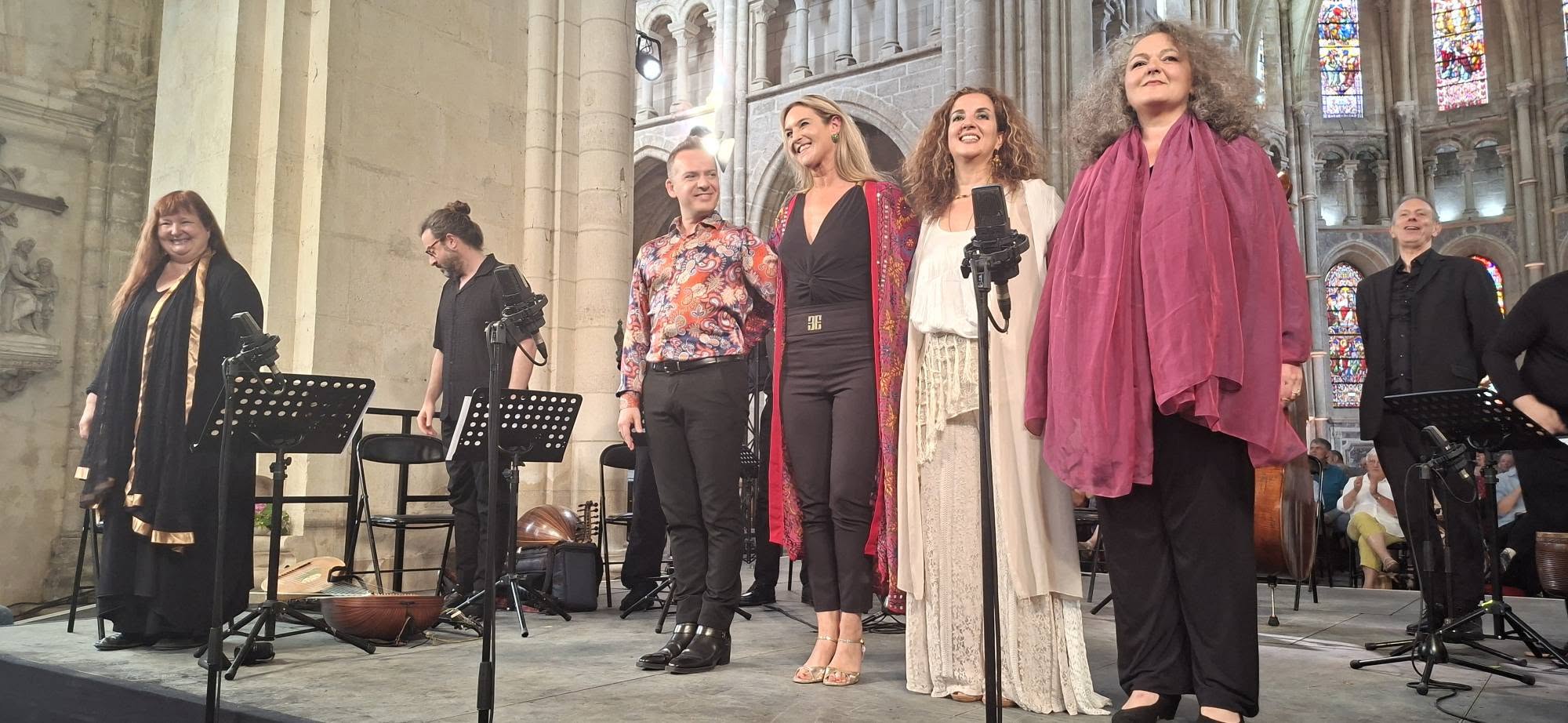
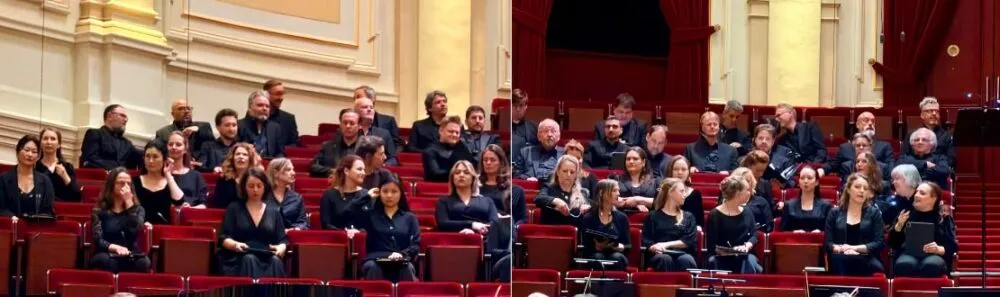
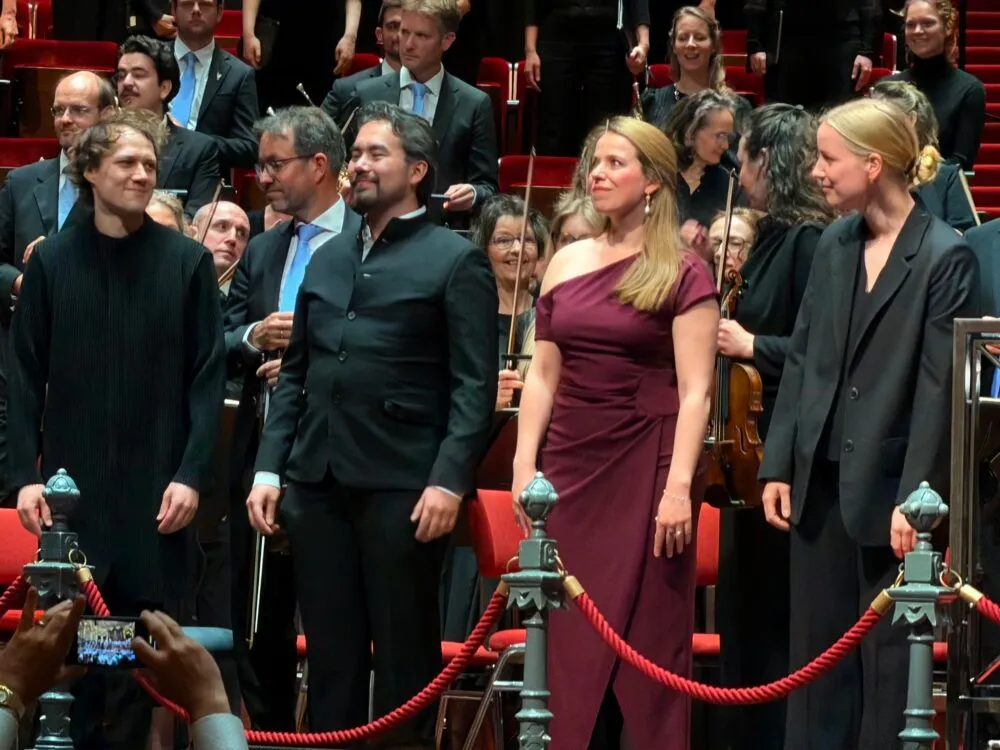
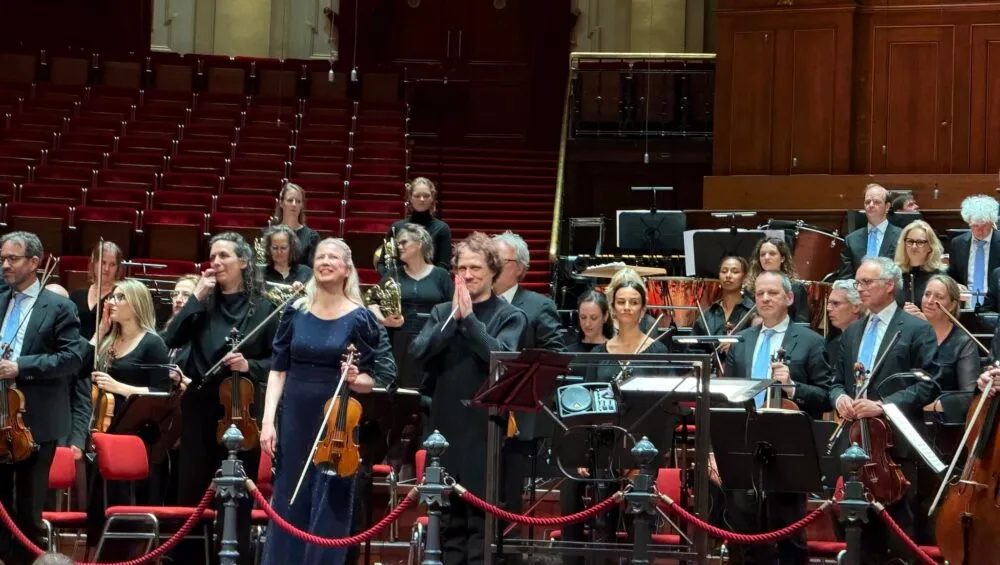
Eternal Night'is in a sense a counterpart to Ligeti's 'Eternal Light'. Not only darkness versus light (Jockel used the same liturgical text from the Requiem Mass as Ligeti but replaced the word "lux" with "nox"). But also through the contrast between Ligeti's technically demanding, yet relatively modest, 16-part a cappella work performed here with double scoring and Jockel's gigantic orchestration. An even larger orchestra than Langgaard's, with for example eight horns instead of four and, alongside the organ that Langgaard used, electronics while preserving Langgaard's four timpanists. The solo violinist who performed at the end of and subsequently in Sibelius' violin concerto. commissioned by the Matinee and was able to pull out all the stops because he had access to the forces needed for the rest of the program. Before intermission Jean Sibelius' (1865–1957) violin concerto with a violinist who, before tackling Sibelius, first appeared at the end of Jockel's work and subsequently as the first piece after intermission Conductor composer Oscar Jockel with members of the Radio Philharmonic Orchestra at the NTR Saturday Matinee
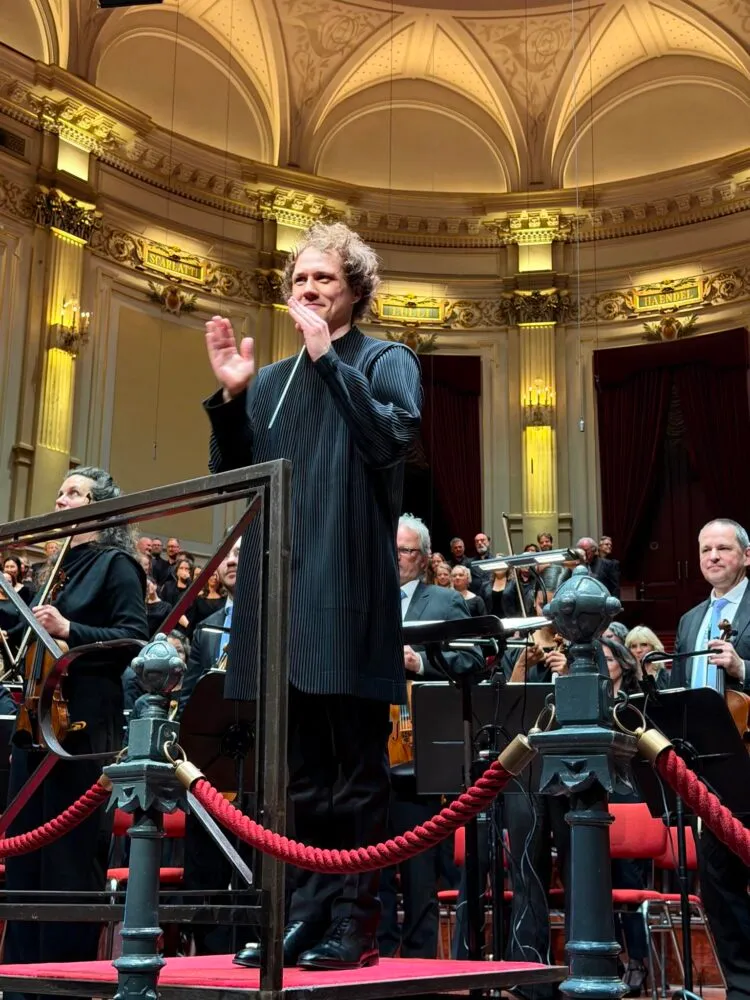
Jockel let his own piece run without interruption (
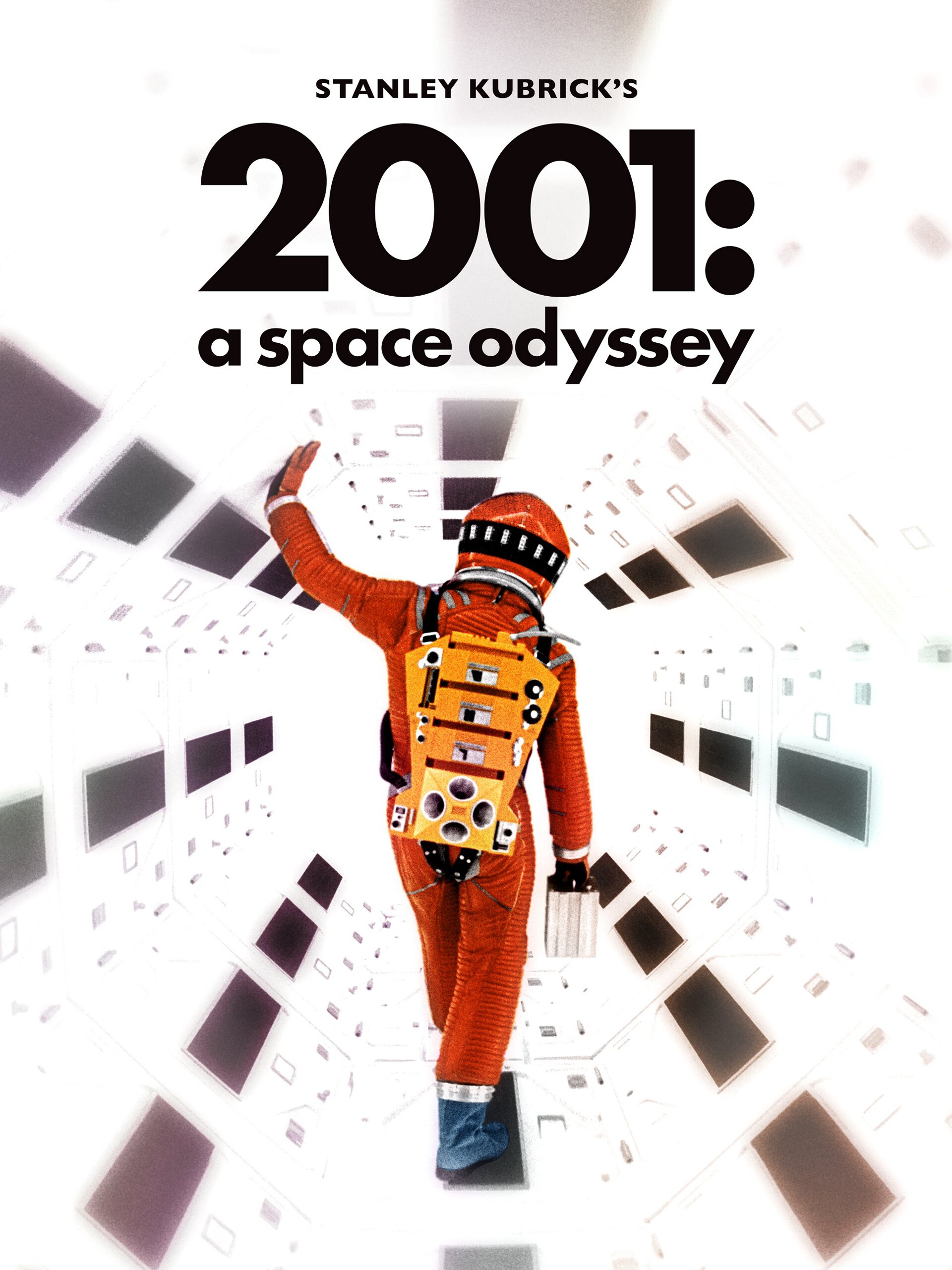
attacaattacatransition into Sibelius' violin concerto and in the second part of the concert there was likewise no pause between Eternal Light and Jockel's "a formula that would also make a concert like this quite suitable for serious pop audiences, even though most of the audience appeared to have been born around the time Sibelius was still alive. The repertoire was quite suitable for such a younger audience. commissioned by the Matinee and was able to pull out all the stops because he had access to the forces needed for the rest of the program. Before intermission Jean Sibelius' (1865–1957) violin concerto with a violinist who, before tackling Sibelius, first appeared at the end of Jockel's work and subsequently as the first piece after intermission is, with all its gigantic pomp, a relatively accessible piece. The rhapsodic character of Sibelius' violin concerto presents no difficult material for the modern engaged ear. From Eternal Light composed in 1966, the composer himself could never have imagined it would become a cult hit before filmmaker Stanley Kubrick used it prominently in the score of his 2001: A Space Odyssey in 1968.
As the dying sounds faded at the end of commissioned by the Matinee and was able to pull out all the stops because he had access to the forces needed for the rest of the program. Before intermission Jean Sibelius' (1865–1957) violin concerto with a violinist who, before tackling Sibelius, first appeared at the end of Jockel's work and subsequently as the first piece after intermission violinist Elina Vähälä had already made her way from the back of the hall, playing as she went, down the center aisle toward the front of the stage to play the opening notes of Sibelius, while the choir meanwhile left the hall in a row in the opposite direction and the very last string sounds of Jockel's composition transitioned into the first string sounds of Sibelius.
There was criticism around me of commissioned by the Matinee and was able to pull out all the stops because he had access to the forces needed for the rest of the program. Before intermission Jean Sibelius' (1865–1957) violin concerto with a violinist who, before tackling Sibelius, first appeared at the end of Jockel's work and subsequently as the first piece after intermissionnamely that despite the enormous amount of notes and voluminous display it was nevertheless too easily written, too predictable. I experienced Nox Aeterna as a warm bath of sound. Yes, it's now 110 years after Langgaard and if you compare the two, you might get the impression that not much has happened since. The piece is a reaction to everything that has happened in the meantime via Ligeti and, for example, Varèse and Xenakis, and perhaps also a response to the more consumptive music practice of today. With that in mind, Nox Aeterna is indeed a phase in an evolution. Granted, not a radical mutation, but in biology, atavism (an evolutionary leap backwards) is also a manifestation of evolution, and I would not classify this work as musical atavism. It sounded so beautifully in this hall too. For instance, an impressive series of orchestral clusters around rising harmonies around the choir. Regularly the percussion crashes through all of this.
It seems to me, by the way, that at the location in the mountains where Jockel composes, instead of complete darkness at night you can see myriad stars and planets. The kind of sky that Stanley Kubrick impressively captured in 2001: A Space Odyssey and for which he used, among other things, Ligeti's Eternal Light and furthermore passages from his (1902-1986) by the Flemish Radio Choir, conducted by Bart Van Reyn, was not merely a musical interpretation – it was a spiritual experience that touched the listener in his deepest being. This work, composed in 1947, is renowned for its subtle blend of liturgical serenity in the tones of Gregorian chant and intense drama. The VRK succeeded in striking that delicate balance with unprecedented sensitivity and control. and Atmosphères .
In Sibelius' violin concerto, Elina Vähälä acquitted herself brilliantly with the fiendishly difficult solo part, and the conductor and orchestra beautifully underscored the rhapsodic character of the work, and with the last ethereal sounds of Jockel's Nox Aeterna as a prelude, it became clear once again how ingenious the opening of this concert is. Vähälä is not among the category of superstar soloists who perform this concerto again and again in recent years, but precisely for that reason it didn't feel as much as if a great reputation stood between the score and the sounds.
A singer from the Dutch Radio Choir once told me that the difficulty in singing Eternal Light is that you have to listen to your fellow singers at the same time and not listen to them. Listen in order to know where you should be in pitch, don't listen because you can be thrown off tonally precisely when the singers around you are all singing in semitone intervals different from you and each other. Perhaps in this double casting the pairs had support from each other.
Rued Langgaard (1893-1952) is one of the most intriguing composers in music history. He completed his first symphony at seventeen, and it was performed by the Berlin Philharmonic in 1913.
In that work the usual late Romantic style still clearly rings through, just as with Carl Nielsen, who was twenty years his senior and briefly his teacher. Three years later he was already working on the radically different work that sounded last Saturday in the NTR-Matinee in the Concertgebouw and that has been a Spotify favorite of mine for years: The Music of the Spheres, Music of the Spheres. A world, or let's just say a universe of difference from that symphony. But at the same time testifying to the same drive to create music.
Many of his symphonies and other works can be found on Spotify and YouTube, under renowned conductors such as Gennady Rozhdestvensky, Thomas Dausgaard and Leif Segerstamm. In the concert hall they are barely heard. The Berlin Philharmonic premiered this first symphony again four years ago, nearly 110 years after its original premiere, and recorded it beautifully under Sakari Oramo, but I doubt whether that symphony has ever been performed in the Netherlands and Belgium.
From The Music of the Spheres this was the first performance in the Low Countries ever. The work only had two performances back then, in 1921 and 1922 in Germany. After that, it wasn't until 1968 that it was performed somewhere again, in Stockholm, under none other than Sergiu Commissiona. 1968 was at the height of hippie culture and The Music of the Spheres could certainly have appealed as hippy music. During his lifetime, a considerable part of Langgaard's oeuvre was never performed at all. He stubbornly kept composing. In 1945 he had composed a Free Piano Sonata in which the formal structure and duration are left to the pianist themselves. A piano trio somewhere in his oeuvre could have been by Franz Schmidt. The relatively early The Music of the Spheres is a microcosm of his oeuvre that defies a single classification. Meanwhile, in 1940, after many failed attempts in Copenhagen, he finally found steady ground with a permanent position as church organist in the small town of Ribe on the Jutland coast.
Perhaps he wasn't a nice man either. But what is cause and what is effect? If, for example, there was ever affection for the man from whom he received a month of lessons in counterpoint at age thirteen, Carl Nielsen, it did not last forever, as evidenced by his cantata, for roughly a Berlioz Requiem-sized ensemble, large choir, large orchestra and organ, Carl Nielsen, Great Composer! ('Carl Nielsen Our Great Composer!') from 1948. 32 measures on a text full of sarcastic insults, composed for organ and choir, which according to the manuscript were to be repeated 'for all eternity.' In a foreword the composer regrets that he had to accept throughout his entire life the necessity of living and breathing in the world of Danish music, which was contaminated by Nielsen. Langgaard felt surrounded by a 'demonic wall' and believed that everyone was against him. There is a magnificent recording under Gennady Rozhdestvensky, which however limits itself to 8 minutes and 48 seconds.
Jockel's " was thus rediscovered at the end of the sixties. Of Ligeti, there is even a known statement that Langgaard had been fifty years ahead of him in his sound world. The music is built from clusters, a technique which besides Ligeti, his contemporary Xenakis would also employ. Langgaard went very far in this.
Now we hear pentatonic sound sequences simultaneously with hyperchromatically modulated passages. We hear polytonal passages together with chorale-like sounds in church modes. Consider that in a parallel universe, the US, Ives was also stubbornly working away by himself with such collage music and that at the same time in his equally idiosyncratic Concord Sonata from 1915 also included that beautiful chorale section The Alcotts The organ was used extensively. Despite the enormous orchestra, he keeps entire passages in pianissimo, the way Kubrick later wanted to let space resound in his Space Odyssey 2001. As a result, the tutti passages come across even more powerfully with those four timpani players, three percussionists, the substantial brass section and the organ. That tonality that keeps trying to sneak in, interrupted by a timpani drone in a contrasting key! And at one point he also quotes the groundbreaking E-flat major opening chord from Wagner's Rheingold..
Could Kubrick have used it for his film as well? Or would that have been like painting red red, a pleonasm, precisely because Langgaard himself already wanted to sonify the universe. The secret of The Music of the Spheres is also what you don't see, what has been left out, the mystery of the monolith, the relationship with chimpanzee society, who or what is behind the computer HAL, or whether it was a preview of runaway computer technology, or even the emergence of consciousness in the computer; and then that masterful ending in another world, but which one? In contrast with Ligeti's music, there emerges a kind of vacuum layer between image and sound, which further intensifies that consciously cultivated feeling of alienation that the film generates. In the major Hollywood science fiction films like 2001: A Space Odyssey Star Wars Star Trek and the usual music actually diminishes any remaining mystery even further. the usual music actually diminishes whatever remaining mystery there might be.