Last week, the Munt brought their Wagnerian tetralogy to a close with Twilight of the Gods (1876). In this final installment, Richard Wagner quietly leaves the supernatural Valhalla pantheon behind for earthly reality. Directed by Pierre Audi and conducted by Alain Altinoglu, the opera house completes an absolute tour-de-force. With this, the Munt concludes their Ring cycle—more than forty years after their last Ring productions—with a distinctly contemporary human touch.
A heraldic swan song
Twilight of the Gods is derived from the famous Ragnaröktale. In it, the world of gods battles until their end, and a new human dawn emerges. The result—palpable in the heroic Brünnhilde (soprano Ingela Brimberg)—is a new, purer world that rises from the ashes.
The opera is a heraldic swan song: of human heroism and enchantments, of altruism that conquers greed. The Ring, the cursed driving force, returns to its homeland: the Rhine. There are no black-and-white characters in this production, and that gives it its contemporary edge. In a world where we—hopefully—realize that each individual is a unique combination of their own qualities—and can therefore make both good and bad choices—the concept of magical entities stands out.
The concept of Siegfried (tenor Bryan Register) who, under a spell, forgets his beloved—the former Valkyrie—Brünnhilde might come across as archaic in the wrong hands. The same goes for her story. She realizes her hero is enchanted, yet she still feels betrayed and deceived, and swears magical blood oaths. Audi's direction gives us rather a sense of magical realism. The characters are believably human, but the world around them has a magical edge. We remain grounded in a connection with characters whose emotions we dare to believe in. The enchanted Siegfried seems almost obsessively in love with Gutrune (soprano Anett Fritsch). She seems—despite her role in the spell—tormented by his tragic death. Hagen, masterfully and intimidatingly played by bass Ain Anger, has, despite his hatred and murderous intent, a tragically human side. The point is that we might recognize something of ourselves in it. After all, they are, more or less, people.
Of gods, men and monsters
With this phrase, the tetralogy can be summed up. It's an epic tale of dragons, heroes, gods, and men. Twilight of the Gods does obscure this somewhat. We still get hints of the idea of Valhalla, of dragons and Wälsungen, Valkyries and magical rings—combined with human, earthly voices. You almost forget that Brünnhilde was a powerful, warrior Valkyrie. Almost, because the masterfully executed Valkyrie motif that returns, time and again, reminds you that she is certainly far more than a pawn for the men.
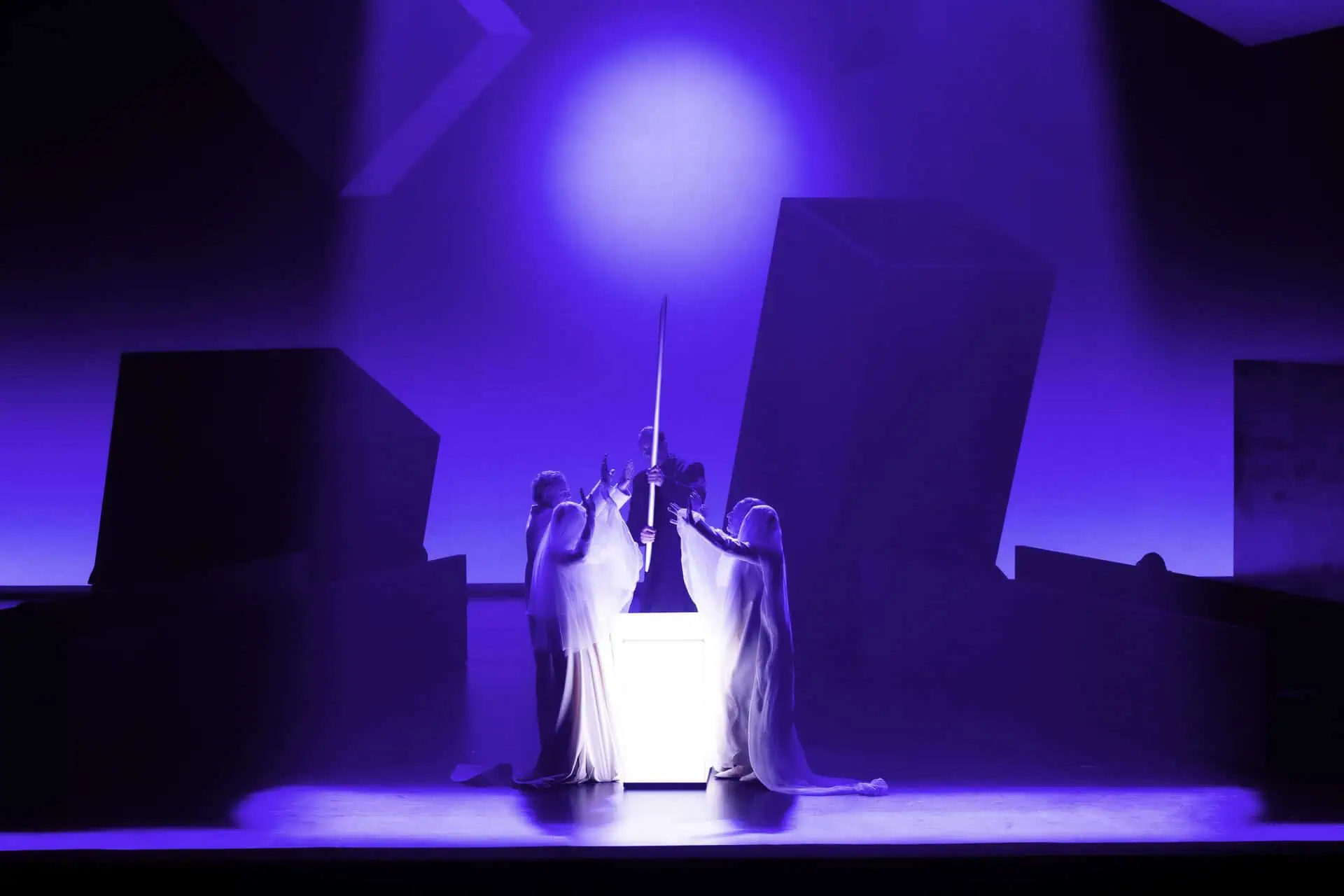
Pierre Audi's scenography plays with movement and light. The story has no need for many details, but it does need action. This helps to clearly place the fateful object, the cursed Ring, at the center. The use of rising and falling stage elements suddenly blur magical and realistic ideas and perspectives. The light, in the form of light rays and reflections, sublimely plays with this concept. The Norns (soprano Katie Lowe and mezzo-sopranos Marvic Monreal and Iris Van Wijnen) appeared as ominous water reflections in a twilit staging. Drama and movement took center stage notably. All without kitsch.
Vocally, the entire ensemble was a top selection. Bryan Register surprised with his vocal performance during his closing narrative about the Wood Bird. This bird had helped him achieve victory over the dragon Fafner. The singing of the motif, in the opera {{NOTRANSLATE_Siegfried}}, brought by a soprano, made his clear heroic tenor voice shine all the brighter. Brimberg delivers a magnificent Brünnhilde with an overwhelming powerful voice. All emotions can be felt like a hurricane when she sings. The other cast members certainly don't fall short of these two stalwarts. Anger as Hagen was the standout of the evening. This is what you call a menacing, darkly resonant bass as an antagonist. You feel yourself, in the audience, instantly shrink when he sings – almost frightening. It's beautiful how humanity reaches its vocal culmination. No one is a caricature, and you can hear it. The Munt brought an original sonic world to a late-nineteenth-century Wagner opera. This was both audible and palpable. With this, a new standard has been set for future productions. In 2025, less epic grandeur and more humanity are what impresses: a new dawn for Wagner! Moreover, I wish to apologize to our readers for an unfortunate typo in the introduction of this text. This has since been corrected. Thank you for your understanding. – Jessy Baeken (12/02/2025)
Meow Gallery:
—
The gallery is empty.
Alain Altinoglu (conductor), Pierre Audi (director), Klaus Bertisch (dramaturg), Bryan Register, Andrew Foster-Williams, Scott Hendricks, Ain Anger, Ingela Brimberg, Anett Fritsch, Nora Gubisch, Marvic Monreal, Iris Van Wijnen, Katie Lowe, Tamara Banješević, Jelena Kordić, Christel Loetzsch, Symphony Orchestra and Choir of the Munt. The Munt/La Monnaie, Brussels.