In April, OpusKlassiek discussedherethe double CD featuring the complete organ works of César Franck performed by Flemish organist and music educator Ignace Michiels (Bruges, 1963), a true gem of both compositional organ artistry and organ performance. I wrote at the time that any organ enthusiast would have expected nothing less, as Michiels has built a broad and versatile repertoire over the years and enjoys worldwide recognition as a result. His education is equally impressive: he studied at the Lemmens Institute in Leuven and at the conservatories in Brussels, Ghent, and Paris (where he won thePrix d'Excellenceaward).
Now then, this CD dedicated entirely to Flemish organ music represents an ambitious undertaking whose roots stretch back to the sixteenth century, when the organ was an important vehicle for the prevailing culture as it was disseminated from monasteries, churches, and cathedrals. Only in the (early) Baroque period did organ repertoire gradually emerge, shaped by fantasias, preludes, toccatas, and fugues, largely inspired by what the North German masters demonstrated in this field. Not until the nineteenth century did a stylistic shift occur toward a more (early) Romantic, and later symphonic character; whereas in the second half of the last century, the emphasis increasingly turned toward historically informed performance practice, alongside contemporary compositions of course.
A key stimulus in this regard was undoubtedly the high-quality Flemish organ building, with names such as Pieter d'Oude Van Peteghem (1708-1787) and Pieter Albertus Loncke (1821-1897), who delivered outstanding instruments that excelled in brilliant tone and extensive registers. Instruments that proved their worth in both Baroque and later Romantic, and even contemporary repertoire.
Spurred on by historically informed performance practice, from the late 1960s onward, organ restoration became increasingly important and attractive, leading to the emergence of specialized firms, such as that of Patrick Collon. Workshops that also handled maintenance and found steady work among the many historic organs throughout Flanders, notably including Antwerp.
Organ-related magazines also came into their own, such as the quarterly Flemish journalOrgelkunst(often with an accompanying CD), which focuses on Flemish organ culture from past, present, and future. In its carefully selected themed issues, enthusiasts find extensive information about historic organs and their builders, along with an 'organ calendar' listing concerts in churches and similar venues throughout Flanders.
In the Netherlands, one of the most important publications in this field is the more professionally oriented The Organwhich also appears four times a year and is published by the KVOK, the Royal Association of Organists and Church Musicians.
Also interesting is the Dutch online journalThe Organ Friendwhich appears ten times a year and likewise devotes much attention to organ culture in its broadest sense, with many in-depth articles, reviews (books, CDs, DVDs, etc.) and a concert agenda.
Not only the preservation of Flemish musical heritage is of great importance, but also bringing it to attention and keeping it there, thereby extending beyond merely maintaining a museum or, if you will, 'fossil' function. In this context, I recall the phenomenal CD seriesFlanders' Fields,an extremely valuable initiative by the Flemish music label Phaedra, founded by Luc Famaey, with now over a hundred titles, several of which we have reviewed on our site. Unfortunately, Famaey stopped in early 2019 and the label was taken over by Dutch Music Works (DMW), which – as far as I could tell – was not a successful transition (there is still no catalog of the Phaedra range on the DMW website).
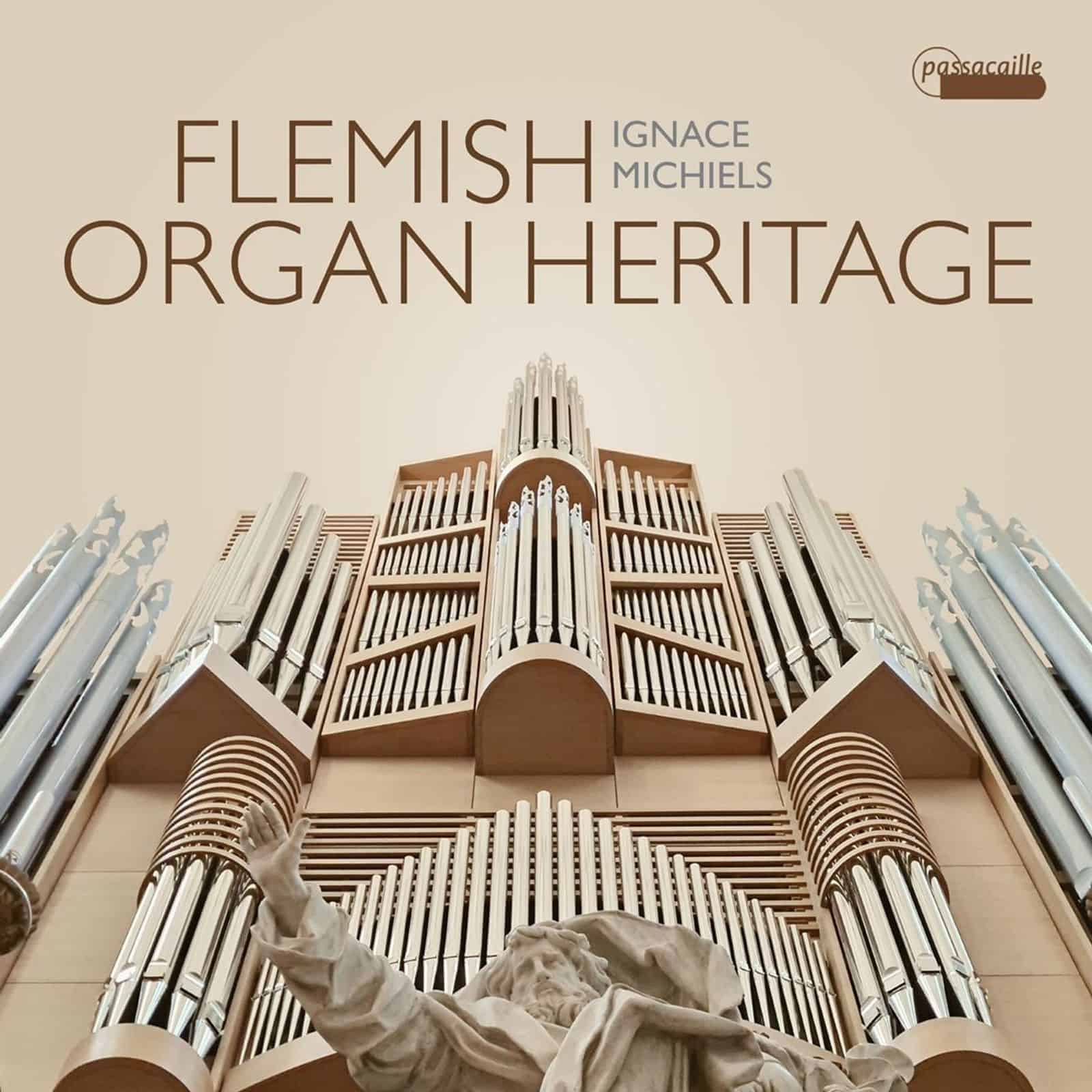
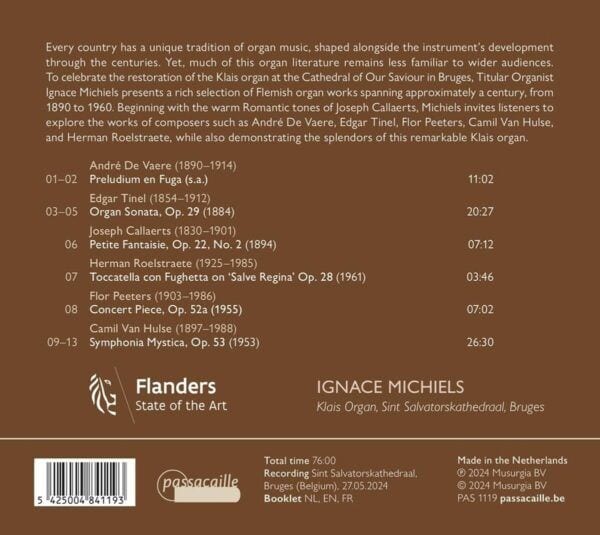
But back to Ignace Michiels, who with the Flemish music label Passacaille will undoubtedly fare much better and for this Flemish organ program has once again 'engaged' the colossal Klais organ in the Sint-Salvators Cathedral in Bruges to place these six organ works in a musically brilliant light. Organ works by six Flemish composers who enjoy little or no recognition in the Netherlands, yet their music deserves it in my opinion. To support this introduction, below is a summary of the explanations provided by the organist in the CD booklet.
The compiled program is also based on interesting cross-connections, starting with the pianist and composerAndré Devaere(1890-1914), who in November 1914 – the First World War was only a few months old – was conscripted into the Belgian army and sent to the combat lines around the River Yser. However, just ten days later, he was hit in the lungs by a German projectile near Sint-Joris. Severely wounded, he was transferred to the Anglo-Belgian Military Hospital No. 2 based in Calais, then commonly referred to as 'Pensionnat Sophie Berthelot', where Devaere died on November 14, 1914. He was buried in the Cimetière du Nord military cemetery in Calais.
Shortly before his seventeenth birthday, Devaere was awarded the first prize for his piano playing at the Brussels Conservatory, where he studied with Arthur De Greef. Was he a child prodigy? It certainly appears so, as at eleven years old he was already working as an organist at Sint-Amand College in Kortrijk. It clearly ran in the family, as his father Oktaaf Devaere also won first prize at the same Conservatory, for organ playing (he later became organist at Sint-Maarten Church in Kortrijk).
André Devaere left behind – his age says it all really – only a small body of work, including two organ works that are presented together on this album for the first time. The prelude and fugue were submitted for the famousPrix de Rome. Devaere wrote it during his composition studies with Edgar Tinel, then director of the Brussels Conservatory. Tinel's corrections are visible on Devaere's manuscript. It was first found after Tinel's death in his room in Brussels. The performance of the work is based on a handwritten copy by the composer and musicologist Herman Roelstraete, who kept Devaere's manuscripts. They eventually ended up in the archive of the Royal Library of Belgium.
Edgar Tinel(1854-1912) began his career as a piano and organ virtuoso, but gave this up fairly quickly to devote himself to composition. Today, however, his music is virtually forgotten. He studied piano at the Brussels Conservatory with Jean-Baptiste Michelot and organ with Alphonse Mally.
Around 1885, the Organ Sonata in G, op. 29 was created. It would remain his only major organ work. Tinel's shining examples were Brahms, Schumann and Mendelssohn. He called them, along with Bach, 'apostles of the Ideal'. He had little time for Wagner's operas: while he acknowledged his genius, marked by a strict Catholic upbringing, he found them 'immoral' (which did not prevent him from conducting certain fragments from them!).
Joseph Callaerts(1830-1901), a student of Jacques-Nicolas Lemmens at the Brussels Conservatory, had been an organist with the Jesuits in Antwerp since 1850 before succeeding Karel Delin as principal organist of Antwerp Cathedral in May 1855. He didn't even have his organ diploma yet! He must have been an excellent organist, but besides that – in this sense also following in Bach's footsteps – a much sought-after expert in organ building. As an educator, he also made a name for himself. From 1867, Callaerts taught organ and practical harmony at the Antwerp School of Music (the later Royal Flemish Music Conservatory).
Besides his busy career, Callaerts composed a large number of religious works, including cantatas, choral works and songs. He also wrote for orchestra and small ensembles, composed an opera and around sixty organ pieces.
Of that large body of work, only theToccata(in e-small) played fairly regularly, a showpiece in the hands of prominent organists, which meant that in serious organ circles from the 1950s onward he was taken less seriously as a composer. The one documented by Michiels Petite Fantaisie 'strikes—I quote Michiels again—through the elegant lyricism of a melody [at the beginning and end], as well as through the beautiful Romantic harmonies in the middle section'.
The name of Herman Roelstraete ((1925-1985) has already been mentioned. He received his basic training in piano, organ, church music, and music theory at the organist school in Torhout. In the midst of all the turmoil of war, in 1942 he went to the Lemmens Institute in Mechelen, where he earned his diploma in 1946. His organ teacher was Flor Peeters, while Marinus de Jong taught him counterpoint. Roelstraete's studies also took him to the conservatories in Brussels and Ghent. His formative years were completed with private lessons in orchestral conducting with René Defossez, composition with Marcel Poot, and twelve-tone composition with Matthyas Seiber. Roelstraete was especially active as an organist, conductor, composer, researcher, and music teacher, first in Izegem and later throughout Flanders and also in Brussels. For organ he composed a large number of works, including the one recorded on this CD, dating from 1954, based on the solemn Salve Regina Toccatella and Fughetta (op. 28).
Flor Peeters (1903-1986)—his name was also mentioned earlier—composed his greatest work as an organ concerto. It was created during the dark final weeks of 1944, at the time of the bloody Battle of the Bulge. The piece premiered in 1945 on Belgian radio.
Exactly a decade later, Peeters published for solo organ a shortened arrangement of the finale of this organ concerto under the title Concert Piece (op. 52a). It begins with the spectacular solo cadenza from the organ concerto, ending with some brilliant closing pages, with the quiet middle section—in which some of the most lyrical elements from the orchestral version are incorporated—serving as a welcome contrast.
Peeters described some of his works as frescoes with a Flemish character: energetic rhythm, decorative form, powerful substance, and colorful registration.
Peeters grew up in a musical environment, as the youngest in a family of eleven children. At age sixteen he began his musical studies at the Lemmens Institute, where he was taught by Lodewijk Mortelmans, Jules van Nuffel, and Oscar Depuydt. After receiving his diploma in 1921, he became assistant organist at Sint-Rombouts Cathedral in Mechelen that same year. Two years later he was appointed organ teacher at the Lemmens Institute itself and received the position of titular organist at Sint-Rombouts. Furthermore, he also taught organ in Ghent, Tilburg, and at the Antwerp Conservatory (where he was director from 1952 to 1968).
Finally, rounding out this kaleidoscope Camil Van Hulse (1897-1988), according to Michiels an obscure but nonetheless interesting organist, pianist, and composer. He came from Sint-Niklaas and died far from home, in Tucson, Texas. Van Hulse received his first lessons from his father Gustaaf (composer, organist of the local Sint-Niklaas Church and himself a student of Edgar Tinel!), then from Edward Verheyden, Lodewijk Mortelmans, Frans and Constant Lenaert at the Antwerp Conservatory, and finally from Arthur de Greef at the Brussels Conservatory. In 1919 he succeeded his father as organist of Sint-Niklaas Church.
After completing his studies, he emigrated in 1923 to Tucson for health reasons, where he became organist of the local All Saints Church in 1924 and also took the initiative to found a symphony orchestra. He later gained recognition as a concert organist and composed a large body of work (some 130 of his compositions have survived), including several organ pieces.
In his Symphonia Mystica we find—as Michiels writes—on the one hand influences from the twentieth-century Belgian organ school, with Joseph Jongen as its principal representative.
Van Hulse's compositional style is predominantly late Romantic mixed with new influences such as Expressionism. On the other hand, his style also shows American influences from film music and jazz.
The recording made in May 2024 in Sint-Salvator's Cathedral in Bruges by Marien Stouten showcases the many fascinating coloration aspects of the impressive Klais organ. This is also evident from the impressive contrast between the 'normal' 8-foot and the one octave lower 16-foot and the two octaves lower 32-foot. Certainly, speakers that can really produce such low and undistorted organ sounds provide—if audible but otherwise at least felt!—not only a very impressive foundation, but also an extra warmth in the frequencies above it. Moreover, this brings the space in which the recording was made optimally to life; as is certainly the case with this very successful recording.
Of course, most attention goes to the sublime organ playing of Ignace Michiels and the impeccably tasteful registration choices that accompany it.
In his afterword, Michiels thanks Johan Huys (Ghent, 1942), who has built a great reputation in Flanders as a keyboard player, pedagogue, and advisor:
I want to thank Johan Huys for his tireless dedication and passion for bringing forgotten and remarkable music back to life.
His commitment and support contribute to the rediscovery of invaluable musical treasures, for which I am deeply grateful.
I can only add: take advantage of it and savor this striking music to the fullest!