
Competition or Festival?
The Elisabeth Competition is already behind us. After the final evening and announcement on June 1st, the laureates continued to perform throughout the entire month of June across the country, with orchestra or in recitals with piano. On June 12th, the three first prize winners performed one last time at the "closing concert" of this violin session, in the presence of Queen Mathilde.
The competition has always been a major festival, this year a violin festival. Everyone knows that the judging doesn't happen like in a sports competition. That makes it all the more thrilling. Nobody knows who will ultimately be victorious. Names of favorites circulate, night after night there's a ranking by listeners and viewers on Klara and VRT Canvas, but often the winner is a surprise because the jury doesn't deliberate. This is good for objectivity, but it means that strong personalities, who can provoke both admiration and disapproval, often don't get the recognition they deserve.
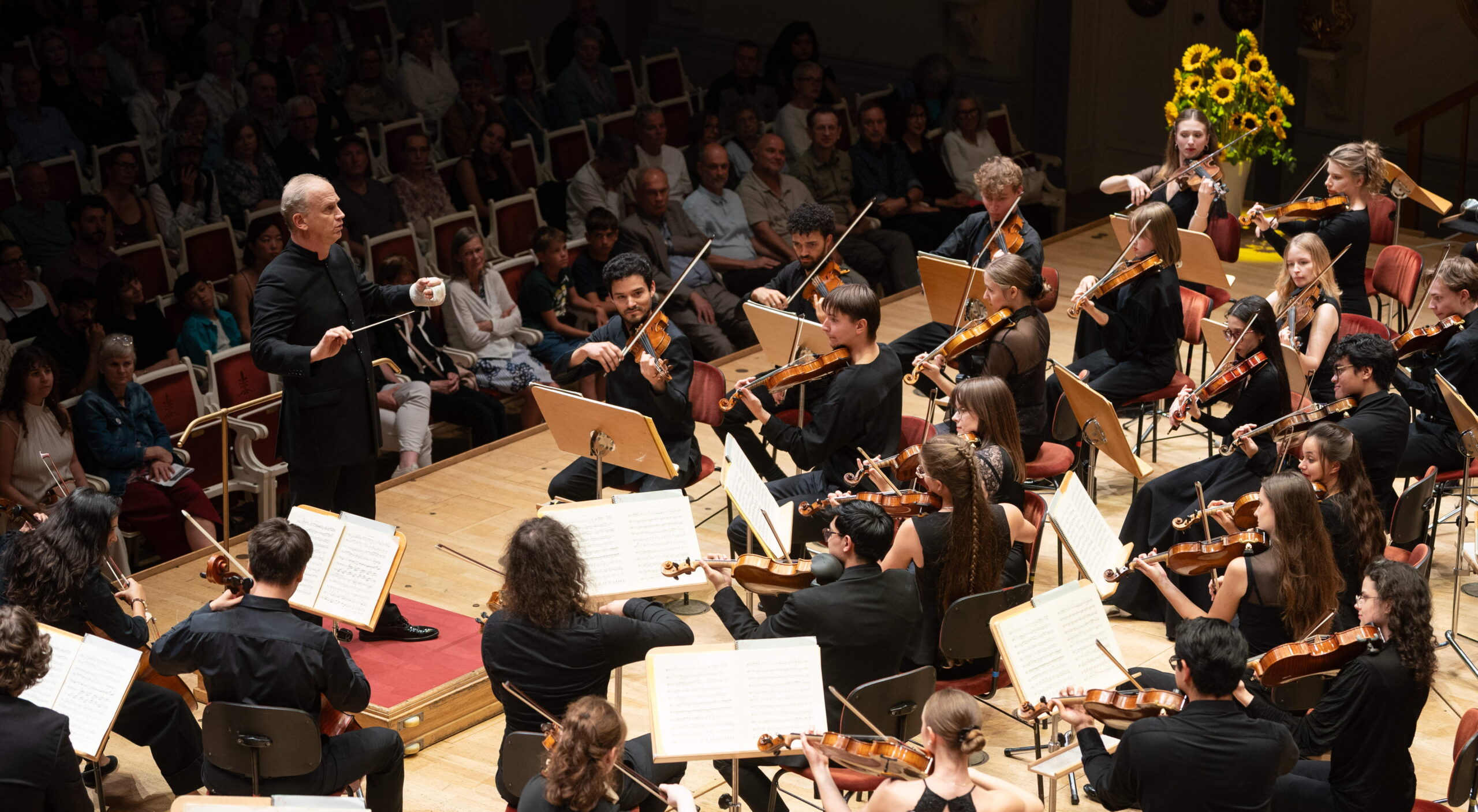
Both in the semi-finals and in the finals, the audience in the hall, via radio or internet, can hear very different performers often playing the same piece. The same Mozart violin concerto and the same solo sonata by Eugène Ysaÿe in the semi-finals or the same contemporary compulsory work or optional concerto in the finals. Incidentally, we heard Shostakovich's first violin concerto four times or Brahms's concerto three times. This allows the audience to compare the finalists with each other and make assessments.
Contemporary Classical
If there is a winner at the Elisabeth Competition, it's contemporary classical music. This year, the compulsory work for the finals was Litanic Variations composed by French composer Thierry Escaich. During the week of seclusion at the music chapel, it is rehearsed and performed by the twelve finalists night after night. The audience gets a chance to become familiar with a contemporary piece, which often sounds quite unfamiliar to many ears at first hearing. This is perhaps the most commendable aspect of the competition: giving a broad audience the opportunity to listen to, learn, and appreciate a contemporary work multiple times.
It was often emphasized by commentators during this edition how high the level was this year. On a technical and musical level and in terms of stamina, that's true. Decades ago, you sometimes had finalists who performed weaker in their final than in the semi-finals. Finalists who faltered due to stress or fatigue in terms of intonation or musical expression. When Japanese violinist Yayoi Toda won the competition in 1993, violinist and commentator Rudolf Werthen dryly remarked: "She won because she was the only one who didn't play any wrong notes." In this final, there were twelve violinists who each gave a fully accomplished performance. With a few, it was notable this year how they somewhat over-played in terms of tone or tempo. Too fast, too loud, too much bravura.
The Far East and Belgium
In this edition, ten of the twelve finalists were of Asian descent. A trend that has been noticeable for decades, ever since Japanese Yuzuko Horigome became the first Asian to win the competition in 1980. The six violin editions (2005, 2009, 2012, 2015, 2019, and 2024) of the past twenty years were dominated by Koreans, Japanese, Chinese, and Americans with Asian roots. Why is that? Greater discipline, more flexible hands and fingers? We often hear complaints in our country that young musicians are no longer motivated from childhood to pursue excellence, and that this would also be visible in the competition's winners list. But what do we see when we tally up the countries of origin of the 72 finalists from these six violin editions? Besides the Far Eastern countries, the US, Russia, and Ukraine, there are only two Western European countries with four finalists: Germany and... Belgium. As a small country, Belgium is thus the country best represented, taking population size into account. The explanation is simple. The competition is still better known in our own country than abroad, and among the general public in our country, the Elisabeth Competition is a household name.
Russia and Ukraine
Despite Asian dominance, Ukrainian winner Dmytro Udovychenko and second-place finalist Joshua Brown from the US had no ties to the Far East. "Sublime struggle, sublime winner," De Standaard proclaimed. However, some commentators have raised doubts about the winner. He played with great expressiveness and intensity, but not optimally. He chose Shostakovich's first violin concerto, which gives voice to the oppression of Soviet society during Stalin's regime. This immediately alludes to the current tragedy in his country, which has been ravaged by Russian aggression for the past year and a half. This would not have had a conscious influence on the judges' decision. But you never really know how a jury member arrives at their verdict. It wasn't Udovychenko, but rather second-place finalist Joshua Brown who received the audience prize from both Klara and Musiq3.
During Saturday night's announcement, winner Udovychenko caused a minor stir when he refused to shake hands with Russian jury member Vadim Repin, as he did with all other jurors. Instead, he bowed to Repin. A sign of respect, but his refusal of Repin's outstretched hand gave the competition and his prize a political undertone. Many disapprove. What does Repin have to do with Putin? There was another Russian on the jury, Dmitry Sitkovetsky, who emigrated to the US as a young man in the seventies. Dmitry did get a handshake from Dmytro. Vadim Repin is the legendary winner of the 1989 Elizabeth Competition, internationally active as a soloist. He lives in Vienna but serves as director of his Trans-Siberian Art Festival in his hometown of Novosibirsk. That festival is under the patronage of Russian authorities and therefore has ties to Putin's regime. Better not to shake hands, thought Dmytro Udovychenko...