
Three towers equal three lives, actually four, no five, or should we say and write six lives? Insiders can immediately connect 'the hare' and 'the tower,' but the younger generation less so. Which hare then? Not a real one, but Jo Haazen, the unparalleled carillonneur and pedagogue.
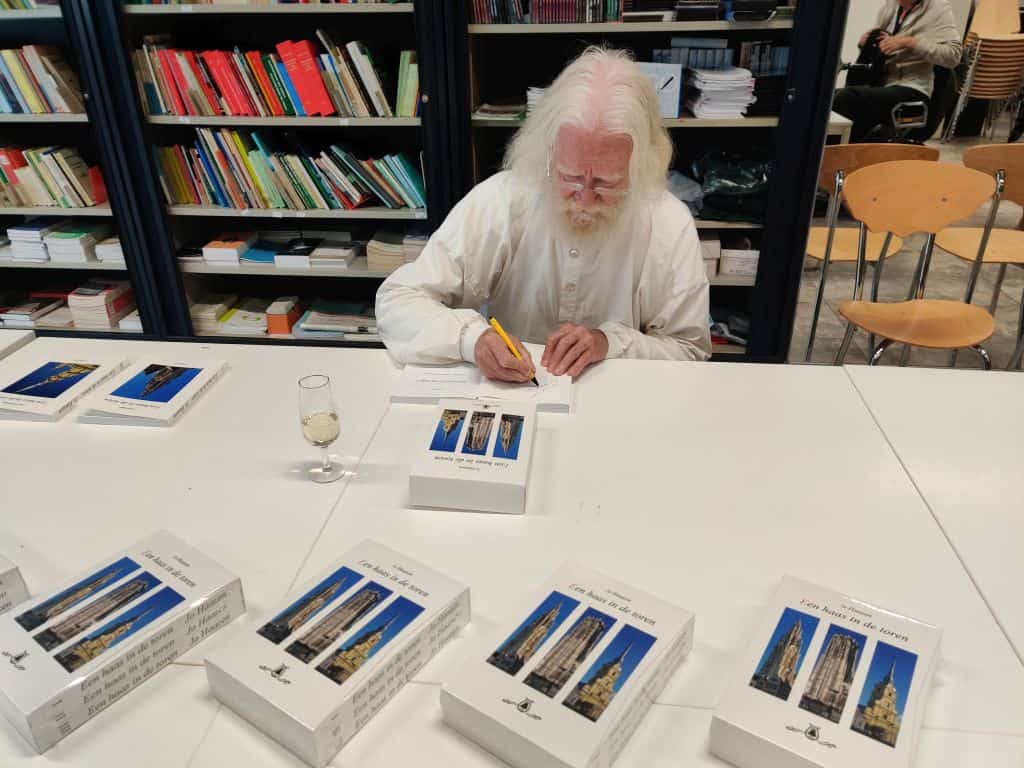
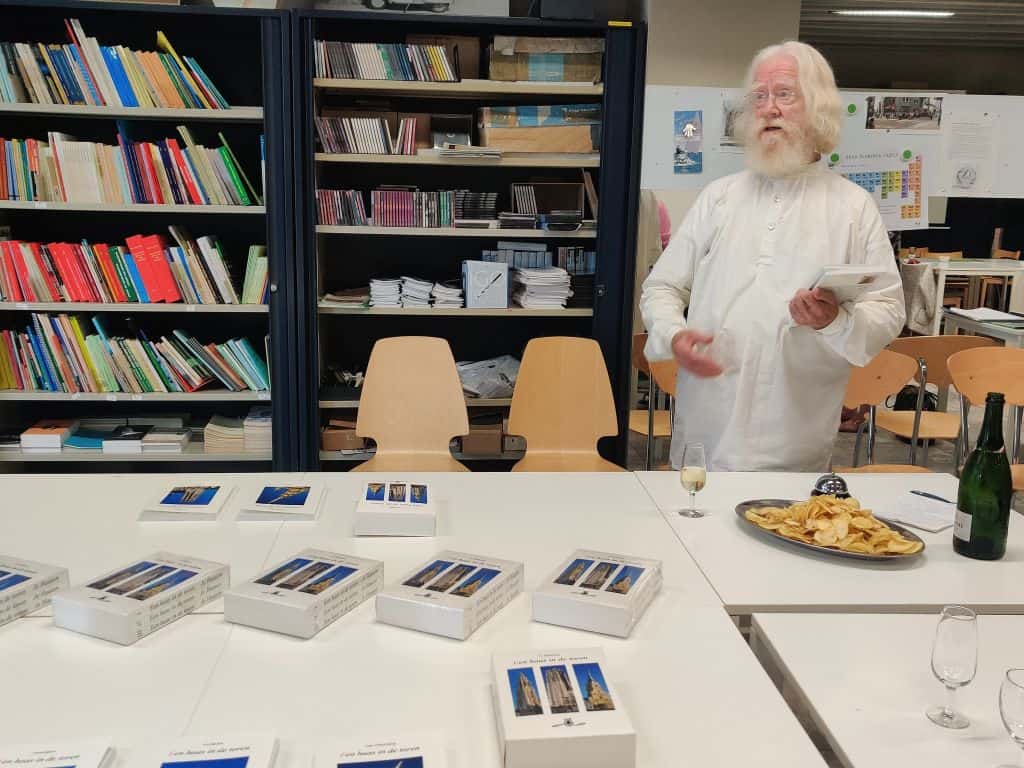
Jo Haazen's autobiography recently appeared as a bronzeworking tower climber—a 'climber' out of necessity, since there are hardly any carillons that don't stand in a tower. Three towers largely shaped the artist's life. For each tower, Jo Haazen wrote a book volume—Antwerp, Mechelen, and Saint Petersburg, collected in a beautiful book set under the shared title 'A Hare in the Tower.'
Jo Haazen, a real go-getter—well, in the tower—could rightly be called a hare. What an active, complex life in general and what a rich, rare professional career he can and may look back on with well-deserved pride. Haazen is currently a living piece of carillon history of world significance.
Antwerp
It began when he was a 14-year-old teenager drawn to those weekly, even daily ringing bells in the Gothic lace tower of the Cathedral of Our Lady in Antwerp. His mother was born in the Grand Market, you couldn't get much closer to the bells. Jo, almost 'little Jo,' born on December 24, 1944—he'll turn 80, almost became a Christmas baby. One more day he couldn't wait. Well, that's how it goes with people who are always busy with a thousand and one things.
As a young man, he went to carillon school in Mechelen with Staf Nees. He was, even for carillon, a brilliant student and barely an adult when he was appointed city carillonneur in Antwerp. While giving music lessons, learning Esperanto and teaching it, and playing carillon on his tower, he won the International Carillon Competition of the Holland Festival three times.
Jo built the Monday evening concerts in Antwerp into legendary events. The run-down surroundings attracted tens of thousands of listeners, plenty of restaurants opened, and the neighborhood came alive and remains so today. Unfortunately, the carillon no longer has the appeal it had during the 'Jo Haazen years,' but enthusiasts still get plenty to enjoy. Read more about the Antwerp story in the first book volume.
Mechlin
Saying goodbye to Antwerp was very difficult and hard for Jo Haazen. He was never really able to process that farewell, but the challenge of becoming director of the Royal Carillon School and at the same time city carillonneur of Mechelen, where a powerful new carillon had just been installed in the Sint-Rombouts Tower, was ultimately too great. After many phone calls, even at 3 in the morning before the deadline for candidacy passed, Jo Haazen gave in and agreed to go. With his merit, experience, and knowledge, he wanted to not only get the school out of the doldrums but also make the Mechelen Monday evening concerts what they were for WWII under Jef Denyn or what he achieved in Antwerp.
As for the concerts, it didn't work out. Mechelen is a completely different city, a completely different mentality and culture. The school, on the other hand, transformed from a dingy hole reeking of stale tobacco, crammed with stacked advertising newspapers, into a living internationally respected institution that still reaps the benefits of his work today under his successor. 100 students from multiple countries are currently enrolled this academic year 2024-25. The level is equal to the great international conservatories. The quinquennial Queen Fabiola competition has only increased in quality.
The Mechelen years, as far as the school's success was concerned, went smoothly, but we also read between the lines that things were sometimes particularly difficult with a board of directors that remained stuck in the past and sometimes provided heavy resistance. Meanwhile, contact came with Russia, where in Saint Petersburg they wanted to thoroughly restore the carillon of Tsar Peter the Great. It became a new instrument. Jo Haazen traveled even more, no longer to the US or Japan as before, but to Russia. Parallel to Mechelen, he also taught there.
Saint Petersburg
Everyone has to retire as a civil servant, and Jo Haazen was a city carillonneur and thus a municipal civil servant, and as director he was an employee of the Ministry of Education. Retirement then. You'd think he'd have more free time? Jo Haazen would pour all that freed-up time into his Russian project. Meanwhile, he had already been honored with the 'Order of Friendship,' the highest decoration a non-Russian can receive. In 2006, he was appointed professor at the Faculty of Arts, organ, harpsichord, and carillon department in Saint Petersburg.
Jo Haazen built a concert tradition from the ground up, attracting countless tourists then and now. Politicians from his own country made the pilgrimage, bringing hordes of journalists and entourages of business delegations in their wake. These days, however, Western interest has cooled considerably due to political tensions and the war in Ukraine. A real shame, because culture should transcend politics—indeed, it should unite us. Before the war, Jo Haazen trained not only Russians but also Ukrainians in St. Petersburg's grand palaces. Let's hope that once the fighting ends, we can gather again in a spirit of peace and brotherhood, letting the Fine Arts prevail.
A Hare in the Tower, the three-part autobiography of carillonneur Jo Haazen – Antwerp, Mechelen, and St. Petersburg.
Forewords by Bart De Wever, Mayor of Antwerp; Marc Hendrickx, former First Alderman of Mechelen; and Natalia Dementieva, former Minister of Culture of the Russian Federation.
A lavishly illustrated publication of six hundred pages, featuring never-before-told stories from the carillon world in the aforementioned cities and beyond.