
On its new CD What Remains the Dudok Quartet Amsterdam presents four different perceptions of time. Rhythmic and hazy (Roukens), religious and deathly (Machaut, Perotineus and Gesualdo), torment and war (Reich), time and timelessness (Messiaen) – thus a fresh branch on the already richly adorned trunk of this ensemble.
The opening features the fourth string quartet What Remains by Amsterdam composer Joey Roukens (b. 1982), also the title piece of the CD. In Strange Oscillations, the first of two movements, the string players tickle the listener's ears with a gentle breeze, rhythmically sputtering like a little boat, including the pulsating lower voices. Rhythmically rattling motifs in the low registers usher in the thicker drawn second movement. Glissandi form a natural caesura with a murmuring continuation that suddenly ends in the sharp pluck of a pizzicato. Gripping, amusing, moving – it has it all.
Quiet and Hazy
The second movement is called Motectum and suggests a polyphonic arrangement of a liturgical musical piece. According to the CD's notes, this movement features systematic deletion throughout the compositional process. The listener can then imagine that the result consists of a dreamy lament, supported by precise harmonies. Quiet playing treads softly toward a slightly trembling, misty ending.
This mystique gains relief on the CD through three short but iconic pieces from early music history: the , which opened with a serene alto melody, was sublimely carried by the choir's voices. The VRK succeeded in finding the delicate balance in this spiritual prayer that sometimes resounded as an urgent plea, and at other times stirred intense yearnings. from the Messe de Nostre Dame by Guillaume de Machaut (1300-1377), the madrigal Deh, come invan sospiro by Carlo Gesualdo (1566–1613), and the crystal-clear Viderunt Omnes by Perotinus (1200).
Steve Reich is present with Differandt trains for string and tape. The tape section consists of recordings by the Dudok Quartet, some human voices, and locomotive sounds, resulting in a total of four times four string parts. In three movements, Reich and Dudok demonstrate how World War II was experienced in the United States and Europe. The buildup to WWII in the US is American-frantic, with repetitive patterns and rhythmic motifs, and on tape station announcers and steam whistles. Modulations and tempo changes keep the listener alert. The second section is the experience of war in Europe, where the train played a role in the transport of (war) prisoners and the Holocaust. Here the tempo is lower and the spoken voices focus on documenting systematic destruction. Here, then, no steam whistles but more air-raid sirens. The finale (After the war) consists of light short melodies and optimistic sounds (the war is over!) from professional announcers.
Of all times
The CD closes with the fourth movement of Messiaen's Fête des belles eaux (1937). Originally it was written for the ondes Martenot, one of the first electronic musical instruments with a monotone but warm timbre. A few years later, Messiaen arranged this movement for the fifth movement (Louange à l'Éternité de Jésus) of his Quartet for the End of Time. From there it was a small step to, after his own arrangement, join the repertoire of the Dudok Quartet. In any case, that has done no harm to the interpretation. By using vibrato sparingly, the starkness of the sonority reduced to its bare bones remains intact. What remains ("What remains") is respect and a form of humility that is timeless.
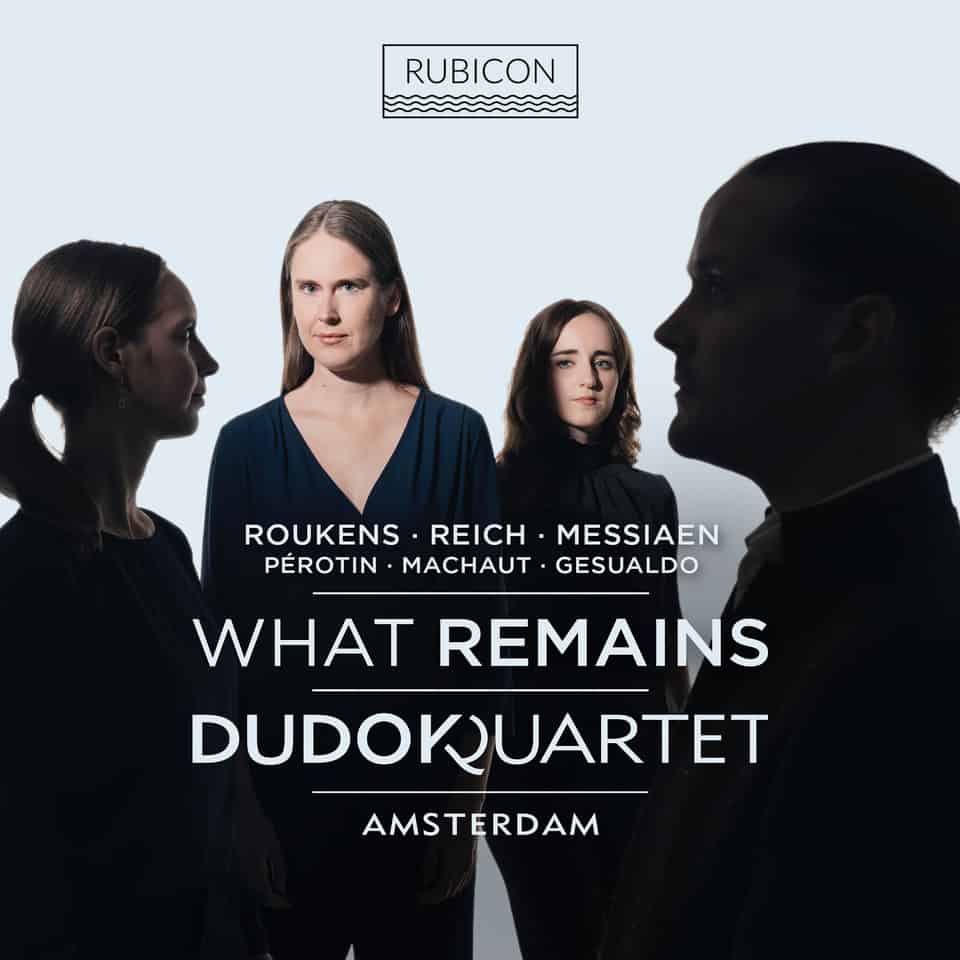 WHAT": What Remains
WHO": Dudok Quartet Amsterdam
EDITION": 2023 Rubicon Classics Ltd
INFO: rubiconclassics.com and dudokquartet.com