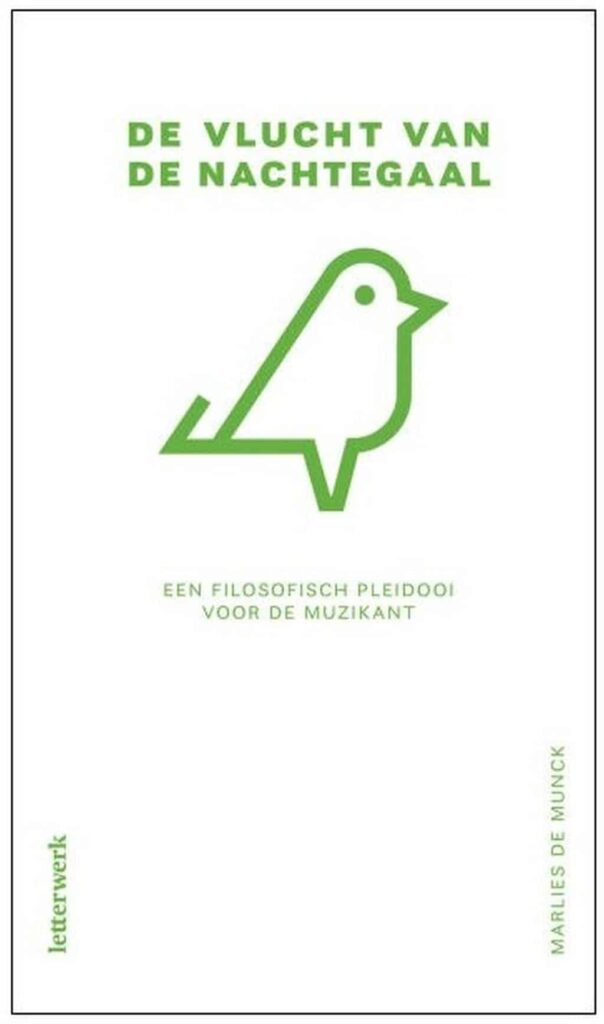

You're surely familiar with Hans Christian Andersen's fairy tale about the Chinese emperor's caged nightingale. It has to make way for a mechanical imitation bird. It can sing just as beautifully on command, but always the same tune. Made in Japan. However, it soon breaks down. Whereupon the nightingale returns to the court and, on the condition of being allowed to live free, saves the emperor from death.
With this fairy tale, music philosopher Marlies de Munck symbolizes the position of today's classical musician. For doesn't that musician have to deliver a faithful version of a composition, just like that imitation bird? Over and over again, always the same?
What freedom does a musician really have to adapt a composition to their liking or to pursue their own artistic path?
In this modest but no less important little book, De Munck addresses the precarious situation in which the performing musician currently finds themselves: the tension between the pursuit of freedom and the increasingly tight straitjacket of contemporary performance practice.
A stage performance must nowadays sound as perfect as a CD recording. How reasonable is that demand when you realize that a studio recording is heavily manipulated and nothing more than a series of spliced-together pieces of music? In fact, a recording on LP or CD is nothing other than a piece of electronic music that bears little resemblance to a 'live' performance.
Making mistakes is nowadays not done as is interpreting a composition in your own way. Those who deviate from the norm can expect harsh criticism and risk excommunication.
It is therefore understandable that musicians resort to so-called beta blockers to escape performance pressure, seek help from a psychologist, or hang up their instruments prematurely.
The musician as a Japanese imitation bird, going through the motions. It's a sad comparison, but no less apt for that.
De Munck guides the reader through the history of music philosophy. She shows the reader how thinking about music has changed over the centuries and why classical music has degenerated into a museum where the musician is the curator.
Music is displayed in a glass case with a sign in front of it: 'do not touch'.
She introduces the reader to concepts such as work concept and Werktreue. Whereby the work concept refers to a development that took place roughly at the end of the eighteenth century: music was no longer an activity in which you yourself participated, but rather an object that became the subject of an activity. From that moment on, people spoke of, for example, 'The Ninth'.
The concert as a form of entertainment was discovered. The era ended when composers had to rely on a patron or a wealthy (church) prince. The composer became self-sufficient. He could compose what he wanted and earn money from the publication and performance of his work. The music industry was born.
Fidelity to the work is the faithfulness to the work you perform. 'Bringing to life all the images and visions that the composer intended', as poet E.T.A. Hoffmann put it. This concept caught on, but degraded the musician to a mere conduit of the composer's ideas, invisible without personality.
With the rise of historically informed performance practice in early music in the nineteen seventies, the idea of Fidelity to the work was further reinforced under the influence of pioneers such as Nikolaus Harnoncourt, Gustav Leonhardt and many others. Performances became increasingly academic, more scientific. Music entered the university. From then on, it was decided there what was and was not justified.
The corset tightened even further.
De Munck does not offer ready-made solutions to this undesirable situation, but you wouldn't expect that right away with such a comprehensive problem.
She sticks to the advice to deal more wisely with tradition and to give the musician back his voice. She points out that the musician has always had the freedom to choose to play works in a completely personal way, to improvise, or to reproduce them as faithfully as possible.
Of course that's true, but here De Munck overlooks the fact that this freedom is only available to a very limited number of musicians, perhaps a few soloists and alternative ensembles. Most musicians have little choice. They are trapped in the gilded cage of a (subsidized) orchestra, ensemble, or choir. Breaking out has major social and financial consequences. That's not within everyone's reach. After all, one has to earn a living!
Yet it seems the time is right to distance ourselves from concepts such as work concept and Fidelity to the work and return to the graindelavoixthe uniqueness of the performer. The fact that this is already happening on a small scale is undoubtedly encouraging. This little book gives those pioneers a pat on the back!
De Munck takes on the role of whistleblower. She makes a convincing plea for the liberation of the performing musician and does so courageously against the current trend. At the same time, she provides an informative overview of the evolution that thinking about music has undergone over the past two centuries and the far-reaching consequences thereof.
Her message is clear: there is an urgent need for an in-depth discussion with the motto 'what on earth are we doing in music!'
No more beating around the bush—the bird has kicked the bucket for good.
- WHAT: The Flight of the Nightingale – A Philosophical Plea for the Musician
- WHO: Marlies de Munck
- EDITION: Letterwerk EPO, Questa Series