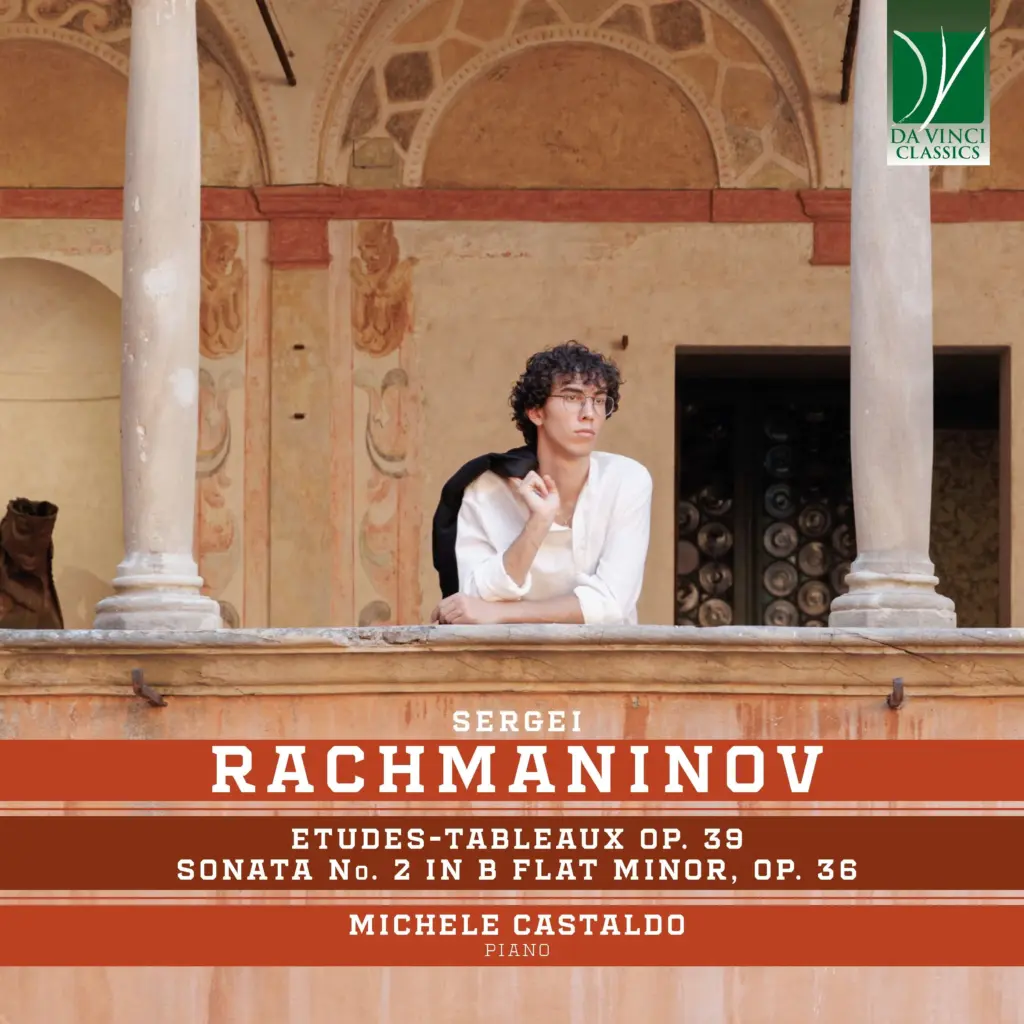
During the years when Sergei Rachmaninoff composed the nine Etudes-Tableaux, Op. 39, Russia underwent a crucial historical transformation: the February Revolution of 1917 and, more radically, the October Revolution had overthrown the tsarist regime and marked the beginning of a new era that initially seemed full of promise. Rachmaninoff, initially fascinated by this wind of freedom, soon realized that he would have to emigrate:
"In March 1917 I had already decided to leave Russia, but I couldn't carry out my plan because Europe was still at war and no one could cross the borders. I withdrew to the countryside and spent the summer in Ivanovka. It would be my last summer in Russia. The impressions I gained through contact with the peasants were most unpleasant. I would have preferred to leave Russia with better memories. At the time of the second phase of the revolution – the Bolshevik uprising – I was still living in my old apartment in Moscow." I began my first piano concerto and set in motion the composition of what would later become the Fourth... At that moment came a completely unexpected event, which I can only attribute to divine providence rather than chance, which came to my aid." He was referring to a concert tour through Scandinavia, which served as a pretext for leaving the country. One of the last musical fragments he composed in November 1917 was one that later earned the nickname Orient Express, perhaps a reflection of his desperate longing to escape to another life. His family joined him in Petrograd on December 23; the famous bass Fyodor Chaliapin sent his friend a farewell letter with a box of caviar and homemade bread for the journey – a gesture that deeply moved Rachmaninoff. After the Scandinavian tour, the great journey to New York began from Oslo on November 1, 1918, aboard a small steamship. Thus began his adventure in the New World, but Rachmaninoff remained tormented for the rest of his life by a deep sense of homesickness – a Russian, as Stravinsky once said, "never forgets the scent of Russian soil".
This sense of nostalgia seems deeply embedded in the human spirit and appears prominently in Rachmaninoff's works, which have a highly virtuosic character and are often suffused with a poignant passion that builds to a climax bordering on tragic despair. The idea of an emotional-sonic "climax" was essential to Rachmaninoff, who in a letter to Chaliapin stated that the performer must reach this peak "after the most meticulous calculation." This idea of passion, rendered musically with almost scientific precision, also applies to Rachmaninoff as a conductor, whom his contemporaries described as someone without theatrical flair, wholly focused on discovering new, precious details in each work. The conductor's art is also evident in his piano compositions, which are often quasi-orchestral in nature; it is therefore no wonder that some of the Etudes-Tableaux were orchestrated by Ottorino Respighi. On that occasion, Rachmaninoff gave the Italian composer some "secret explanations" to help him find the "necessary colors" for Etudes 2, 6, and 7 of opus 39, as well as the fourth of opus 33: