

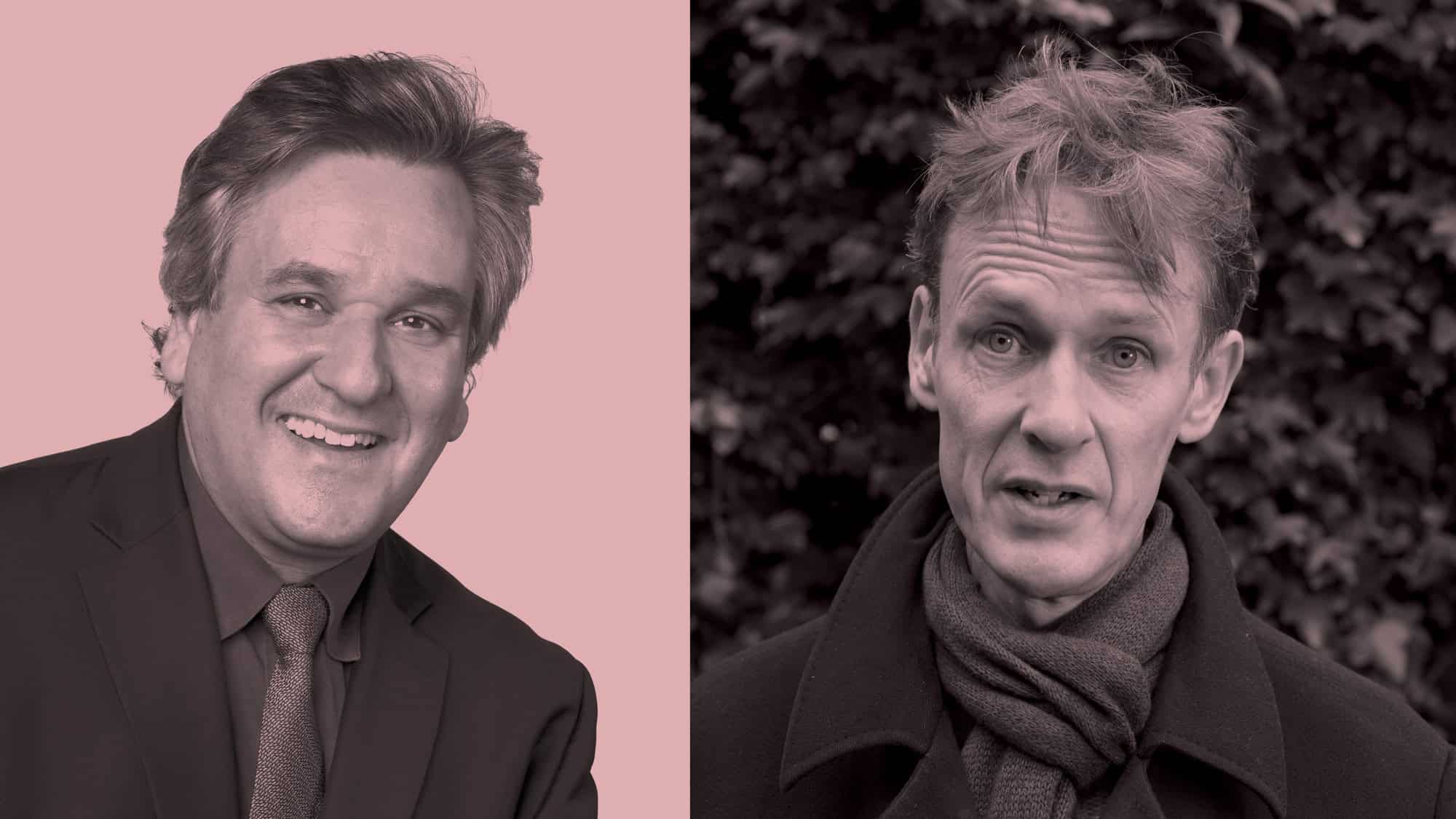
Schubert's Winterreise remains unmistakably Schubert, the voice of Ian Bostridge remains unmistakably Bostridge. A contemporary arrangement cannot change that. That was not the intention of Hans Zender either. About his arrangement of this "icon of our musical tradition" he says "Forgery, no, I say creative change". Tenor Ian Bostridge can deploy his versatile voice equally creatively for this version.
On the occasion of the orchestra's 250th anniversary celebration, the Muntschouwburg brings a select ensemble of artists to the stage for this other Winterreise. Ian Bostridge is an equally iconic tenor for this "komponierte Interpretation" from 1993 by Hans Zender (1936-2019) as for the original Winterreise by Franz Schubert (1797-1828). As a cherry on top, Antonio Pappano conducts at the Munt for the first time in twenty years.
The beginning of the song cycle sounds strange. Zender refers to footsteps in the snow: from nothing he builds a crescendo with various instruments. As if the entire orchestra is walking along with the "Wanderer". Only then follows the more familiar sound of the first song, Gute Nacht: Fremd bin ich eingezogen, fremd zieh ich wieder aus.
The end is equally surprising with a swelling chord followed by a decrescendo that fades away. In other songs too we clearly hear a 20th-century approach (Der stürmische Morgen, Mut or Die Post) where the choice of instruments creates a modern sound. (woodwinds, brass, and instruments such as accordion and guitar.) But overall Zender stays very close to the original composition. He realized a fascinating arrangement that does no damage whatsoever to Franz Schubert's original and that preserves the magical unity of text and music. For his "komponierte Interpretation" Zender works with tempi and tonalities. He achieves different accents and color nuances that are absolutely twentieth-century in character. The complex stratification of the work is strongly expressed through the very distinctive instrumentation. The transformation from piano sound to a diverse ensemble naturally provides a special color. The instrumentation evokes the howling of the wind, the cracking of ice, fleeing crows, hallucinations, growling dogs and so on, but also the loveliness of spring in Frühlingstraum. In that sense Zender's journey can almost be placed more in modern expressionism than in the atmosphere of Romanticism, especially in the second part of the cycle. The farewell to the beloved from the first part increasingly shifts towards the fatal path towards death. In Nebensonnen a definitive farewell from reality can be heard. Contradictory tempi meet in the total sinking into nothingness in Der Leiermann with sharp and stuttering sounds in flute and oboe. It sounds literally as if the ground is disappearing beneath the figures. The cycle ends, if possible, even more strongly in total lostness. The absolute emptiness of the psyche can no longer be represented by any beauty, only by poignant sounds that can evoke such lostness.


Antonio Pappano clearly masters the orchestral palette and handles it smoothly. With his familiar enthusiasm and energy he inspires the musicians to the many often bizarre but always expressively significant sounds of the score, whether it's the harp, the contrabassoon, the guitar or the many colors of the percussion. Even the wind machine the musicians seem to operate with pleasure for the bleak winter sounds that occur in the piece. This performance was the first I experienced live and after listening to the piece on cd it is striking: it is an arrangement for "small orchestra" but the stage is full of instruments.
The rich variety of accents is brought out even more by vocal artist par excellence Ian Bostridge. The timbre of his voice is excellent for sounding spellbinding and bewitching, ghostly rather than lovely. Threat increasingly dominates as the cycle progresses at the expense of serenity. Also the passages where spoken voice comes to the fore sound super-expressive and bitter in his rendering. Bostridge voices longing and hope but especially despair and desperation, anger and irritation. He embodies above all the unity of music and text. Apparently he feared that his voice would not sufficiently convey the harshness of the text and he reinforced his voice in a few songs with the use of a microphone. It did echo more loudly into the hall, but it seemed somewhat unnecessary to me, because his natural voice can really sound loud and cutting enough.
The Muntschouwburg can rejoice in a well-attended audience for this quite special concert. The concentration was palpable throughout the performance. The memory of Antonio Pappano, the beloved chief conductor from twenty years ago, may have something to do with it. But it at least proves that the biting "komponierte Interpretation" in our time certainly deserves its place alongside Schubert's original. The acerbity of both compositions makes them not only contemporary but timeless.
WHAT: Hans Zender / Franz Schubert - Winterreise
WHO: Ian Bostridge [tenor], Kamerorkest van de Munt conducted by Sir Antonio Pappano
WHERE: Koninklijke Muntschouwburg (Brussels)
WHEN: Monday 19.12.2022 - 20:00
Listening tip

WHAT: Hans Zender - Schuberts Winterreise
WHO: Julian Prégardien [tenor], Deutsche Radio Philharmonie conducted by Robert Reimer
RELEASE: Alpha Classics ALPHA425