

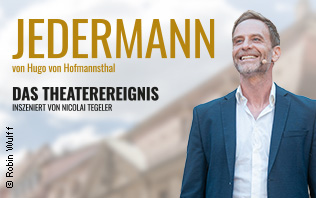
Anyone who hears the name Julian Weigend in Flanders probably furrows their brow for a moment. But as soon as someone adds that he plays the surgeon in the popular ARD series "In aller Freundschaft", a glimmer of recognition usually appears. Yet the true core of Weigend's artistry lies not in the television studio, but on stage – preferably under the open sky, where word, space and transience meet.
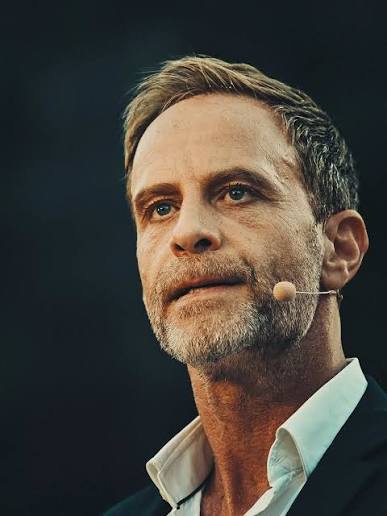 Born on 27 August 1971 in Graz and trained at the Hochschule für Musik und darstellende Kunst there, Weigend belongs to that rare breed of actors for whom theatre is not a stepping stone, but an origin. His artistic path led him through numerous German-language stages – from Klagenfurt to Schleswig-Holstein and the Berliner Kammerspiele – where he distinguished himself early on. In 1995 he was awarded the Publikumspreis of the Bad Hersfelder Festspiele as the first laureate, shortly followed by the prestigious Großer Hersfeld-Preis from critics. The television work came later, as an expansion of an already firmly established theatre career.
This fundamental connection with theatre perhaps explains why Weigend has played the title role in Jedermann from the very first performance – a role that cannot simply be set aside, but rather seems to attach itself to its performer over time. Werner De Smet spoke with the actor for Klassiek Centraal about that special bond, and about the place where he gives it shape again this year: the Marktplatz of Weimar, laden with cultural-historical weight and existential resonance.
Jedermann Theater, Tegeler's touring production, has now entertained more than 20,000 spectators since its start in Beelitz in 2022, with venues such as Berlin, Bayreuth and Regensburg and soon also Bremen, Coburg and Graz. The production has returned to the Thuringian cultural city before – and each time that return proves to be more than logistical. "Weimar means much more to me as an actor than just a location," says Weigend. "It is a spiritual and cultural space that has fascinated me my whole life."
That fascination has everything to do with what Weimar represents as a place: the legacy of Goethe and Schiller, language as an instrument of truth, the Bauhaus tradition as an engine of renewal. Weigend does not feel that weight during rehearsals as a burden, but as an enrichment. "You cannot escape the history of this place. There is a certain density – a connection with all the artists, thinkers and visionaries who have worked here." And that connection is, he emphasizes, not merely nostalgic. "Through the Bauhaus tradition, Weimar also stands for courage and for the idea of constantly rethinking art. That mix of tradition and renewal I find very inspiring."
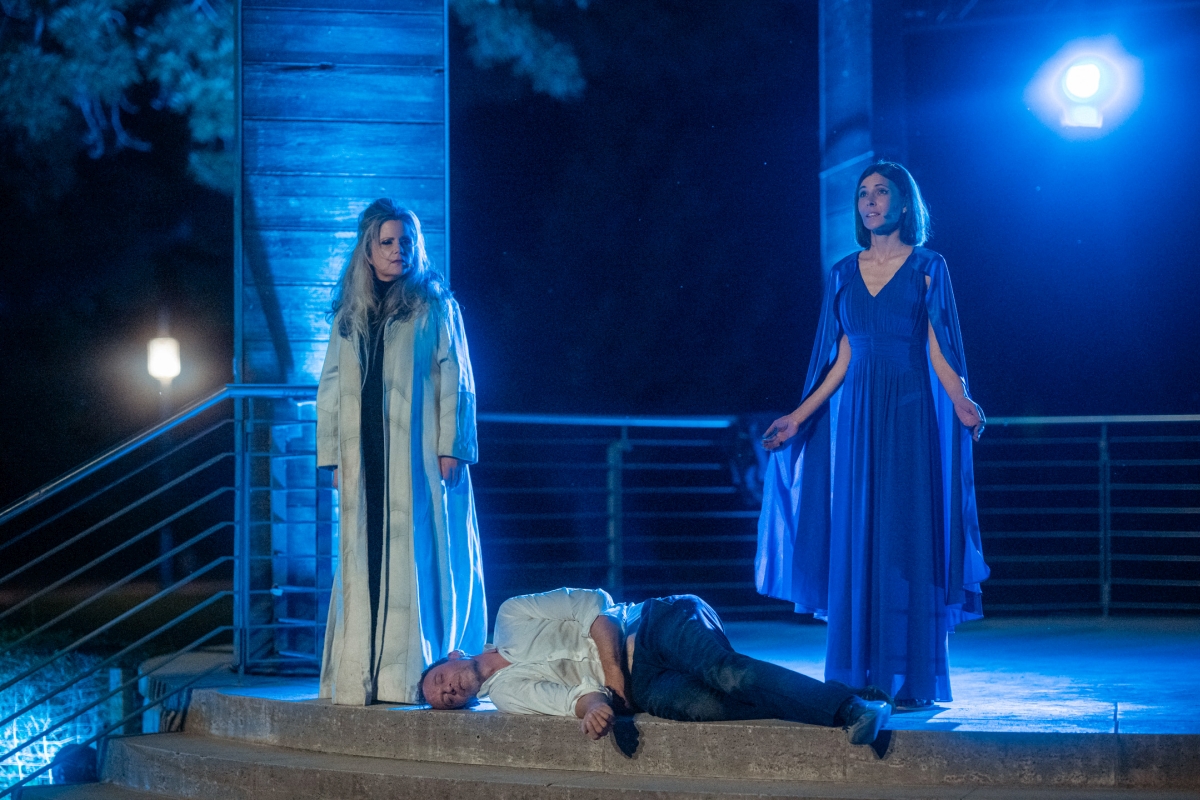 The parallel with Jedermann is remarkably self-evident in this regard. Hugo von Hofmannsthal's play – which has found its most famous home in Salzburg, but in Tegeler's version is deliberately loosened from that specific tradition – poses questions that resonate particularly loudly in Weimar: about transience, responsibility, about what ultimately matters. "You don't just perform a text here," says Weigend, "but you enter into dialogue with a cultural heritage that has grown over centuries."
Asked whether that same role would feel different elsewhere, he is nuanced. Salzburg, he associates with the heavy burden of a decade-long performance history and the immediate connection to Hofmannsthal himself. Berlin has a different dynamic – more challenging, more abrasive, more in motion. "Weimar, by contrast, I experience as a place of depth and reflection. The confrontation with the human, with language, with what endures – that is particularly palpable here." And precisely that makes the role in this location different, he adds: "One does not perform Jedermann merely against a historical background, but in a place where for centuries people have reflected on what it means to be human, on art and on life's great questions."
That Weigend has personally changed through the role is clear: "Every intensive engagement with a character leaves traces – and Jedermann particularly so," he says. The figure undergoes a development: from someone who lives in the illusion of what can be made to someone who is confronted with the absolute limit. Going through that process year after year, Weigend explains, changes one's own perspective on time, on relationships, on success. "Jedermann did not come into the world ready-made – he undergoes a development. It is about insight, about responsibility and about the possibility of change." What strikes him most is that the figure is never "finished", but remains constantly in motion. "You don't just play a person who meets death – you also meet yourself again and again."
The audience seems to sense that. Weigend is surprised anew each time by the immediacy of the reactions. Not admiration for a technical achievement, but something more personal: recognizing oneself in a figure that is initially anything but sympathetic. "People don't just see the story of a rich man confronted with finitude – they recognize themselves at certain moments." After performances, he often experiences a great silence among the audience, a deep emotional presence. "That shows me that theater still has the power to truly touch people."
For the performances on the Marktplatz in Weimar this summer, he hopes the audience takes more than theater home with them. "I hope they experience a moment of encounter – with history, with the character, and perhaps also with themselves." Jedermann doesn't offer great answers, he knows. But the questions the piece raises are of the persistent kind. "If spectators go home with a thought, a feeling, or a question, then theater has achieved something."
On that Marktplatz, in front of the Rathaus, under the open sky of a city that once housed Goethe and Schiller and that now brings a medieval morality play back to life – that feels like the right place.