


An open violin case lies on the ground. A violist plays for passersby. In the case lie a few coins and banknotes. On this black-and-white money are depicted the faces of three composers: Claude Debussy (1862-1918), Maurice Ravel (1875-1937) and George Enescu (1881-1955). The scene is less far-fetched than one might think and breathes the nostalgic atmosphere that Philippe Graffin wants to convey with his latest recording project À la Valse. Klassiek Centraal put on the dancing shoes together with the acclaimed French violinist and Belgian pianist Tim Mulleman, who made the arrangement for strings of Ravel's iconic poème chorégraphique.
12 December 2020. It is precisely one hundred years ago that La Valse premiered, Maurice Ravel's stunning apotheosis of a genre that dominated much of the 19th century and became a hallmark of the by then defunct Austro-Hungarian empire. The end of the First World War also meant the end of the waltz, for which Ravel wrote the remarkable death notice. Oddly enough, the undaunted composer did so by creating yet another waltz, albeit a very atypical one. "Un tournoiement fantastique et fatal", as he called it: the celebration of a bygone grandeur that came to a standstill through the decay and ultimately the downfall of what Austrian novelist Stefan Zweig (1881-1942) described in his autobiography as "das goldene Zeitalter der Sicherheit". On this occasion, and to celebrate his brave compatriot, the French violinist Philippe Graffin (Romilly-sur-Seine, °1964) finally wanted to make La Valse his own. He therefore commissioned a brand new version of the piece for string nonet from the Belgian composer, arranger and pianist Tim Mulleman (Turnhout, °1993), whose name might ring a bell. Earlier this month, Klara spotlighted Mulleman and his piano duo Mimese as part of the series De Twintigers, which encourages promising and often versatile musical talent.
"I know Philippe through the Karski Quartet, and specifically through their violist Diede Verpoest", Mulleman recalls as we meet the three of us in Brussels in mid-January. "We played together as part of Tmesis, a quintet of flute, clarinet, cello, violin and piano, in which Diede plays the violin. The repertoire for this specific combination is not very extensive, so we decided we needed some new music. I arranged Debussy's Prélude à l'après-midi d'un faune, actually the piece that got me into arranging. With Tmesis we played a few pieces for Philippe, such as Webern's arrangement of Schoenberg's Kammersymphonie. Now, a few years later, he asked me to take a look at Ravel's La Valse."
"I had already heard from various other musicians and ensembles about Tim as an arranger. I was looking for a young person from Belgium who knew the piece, and in fact Tim already had the four-hand piano version on his repertoire for quite some time. I was certain that he would do something creative and at the same time respectful with the piece. I was also looking for someone with whom I could discuss my ideas about creating certain details, colors and effects that I already had in my head. Because in my opinion La Valse is a work that is destined to play a role in the life of a string player. Until now there have been so many versions for piano made that we felt a bit left out, while the original conception of the traditional waltz is very familiar to us string players."
To reinforce his point, Graffin has put together a programme with the waltz as its leitmotif. First comes George Enescu's Octet for strings in C (opus 7). This substantial work, written at the threshold of the 20th century, culminates in a very spirited Mouvement de Valse bien rythmé. The spinning and swirling continues with La Valse, before the acclaimed violinist lives up to his reputation as a treasure-seeker with Debussy's La plus que lente: yet another waltz, originally written for solo piano in 1910, but here presented in a different combination for solo violin, string quartet, double bass, flute, clarinet, piano and ... cimbalom.
Philippe Graffin: My entire being is oriented towards the idea that the repertoire is not fixed, but rather something that still needs to be built. Each piece has, so to speak, its own life. In fact, you can delve into the past and collaborate with composers to complete their works or to bring them to light in a different form. That is why I have spent a large part of my professional life as a musician searching for and bringing to light unknown music. This is how I discovered a work by the famous violin composer Ernest Chausson (1855-1899), a friend of Eugène Ysaÿe and pupil of César Franck, who died young after an unfortunate bicycle accident. With Poème (opus 25), he wrote a beautiful concerto-like piece for violin and orchestra. In the mid-nineties I found at a bookseller in Paris, near the Seine, a version of this music for string quartet, violin and piano that nobody knew. I helped to find out what it was and to play it for the first time. In South Africa I also recorded for the first time the romantic violin concerto (opus 80) by the black composer Samuel Coleridge-Taylor (1875-1912), and I found a version of the last movement of the third violin concerto in b (opus 61) by Camille Saint-Saëns (1835-1921) that had actually been written fourteen years earlier but was considered a completely different piece for violin and piano (the Caprice Brilliant, ed.).
Suppose you were to discover another unknown masterpiece, which composer would appeal to you most, and why?
Graffin: If there is one piece I would have liked to discover, it would be the Trois Nocturnes that Claude Debussy originally wrote for violin and orchestra. He threw away the parts and made the version for orchestra that we know today. There is a letter that Debussy wrote to Ysaÿe in which he says that the three movements are like tonal color paintings – what would be a study in grey in painting – with only violin and strings in the first movement, violin, woodwinds and brass in the second movement and a mixture of the different instruments in the third movement. Because the two gentlemen quarreled afterwards, Debussy later reworked the music into the nocturnes as we know them. I would have liked to find the original version of these three pieces on a shelf at some old lady's house (laughter). But it is said that they probably no longer exist. I even went to François Lesure (1923-2001), one of the most prominent Debussy experts, who believed that Debussy was lying in his letter. He only hoped that Ysaÿe could help him perform his opera Pelléas et Mélisande in Brussels.
If money and time were no problem, what project would you immediately want to start?
Tim Mulleman: I am actually very happy with what comes my way. I would never have thought of making, for example, an arrangement for strings of Ravel's La Valse. Some commissions simply find their way and give you the opportunity to challenge yourself. I prefer to let things come to me. I have no clear idea that I want to write a symphony or another work in a few years. That is why I prefer to leave this question open.
As a composer, both Leoš Janáček (1854-1928) and Alban Berg (1885-1935) fascinate me enormously. That is why I would not mind discovering a mysterious piece by one of them. Or by Dvořák or Enescu, who worked more or less in the same style. But there is still much repertoire to be written by living composers that also deserves to be discovered.
Which version (orchestral, piano, ...) of La Valse did you use as the basis for making the arrangement for string nonet?
[caption id="attachment_21865" align="alignleft" width="300"]
 Tim Mulleman: "The flexibility of La Valse is actually one of its greatest assets."[/caption]
Mulleman: Of all the possible versions that exist. First and foremost, I listen carefully to all versions and to many different interpretations. Because I have played the quatre-mains version so much, I already had the structure of the piece firmly in my head. Then it doesn't work by simply redistributing the parts. It really becomes fun when you start to dismantle the music and pick up the different puzzle pieces again to create another monumental composition, but on a different scale. In the end, you don't think about the different existing versions anymore. It must become a self-contained version, totally idiomatic. Otherwise, the new piece is nothing more than a reduction of the original orchestral version, and that's certainly not what we want to hear. Because there is so much information in the original piece, there is always some reduction involved. But the art is to make this not noticeable by creating a kind of balance and relief. Although I try to keep everyone busy and give everyone their part, I think a very sober way of arranging can work very well. For example, we decided to add a double bass to the nonet, but this instrument only becomes noticeable if it doesn't have to play all the time. As Philippe said, he also had some suggestions. For example, there's a very interesting section where the harp plays some glissandi and long scales. These have a very different effect on the violin, but are especially very difficult to execute. The wonderful musician that he is, Philippe showed me how it could be performed.
Graffin: In La Valse, different instruments have to sound all the time, so you take on the role of harp, woodwind or piccolo. We also have to imitate percussion very often, with all kinds of plucking and that sort of thing, because those instruments play an important role in the original piece. What is not said is actually the most important thing to evoke an unexpected tonal range, from very soft and sweet to hard and dynamic.
Has your re-arrangement of La Valse changed the perception of the original piece, and if so: in what way?
Mulleman: The purpose of an arrangement is precisely to shed new light on the music. That is essentially the essence. Otherwise, it would make no sense. Moreover, of course, it gives these fantastic musicians the opportunity to also play this piece and for the audience to hear new and different things. Even for Ravel, there was no original version of La Valse. Around that time, an arrangement was more or less the equivalent of the original piece. In Vienna, you had the Verein für musikalische Privataufführungen, founded in 1918 by Arnold Schönberg (1874-1951), where it became an art to re-arrange modern pieces to make them more transparent. This sensitivity to transparency revealed the mastery of a work. It really became an art in itself to create new versions of already existing works that stood at the same level as the original pieces and that were performed multiple times for a select group of musicians and listeners.
When a composition is appropriated in different combinations – for orchestra, piano duo and now also for chamber ensemble - it must mean there is something special about it. Apart from the fact that this ballet music had its premiere 100 years ago, what is so intriguing about Ravel's La Valse?
Mulleman: La Valse has tremendous energy that drives you from the first to the last minute. There is that remarkable tension that you experience from beginning to end, with that incredible macabre dance. Of course, you can try to analyze the score, but it is probably the difficulty of capturing this tsunami of tension precisely that makes it a masterpiece. It is really difficult to perform, even and perhaps especially on one and the same piano.
Graffin: I have the feeling that this piece also has a reputation because many of the great musicians are pianists. It demands so much virtuosity in whichever version you play it, that it has the aura of a small holy grail within the piano repertoire.
Mulleman: Lucien Garban (1877-1959) made many transcriptions of Ravel's music among others. Until the end of his life, he was also director of the renowned publishing house Durand. So he was a very important figure who encouraged this arrangement practice and he did not do it only for practical or financial reasons. The version for two pianos of La Valse that Ravel himself made was primarily intended to let Sergei Diaghilev (1872-1929) hear the piece, who commissioned the ballet. The striking thing is that Diaghilev considered it a masterpiece... but not as a ballet. He saw it more as a painting or a portrait and thus rejected it. This caused the two to have a big falling out. In later years, however, many companies have successfully proven that you can make a ballet out of this music. The flexibility of La Valse is actually one of its greatest assets.
In one of his music essays titled "Viennese Sentiment and Good Taste", Dutch writer Simon Vestdijk poses himself the following question: "Already by its multiple interpretability, La Valse is infinitely more interesting than the Bolero; for what is this actually: ballet music, waltzes on which one can 'just' dance, a symphonic poem? It is all of that at the same time; but the accent can fall on one or the other, and therefore the orchestra conductor will do well to determine beforehand which direction he wants to go [...]." Which path did the ensemble take with this recording?
Graffin: When we play this piece, there is actually nostalgia throughout. We see an imaginary couple waltzing and part of a harmonious world, a world we care about but which belongs to the past. This music is particularly suited to this specific feeling. The note that Ravel gave at the beginning of the orchestral version of La Valse also expresses something along those lines. He sets the scene of the film, as it were: "La scène s'éclaire progressivement. La lumière des lustres éclate au fortissimo. Une Cour impériale, vers 1855." When we play, we long for this lost time that we want to return to. The piece tells this story, but ultimately it becomes chaos because we are so upset that we cannot return to this somehow romanticized past.
Mulleman: The murmuring beginning of La Valse is also very special. You don't know exactly what's happening. Then the basic melody emerges, but quite late in the piece. Ravel saw this as the birth of the waltz as a genre and then likes to jump from one period to the next, making it a sort of collage of different styles.
Graffin: For a large part, you could indeed regard La Valse as a kind of pastiche, but it is not a caricature. Because what Ravel does is never without irony. It is actually a gentle and refined form of colonialism, in which the composer twists and transforms a cornerstone of Austrian culture, the waltz, into something French. Fortunately, it is less harmful to colonize the past than the future (laughter).
It's not the first time you've combined Debussy, Ravel and Enescu on one and the same CD, Philippe. I'm referring of course to In the shade of forests and Fiddler's blues, two recordings for the independent music label AVIE Records based in the United Kingdom. How is it that these three composers become so easily entangled with one another?
Graffin: That's an interesting question. All three of them knew each other, of course, although Debussy was apparently a difficult person to approach. So neither Ravel nor Enescu were particularly close to him. But Ravel and Enescu were close to each other, as they both studied at the conservatory in Paris at the same time and in the same class as Gabriel Fauré (1845-1924), among others. They also played together. There is a story of the young Yehudi Menuhin (1916-1999) that he took lessons with Enescu and that Ravel showed up to ask his friend to read and play through his new (second) violin sonata before he sent it to the publisher. This piece has a notoriously difficult final part (the Perpetuum mobile, ed.). Yet he played it from memory after just one reading. Unbelievable and bizarre at the same time!
In any case, there is a close bond between Ravel and Enescu. In 1924, Ravel wrote his Tzigane, a well-known violin piece, as a tribute to gypsy music. That was also the core of Enescu's inspiration, coming from his native Romania. One day Debussy went to Budapest where he heard a gypsy violinist play in a brasserie. Afterwards, he wrote one of the most moving letters, with this poetic image that became the title of the album In the shade of forests. This musician, he wrote, loves music more than most of us. When you listen to him, you are in the shade of the forest, thereby referring to a deep feeling of solitude and even existential fear: a very deep and seductive feeling that can be inspired by gypsy music. That is why with all these projects we get the feeling that we are looking back at the essence of music.
There is also a third waltz on the recording that touches this essence. The transcription of Debussy's solo piano work La Plus que lente appears, as far as we know, to be a world premiere. Can you tell us more about this specific piece?
[caption id="attachment_21867" align="alignleft" width="300"]
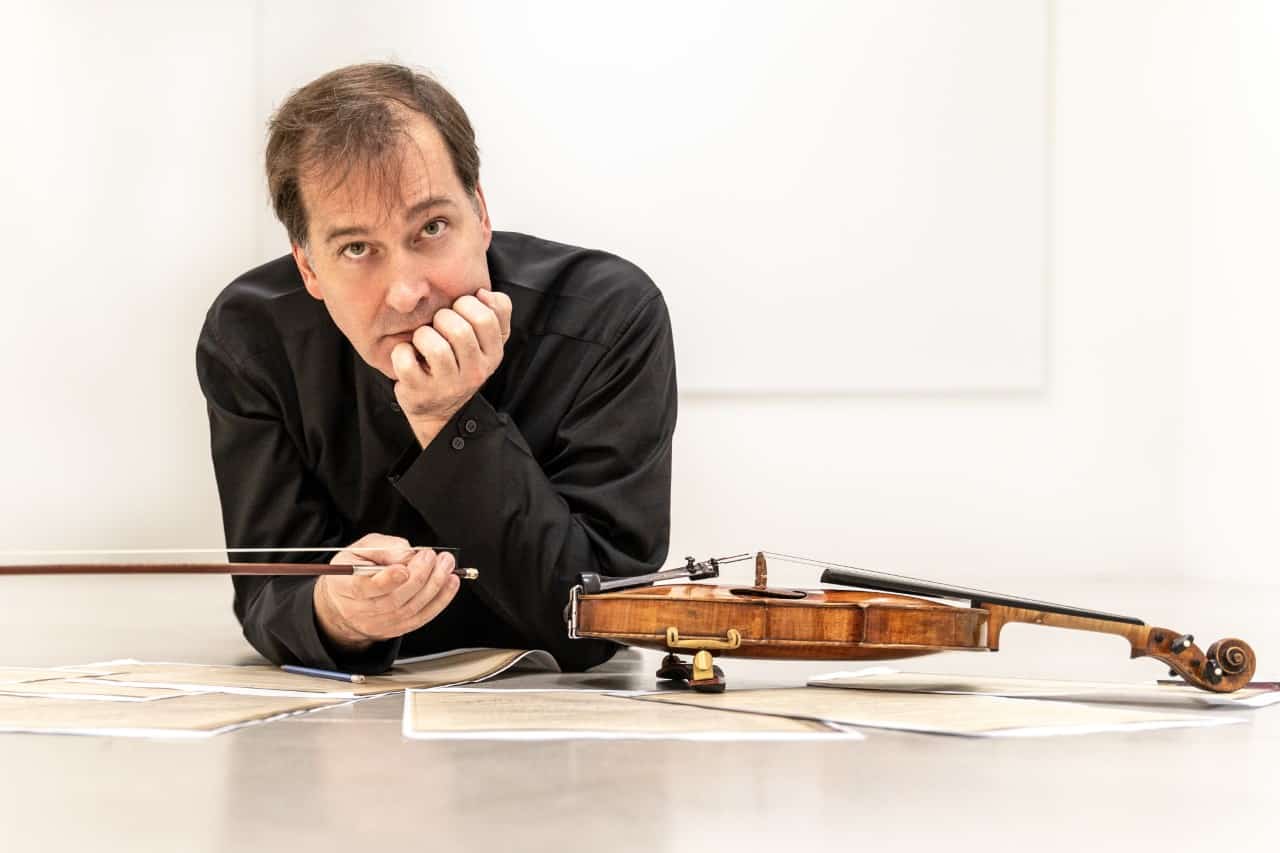 Philippe Graffin: "My whole being is tuned to the idea that the repertoire is not fixed, but on the contrary something that still needs to be built."[/caption]
Graffin: I discovered this story in a book written by American violinist Arthur Hartmann (1881-1956), who was friends with Debussy. Hartmann described how Debussy took him and his wife to a dinner at Hôtel Ritz in Paris, where a gypsy band was in residence. Debussy enjoyed listening to them. One evening, after they had gone home, Debussy sat down at the piano and began playing La Plus que lente, which he had just composed. His wife said that he had spent the entire summer of 1910 writing this music in an attempt to compose something that was very popular and would thus make him good money. After playing it for the second time, Debussy began describing what instrumentation he would like for this piece, referring to the gypsy band and their cimbalom that they had heard earlier. Hartmann told him he had one at home. Only twenty years later did he find out that Debussy had made a transcription of his music for orchestra and cimbalom. We recorded this piece as a kind of encore in a very rare version for solo violin, string quartet, double bass, flute, clarinet, piano and cimbalom.
Together with Ravel's La Valse, Enescu's Octet for strings is the other great work on the recording. It is a very long, complex and challenging piece that tests both the stamina and analytical ability of the musicians. To what extent were you able to get to the bottom of this piece?
Graffin: The octet is a formation where you need more people than for a string quartet or a piano trio, which in principle can rehearse every day. But to get eight people to commit daily, that is almost impossible. So you can only play these pieces occasionally and therefore under considerable time pressure. On the other hand, Enescu's music is incredibly complex and was also particularly unpopular for a long time. Many musicians don't know his Octet, which means that when they have to play it at a festival, they really struggle to keep their head above water. That is why the idea of getting to the bottom of this piece is utopian. By that I also meant earlier taking time to explore each phrase: to really bring out the character that I see in this music, and to share that with the audience. In music you never really get to the essence. Because it is fleeting. But what we did was try to hold this piece for a few days and embrace it very closely.
What feelings does this Octet evoke, what is the character of this piece?
Graffin: Due to its length, it has very different moods. But what impresses me most is that this complex work was written by a very young person. Enescu was only nineteen years old when he wrote his Octet. Moreover, the construction is flawless. The composer takes you by the hand from the first theme to the last note. You hear something special and at the same time very honest in this music, which also has something exotic and unbridled about it. At one point, in the main theme of the slow section (Lentement), I even hear a quotation from Guillaume Lekeu (1870-1894). Enescu was probably moved by the premature death of the Belgian composer and was influenced by the second movement of his violin sonata (Très lent). Both movements have a similar character, namely that of a popular folk song.
In January 2019, the first edition of the TRACES Festival, a project you founded, took place in Brussels, aimed at promoting unjustly neglected chamber music repertoire and helping young talented musicians perform. Will the second edition be able to take place in 2021, and what musical paths do you want to explore with the new program?
Graffin: The festival was actually supposed to take place in January, but unfortunately it is impossible to give live concerts or plan anything like that in the current circumstances. For now we have a film of ours in which we play Enescu, Ravel and Debussy, which we will use as a kind of business card for the festival. Next year I would like to do another project with a composer called Karl Weigl (1881-1949). His work is beautiful. He wrote, among other things, a beautiful string sextet and various works for voice and small ensemble. I would like to find some funding to make this initiative happen. The idea of TRACES is actually to play a piece at each concert by a composer whose life was affected by the Holocaust. Some of them died in a concentration camp, others fled overseas. In the case of Karl Weigl, who was born in Austria, he and his wife Vally Weigl (1894-1928), who was also an accomplished composer, ended up in the United States. The reason we don't know his music is precisely because of the political oppression of Jewish artists in the 20th century.
Perhaps the following short but particularly moving piece by the South Korean composer deserves an arrangement. For when the audience at the festival calls for an encore ... In any case, the final number of the soundtrack to the film Old Boy (2003), with the fitting title The Last Waltz, seems like an appropriate way to end our conversation. Many thanks gentlemen!
- WHAT: Interview about the À la Valse project
- WHO: Philippe Graffin (violin) & Tim Mulleman (piano, arranger)
- WHERE & WHEN: Brussels, 16 January 2021
- PHOTOS: © Marije van den Berg & Hiu-Man Chan
- CLICK HERE … for the original, English version of the interview