


"In your face", this somewhat sloganeering title is given by author Pieter Bergé to the introduction to his booklet devoted to Kurt Weill Aufstieg und Fall der Stadt Mahagonny. It has been published in the Operatheek series of Opera Ballet Vlaanderen and Universitaire Pers Leuven. The opening line is borrowed from anything but a gentle sport, boxing, but that becomes clearer later on.
Already this witty introduction gives in a nutshell a good introduction to the content and significance of Kurt Weill's opera (1900-1950). If you want to discover the hidden subtleties of this opera, this guide is an absolute must-read, almost necessary.
In four chapters, Pieter Bergé outlines the path that led Kurt Weill to the final result of the opera.
1) Towards Mahagonny
An important element is the criticism of Wagner's otherworldly and outdated Walhalla world and the aspiration towards "themes with recognizable, current relevance". Political subjects should not be avoided and the music must make connections with jazz and folk music. From Bertolt Brecht (1898-1956) he borrowed the idea of epic theater, the viewer must not be swept away. Their collaboration on Mahagonny-Songspiel (Baden-Baden 1927) is a first step and direct preparation for the later opera. Via the markedly socially critical Dreigroschenoper they arrive at the plan for Aufstieg und Fall der Stadt Mahagonny which was to be the ultimate proof that "the purest form of epic theater is also the purest form of musical theater" (Weill quote).
2) The Paradise City
In the second part, the period of the Weimar Republic is first sketched briefly and sharply as an unmistakable cause for the themes that Brecht and Weill develop in their piece. Despair, hyperinflation and resistance, communist sympathies versus extreme right-wing colors in a society seeking distraction in perversion. A "disturbing context", in which Aufstieg und Fall der Stadt Mahagonny premieres on March 9, 1930 in Leipzig, barely four months after the Wall Street crash. The apocalyptic situation of the city is reflected in the art of that period (e.g. Otto Dix). In that context, Brecht creates his Mahagonny, a new city as utopia, which, however, soon declines again. The city is the protagonist, the characters are types rather than individuals with whom one can empathize. The opera is divided into three acts, the rise, the flourishing and the decline of the city. Most episodes of the city's "chronicle" are preceded by a heading, which is then further developed in the scenes. The deceptive paradise city soon deteriorates into crime, selfish profit-seeking, corruption and decadence. The fact that Brecht/Weill make current political problems the genuine subject of their opera is an essential part of their innovation.
3) Babylon/Berlin/New York
This chapter is a particularly fascinating and surprising examination of the deeper layers of the epic Mahagonny opera. A first part is "Biblical language". Pieter Bergé points to the Biblical influence recognizable in Brecht's language and traceable to his Protestant upbringing. Weill, too, as a Jew, has a religious background - which ultimately forced him into exodus. The elements that refer to the Bible are evident. And we are given a fascinating series of them! "Paradise" and the name of "Trinity Moses" are obvious. But there is much more and the third act can even be linked to the Passion narrative! In the chapter about Mahagonny's music, reference is also made to the chorale.
The second part of this chapter is "America". Besides the Biblical parable content, references to America abound. Weill and Brecht are fascinated by America, the continent that captured imaginations in the twenties and became a utopia of progress, while Berlin was a symbol of decay. On the other hand, the danger of dehumanization lurked in the industrialized New World. The choice of name, the use of English and the appearance of the hurricane are pronounced elements that refer to America. For the switch from German to English for two songs (including the most popular "Oh! Moon of Alabama"), Bergé suggests as a possible interesting reason, "couleur locale".
The third part is "Gold rush in Hollywood", which of course deals with gold mining in America and especially the wealth to be gained from it, a subject that was regularly featured in Hollywood films that reached Germany. The link with the gold rushes in America is evident in Aufstieg und Fall der Stadt Mahagonny and even with Charlie Chaplin's film Gold Rush (1925), which by the way also has a socially critical dimension. The adventurous gold rush is also an exponent of the "Zivilisationsmüdigkeit" (civilization weariness) in Germany, which leads to a surprising slapstick song in the opera. (I'll let you discover the content of the song in the booklet yourself – but it has to do with a sexually transmitted disease). From another silent film comedy, namely The great Navigator by Buster Keaton, Brecht and Weill have persiflaged a passage. Weill's opera thus immediately shows a clear blurring of boundaries between film and opera, "with the explicit intention of giving that older art form a more recognizable actuality and relevance"
The fourth section was given the title: An epic uppercut, referring to another surprising "American" aspect. The uppercut obviously relates to boxing, a sport that had blown in from America and for which Brecht had more than a passing interest. And – as evidenced by the text of the boxing match in the second act – things can certainly get rough and brutal! Moreover, he held the "sports audience" within the cultural world in high regard!
4) Do not (be) seduced. The music of Mahagonny
The music of the opera is an extensive expansion of the Songspiel that preceded it, still maintaining a "predominant wind instrument sonority". In the expanded orchestral palette, there is room for: "schlagers, opera music, religious music, folk music, ceremonial music and even old-fashioned instrumental music". In what follows, the author not only briefly and particularly clearly explains the various styles and techniques of Weill but also sets out the often connecting and especially symbolic meaning of them. (e.g. the funeral march and several song themes that recur repeatedly with each time varied and deepened content). The choral-like pieces lean toward the style of the oratorio, but in a secular sense. But however skillfully Weill has interwoven the themes with each other sometimes across scenes, the work remains accessible to the listener. A staging can contribute to this, especially if it respects the musical tempo that is strictly determined by the pace of the action.
Conclusion
This edition of Operatheek in which Pieter Bergé examines the opera Aufstieg und Fall der Stadt Mahagonny by Kurt Weill under the microscope is extremely illuminating. It brings you closer to the essence of the piece, elevates it above its entertainment value. It makes you realize that the piece is well worth the deepening of the theatrical experience and gains considerably in meaning. The opera-goer gets a better chance to appreciate what he experiences on stage. A successful move then by Opera Ballet Vlaanderen to offer this publication alongside the programme notes of the production.
P.S.: quotations from P. Bergé from the book are in italics and between quotation marks.
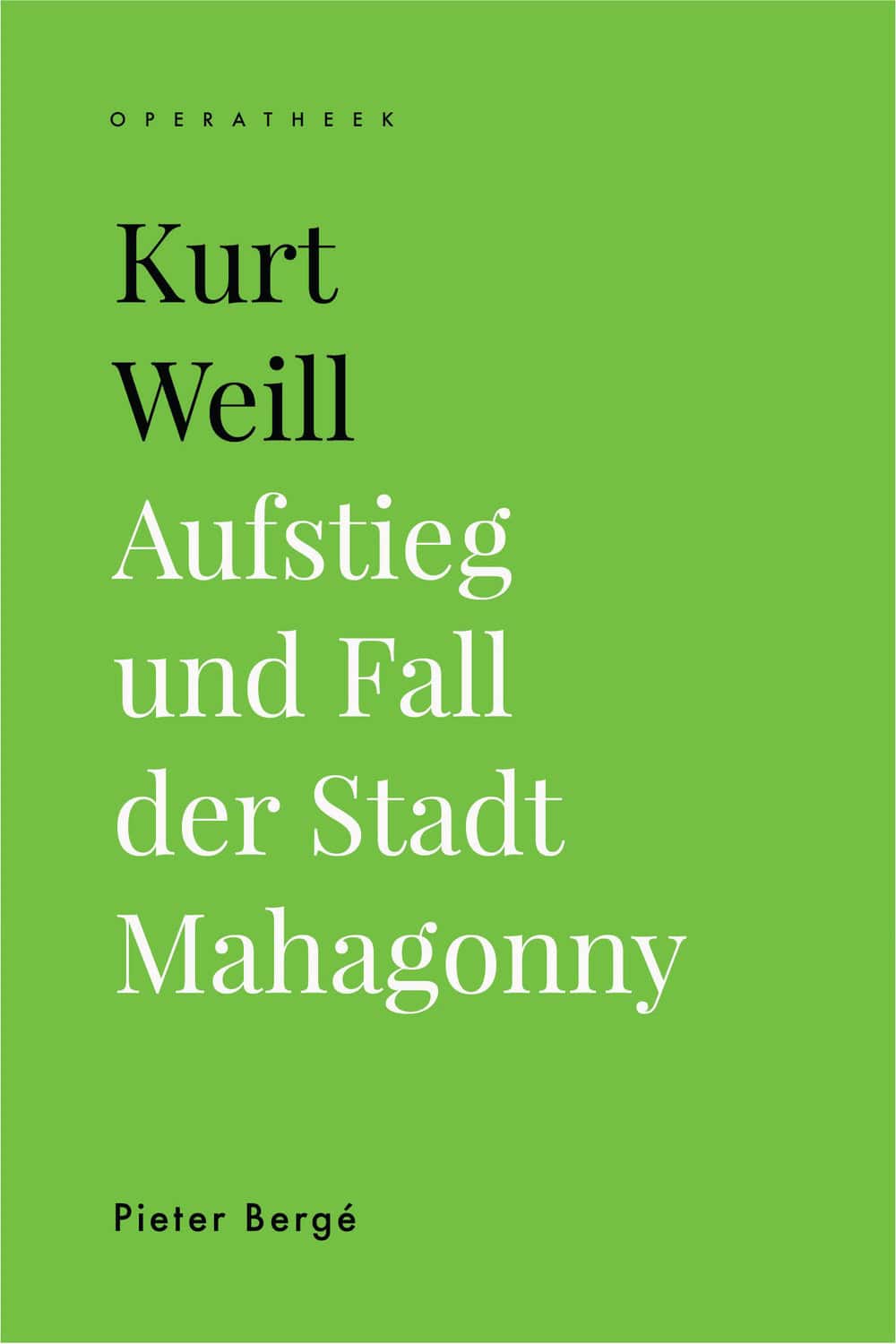
WHO: Pieter Bergé
WHAT: Kurt Weill Aufstieg und Fall der Stadt Mahagonny
PUBLICATION: Operatheek, Opera Ballet Vlaanderen and Universitaire Pers Leuven (ISBN 9789462703346)