


September witnessed the birth of a new Belgian Chamber Orchestra, 'The Romantics'. We spoke with Oriana Dierinck, the founder of this new initiative.
-Tell us something about yourself. What/Who are your greatest musical role models?
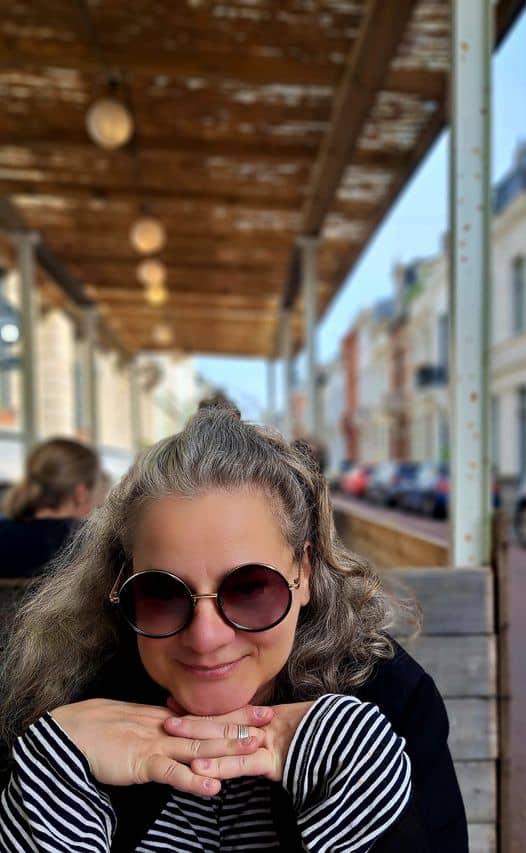 My classical training as a flutist took place mainly in the Netherlands. Initially I had started my studies at the Lemmensinstituut, but I left there – literally – after obtaining my first prize in solfège: I couldn't breathe there and they didn't see who I was. It also felt like it was far too little about music.
It turned out to be the perfect choice: suddenly everything clicked. After completing a DM (Teaching Musician) in Tilburg with Raymond Delnoye (solo flutist Brabants Orkest), I was accepted for the second phase (comparable to what was then called 'Higher Diploma' here) in the class of Jo Hagen (solo flutist Rotterdams Filharmonisch Orkest) at the Rotterdam Conservatory. That way of making music appealed to me enormously – and still does: energetic, in the moment and.. go for it – haha.
Almost every Friday evening I went to listen at the Doelen to that fantastic orchestra, the RPhO. It was a wonderful source of inspiration: I heard (actually it's more "experienced") all the great, important orchestral works in fantastic performances with major soloists and conductors from the international scene. I still remember well the day of my entrance exam – the Gergiev Festival still existed then – where on the same evening Mahler's Third Symphony under Valery Gergiev was on the program. These days it's politically very wrong to even mention his name.. yet he is one of my great inspirations: that man is a genius with a unique vibe.. and it is exactly that vibe that communicates, that makes you – without too many words – feel how he wants the music, your notes. That Mahler III has always stayed with me, it went from soul to soul.. However politically difficult it is, I still think it's essential to make a distinction between the person and their art.
Other great classical musical heroes are largely dead people: Mozart, Tsjaikovski, Stravinsky, Mahler, Wagner.. musicians like Rostropovitsj, Hirschhorn, Horowitz, Schwarzkopf, Callas, Pavarotti, Rampal .. conductors like Kleiber, Rhozjdestvenski, Celibidache… and also the – again "wrong" – rebel Currentzis.
Yet I don't listen to classical music only: I'm a big fan of Blixa Bargeld, David Bowie and Jacques Brel. Tuxedomoon, Current 93, the Legendary Pink Dots, Bauhaus, .. Just last week my partner and I went to a concert by "Die Einsturzende Neubauten" .. it had been a very long time since I felt such a strong connection on, next to, behind and in front of the stage.
The visual also works very well for me as inspiration. While studying, but also "just like that"… I can really be enchanted by an image. Something that often translates into colorful, surrealistic dreams. As a child I liked to paint, but I never took that very seriously. Yet I must admit that over the past decade the boundary between music and image has become a bit blurred: sometimes "strange" paintings emerge and I have become addicted to photography. So much so that, to my own surprise, one of my photos (the self-portrait "O2") in a collaboration with my partner, artist-poet Douglas Park (U.K.), was published by NICC in their festival and associated publication "Without Artists There Is No Art" (MuHKA, 2021). Maybe I should also do something with all those images and photos..
So I lived and worked about 10 years in the Netherlands, mainly Rotterdam. I initially found it a terrible city, but it has never let me go. I taught there (transverse flute and ensemble playing) and played in most Dutch Symphony Orchestras.
Around 2010 I moved back to Belgium (Antwerpen). It may sound strange, but I missed my own dialect. Almost immediately I decided to establish my own chamber music ensemble, Z V E Z D O L I K I, named after a work by Stravinsky.
-What inspired you to establish the new Belgian chamber orchestra, 'The Romantics'?
Pretty much everything and everyone I described above.. plus the beautiful repertoire of symphonic music.
-What distinguishes The Romantics from other (chamber) orchestras?
 The way it was formed. I had been playing with the idea for a long time, but it seemed impossible. At the same time I also felt it could work, so I just started. Somewhere in March-April 2024 I had a pleasant coffee meeting with conductor Michel Tilkin in Leuven and put my idea to him. To be honest, it was with some trepidation because it is and remains an ambitious plan. I also explained to him why I wanted to do this and why this name. Although he warned me about the obstacles, he was immediately willing to collaborate in the form of a first concert.
First step was assembling a beautiful and achievable programme. Then followed a scouting process in which we searched for the right people: musicians who go for the music, who are very good on their instrument and have a sense of adventure and humour.
So based on the desire to want to play beautiful repertoire rather than the "must" to win an audition, because that usually has little to nothing to do with music. The form is also unique: there is currently no professional chamber orchestra active in Belgium.
There is no administrative staff, no HR, no PR people. The strength lies with the musicians and they determine who works with the orchestra as a (guest) conductor. We are (not yet) subsidised, there is (not yet) a main sponsor.. "only" a top Belgian conductor and excellent musicians who are going to "throw themselves" into a beautiful Beethoven programme on 30 November.
Furthermore, I think there is a need for new momentum, a new "fire". The music world is almost "too" conceptualised: everything has to fit in the correct box because the figures are so important. Also.. but I say this with the greatest respect towards authentic performance practice: I think the "stamp" of its founders and representatives has become somewhat too large.. surely it can't be that musicians with modern instruments hardly dare to play Bach anymore..? Doesn't that ultimately lead to stagnation..? And monopolisation..?
In that sense I found and find "The Romantics" an appropriate and beautiful name. I found it while reading Konstantin Paustovki's "The Romantics", in which he writes "the Heart, Imagination and Mind are the environment where what we call Culture is born".
The Romantics also grew out of my ensemble Z V E Z D O L I K I: many musicians I once worked with now play in the chamber orchestra. That way things grow organically.. Collaboration remains important. Between the orchestra members themselves, but also towards the outside world: we want to collaborate with soloists, choirs, organisations, record labels, sponsors … and create our own path in this way.
A nice analogy is that Beethoven himself also assembled an orchestra for the premiere of his first symphony..
-Can you tell us about the birth of The Romantics? (how did you establish the orchestra) Did you encounter obstacles and how did you solve them?
Well.. the biggest obstacle was perhaps myself -haha. I doubted for a long time because I thought I couldn't handle such a large project (because I know from my role within and for Z V E Z D O L I K I what all is involved). So the first step was to push myself into action! Starting is often the hardest part, anyone who starts something exciting will undoubtedly agree.
What was also not obvious: finding the right people. We looked for people who don't fall into the category of "careerists". That sounds somewhat disrespectful, but actually it's not: such a start only works if music comes first. Other, more practical obstacles weren't really there, except that we're still looking for a rehearsal space in Antwerp that's large enough for about 40 musicians.
The opportunity was actually already there: Z V E Z D O L I K I performs a benefit concert every 3 years, "Noot voor Nood" and the 4th edition was scheduled for the end of this year. It's just become somewhat larger than planned..
-You are also founder and artistic director of Z V E Z D O L I K I Antwerp Chamber Music Collective. How do you see the relationship between the two and what distinguishes both ensembles from each other?
I see Z V E Z D O L I K I as a kind of chameleon, because the instrumentation differs per project or programme, but always in chamber music company. Sometimes we play in a trio, sometimes – such as with our "María de Buenos Aires" – there are fifteen people on stage. Z V E Z D O L I K I also regularly collaborates with other art forms, such as visual arts or poetry. The repertoire of Z V E Z D O L I K I is also broader, almost unlimited, so to speak: it ranges from improvisations on Renaissance music, to "regular" programmes with Mozart, Duruflé or Fauré to contemporary work by Henderickx or Celis. Z V E Z D O L I K I always plays without a conductor, regardless of the size of the ensemble.
The repertoire of The Romantics will mainly have Romantic symphonic repertoire as a starting point and will feature different (guest) conductors.
A similarity with The Romantics is that it also started 'from scratch'. By persevering and sticking to my original idea about what I wanted to do, there is now a beautiful international collaboration project with a Basque ensemble where the Basques come here for a concert and we're going to Bilbao in a good week, fully subsidised by the Basque and Flemish Government.
The relationship between the two is that one grew out of the other and both ensembles are "artist run".
-How do you see the future of The Romantics? (the immediate plans, but possibly also in the longer term)
The immediate goal is to give a beautiful concert on 30 November at 20:00 in AMUZ (Kammenstraat 81, 2000 Antwerp). The programme will include a Mozart overture, the famous Beethoven violin concerto with as soloist Queen Elisabeth Competition laureate Sylvia Huang and after the interval Beethoven's first symphony.
That seems to me already quite sufficient in terms of scope of organisation. The starting point as a loose sketch for the future is for now one or two concerts a year, but that can change very quickly..
-Can we infer from the name "The Romantics" that the orchestra will mainly perform 'romantic' music?
The naming applies to both the musicians and the repertoire. Musicians who embark on this adventure typically have a romantic soul. Not in the sense of white grand piano-with-red-roses but in terms of mentality: they believe in the power of music (and art in general) and are idealistic in nature, without being unrealistic. They dream of a better world full of Beauty.
As for the repertoire, the Romantic repertoire will indeed be the starting point. Something that will also be reflected in the way of playing.