

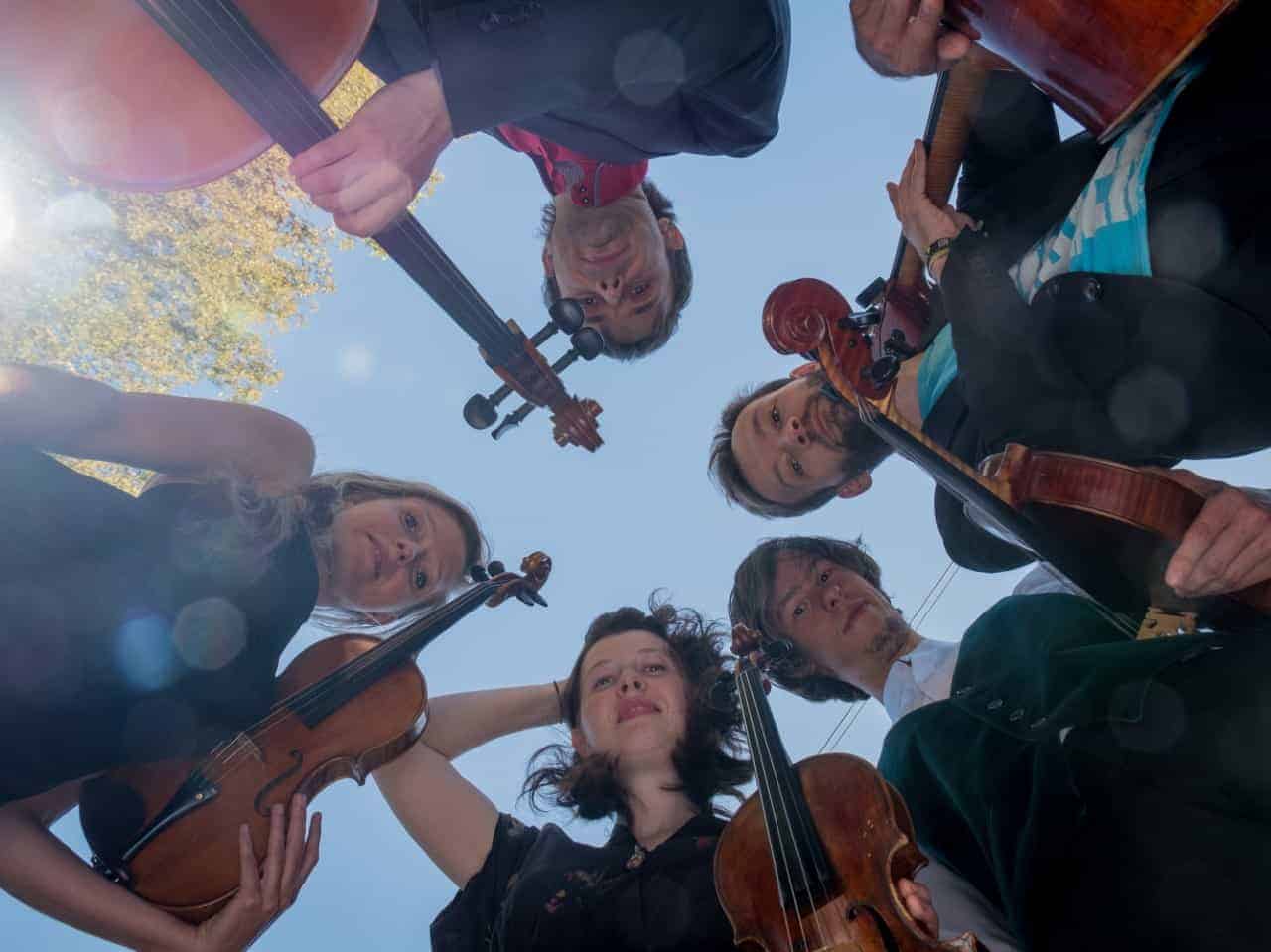
On life's journey, people ask themselves the most existential questions. For musicians, the most fundamental question is obvious, but it is far from simple: why make music? Looking back and with a bit of Hineininterpretierung, one could say that the St. George Quintet was founded to find and give an answer to this calling. After exploring the repertoire of some British Legends and a journey through distant, Bohemian lands, the Belgian ensemble has its answer ready. "One of the reasons why I play music is to develop my abilities as a human being," he says. In harmony it sounds like this: "By devoting myself to art, I hope that I can grow and that other people can do the same ..."
It all started with two good friends from the Symfonieorkest Vlaanderen who wanted to play chamber music together. For double bassist Bram Decroix perhaps not the most obvious choice, but cellist Wouter Vercruysse was certainly all ears. It was not always easy to find good matches to complete the group. First, Bram brought in Dutch violist Marie-Louise de Jong. And together with Wouter, they also persuaded violinist Liesbeth Baelus to join their adventure. Liesbeth knew that Kaja Nowak had just arrived in Brussels. Once in Belgium, she ultimately took the position of second violin.
Inspired by this girl power, the St. George Quintet celebrated its first successes. After winning the Supernova prize in 2016 and recording their debut album British Legends, the Georgians decided to travel to the Czech Republic. In June 2017, they took the so-called Dvořák Express: the train connecting Prague and Brno, the cities of Antonin Dvořák and Leoš Janáček respectively. This journey not only provided an opportunity to talk with the local population and learn more about their relationship with their cultural heritage. The goal was also to record a video that would be used for concerts, in which cinematic impressions of the journey would be projected between the pieces.
February 12, 2019. The ensemble's Eastern European experience ultimately resulted in a second CD. Together with the festive release of Bohemia Express, the ensemble – with Diede Verpoest as the new viola player – performed this engaging combination of live music and film in the Miry concert hall in Gent. It turned out excellently. Perhaps the biggest surprise of the evening was the appetizers. Janáček and Dvořák set the stage for an arrangement of famous Queen songs, which proved to be a fitting finale for this Bohemian Rhapsody.
Just over two months later in sunny Brussels. On the steps next to the bar of the Brussels Beer Project, Kaja Nowak warmly welcomes me to her cozy apartment on the first floor. Wouter Vercruysse is already waiting in the living room. He has his laptop with him. It will soon become clear that he has prepared our conversation well. And the lady of the house too, albeit in a different and tastier way. Pottery and a selection of Polish pastries: the surprise offering looks delicious. But before we indulge ourselves, we first talk about beauty and music.
Based on the name of the St. George Quintet, which the ensemble took from 19th-century Franco-British composer George Onslow, it is surprising that your second album also does not include music by the so-called 'French Beethoven'. Why is that actually?
Wouter Vercruysse: It is really in our DNA to record the string quintets of Onslow in the long term. But the idea of the Bohemia Express came up very spontaneously. All members of the group were immediately enthusiastic. And because I have the gift of selling things that don't yet exist (laughter and agreement), I pitched the idea to some concert organizers and they too were won over by the concept. So this became a priority. Originally it was nothing more than a video and concert project. The album came later. I still vividly remember the discussions about the difficulty of the Dvořák quintet (opus 77), which is a demanding piece to perform. But ultimately we decided that it was now or never if we wanted to record it on CD.
Kaja Nowak: In preparing for concerts, we worked hard on the piece, so it seemed only natural to us to make a recording as well. Yet the Onslow is an idea that we will certainly take up at some point. But I'm just not sure if we've completely figured out yet where we can combine the Onslow with during concerts; although we need that to experiment with different interpretations and see how that works out. Of course we can play his music, but we're still thinking about an attractive format. One option we're considering now is to pair the so-called 'French Beethoven' with the string quintet of the real Beethoven, and combine that with fragments from Tolstoy's The Kreutzer Sonata. But that's not so easy to realize due to the length of both works.
Instead of choosing Onslow, in 2017 the quintet traveled to the Czech Republic to draw inspiration and decided to dedicate its new album to the work of Dvořák and also Janáček. Where did the idea come from to turn this journey into a performance with live music and video?
Vercruysse: We see it as our mission to broaden the audience for classical music by trying out different configurations. That's why we were also looking for a new way to put Dvořák's quintet in the spotlight. We played with the idea of turning the program notes into a performance, and for that we would interview a number of very interesting musicologists and musicians in both Prague and Brno. By showing images before and sometimes also during the different parts of the music, we wanted to give the audience a glimpse of the context and the country in which these composers worked. At the same time, the general public gets a behind-the-scenes look and gets to know us better, making the concert a more personal experience.
Nowak: The film truly fulfilled its role as a means of bringing the music closer to people who normally wouldn't listen to classical music. We received a lot of enthusiastic reactions from the audience. The alternation between film and music makes the pieces more accessible, something many people appreciate.
Where did the eagerness to work with East European music come from?

Nowak: Shall I give the pragmatic answer? The point is that Dvořák's quintet is probably the most well-known piece to play in our instrumentation of string quartet with double bass. This piece was therefore our starting point and also the first work we ever performed as a group. After that we looked for something that would work well with it. Then we came across that incredible Janáček, also a good friend of Dvořák, and the piece by Suk. I think we are also truly emotionally connected to the Suk: a short work that has something very special about it. It is very imaginative, almost like poetry.
Vercruysse: Josef Suk, Dvořák's son-in-law, wrote his Meditation on an Old Bohemian Chorale in honor of Wenceslaus the Saint (opus 35a) as a tribute to the patron saint of the Kingdom of Bohemia, the largest historical region of the country. In Prague you see quite a few statues of him. When World War I broke out, Bohemia was still part of the Austro-Hungarian Empire. That's why every concert had to begin with the imperial anthem: the famous Gott erhalte Franz den Kaiser, set to music by Haydn. Suk added a new Bohemian national anthem to that program. It was a kind of fragile protest song against Habsburg imperialism, which aroused feelings of emancipation.
How did Lars Konings, the director of the film, come on board the Bohemia Express?
Nowak: He is actually first and foremost a musician. That's how he met our former violist Marie-Louise de Jong, who still appears in the film (current violist of the Dudok Quartet Amsterdam, ed.). They studied together at the Maastricht Conservatory. He is a very skilled pianist. As a hobby, he also threw himself into making films, and began taking it increasingly seriously. Eventually it became his profession.
Vercruysse: We got to know Lars as a very passionate producer of artist videos for our first album British Legends. It was such a great pleasure working with him that we invited him to join the Bohemia Express, which was a much larger project. As a musically-oriented filmmaker, he helped conceive the concept of the program and at the same time also operated the camera.
What becomes clear during the travel report is the importance of folk music, and folk songs in particular, for understanding the compositions of both Janáček and Dvořák. How great is the challenge for a Belgian ensemble to deal with this folkloric language?
Vercruysse: It's a great challenge, especially if you want to connect with the folkloric core of the music. Especially since Moravian and Bohemian folk songs are very local and not as widespread as, for example, the Scottish or Irish folk tradition. But on the other hand, it's already been filtered somewhat because it's still classical music. The music itself forms a bridge, because the language is tonal and therefore more or less what we're used to. Nevertheless, we were very pleased with the guidance of Pavel Fischer, the former first violin of the Škampa Quartet and a very active folk violinist. He emphasized the importance of both intonation and accents in the Czech language, which have a major influence on how the music of Dvořák and Janáček should be played. He made us recite their works more than sing them, which was a real revelation for us.
Kaja, is it easier for a violinist with a Polish background – or for the Pavel Haas Quartet for example – to immerse herself in this music?
Nowak: In my heart, I feel in a certain sense closer to this music, especially because I come from an adjacent region. But on the other hand, there are all the details we just discussed, and those are so different. Polish and Czech culture have much in common, and I also understand a bit of the Czech language, but both countries are still different enough. That's why the lessons with Pavel Fisher were also incredibly interesting for me.
Vercruysse: Ultimately, it also depends on your training. If you've been trained in the French-German or Russian interpretive tradition like we have, that's something completely different from what you encounter in Czechia. On our trip, we were very surprised to hear that music is part of their daily life there. It's not something hidden away in a music school classroom, but rather something organic. Many people, from children to the elderly, sang and knew folk songs!
Compared to, for example, Belgium or the Netherlands, Czechia has produced quite a few famous composers. Is this just coincidence, or is there really something special to be found in the Moldau, besides the dead fish that Wouter spots in the film?
 Vercruysse: This is a question I've asked myself many times in the past and for which I've developed a theory. When I look at history, I see that the rise of cultural capital coincides with powerful societies. When the Burgundian realm was at its height, Flanders took a prominent place, and it also generated many famous composers and painters. During the classical and early romantic period, the Habsburg monarchy was dominant in Europe. Vienna was truly the place to be. Haydn, Mozart and Beethoven were attracted to that city and worked there. I also believe it's no coincidence that Bach had a definitive breakthrough only a hundred years after his death. That moment coincided with the rise of Prussia, which also increased interest in national heritage. In the 19th and early 20th centuries, Bohemia was part of the Austro-Hungarian Empire. Cities like Brno and Prague were very close to the cultural hotspot Vienna and profited from it. Mozart often visited Prague and experienced some of his greatest successes there. In the second half of the 19th century, national cultural awareness emerged through the music of Smetana, especially through his operas written in Czech. The Austrian rulers were 'liberal' enough to tolerate this development. It was continued by others such as Dvořák, Janáček and Suk. After the Great War, with the independence of Czechoslovakia, Brno and Prague flourished. The country became one of the richest in the world, and it consolidated the legacy of its greatest composers by exporting their music as a national cultural product. At the same time, music was an equally important part of identity. But unfortunately that came to an end when first the Nazis and then the Soviets took control. Martinů was actually the last Czech composer to achieve international fame.
Nowak: That's why I think talent is found everywhere, but it needs to be nurtured. If there's no money, it's difficult to provide education. An artist might not be happy to admit it, but in the history of mankind, the interaction between culture and power has been a very important factor. And it still is today.
In the film, one of the interviewees considers Dvořák's music a "symbol of the internationalization of our music". At the same time, the roots of this music are essential for its existence … Do you have an explanation for this interesting paradox?
Nowak: It's interesting to compare Dvořák and Janáček with each other. Although Dvořák became famous by drawing on Czech folklore, he was also deeply rooted in the classical language of his Viennese predecessors. That's even audible in his most 'folk-like' works. Janáček, on the other hand, used folk songs to quote them literally rather than rework them into classical sonata themes. He went much further in reinventing his musical language and breaking with classical structure. In a sense, this could mean that Dvořák's music, which is closer to classical forms, is more accessible to Western Europeans, while Janáček's work requires more listening time to understand it.
Vercruysse: As a young composer, Dvořák had little success in Vienna because he was a kind of wannabe Brahms. But abroad, people weren't interested in a copycat, so he had to find his own voice. At the moment he began finding inspiration in Czech folk music, his work was picked up abroad. The Slavonic Dances became his greatest hit and breakthrough, even though they were only a little bit folkie – Dvořák actually invented the melodies himself. According to the well-known Dvořák expert David Beveridge, whom we also interviewed during our trip, the string quintet was a milestone in that respect: it was one of the first works in which he consciously incorporated melodies in a folk style.
A moment in the documentary that I really enjoyed is when the five of you discuss what is most important when playing music. Wouter exclaims: "Emotion must come first!" But then, as Kaja states in the promotional video of your new cd (see below): "Of course you also have to use your mind." How do you reconcile emotion and reason when playing music?
Vercruysse: You're talking with two very instinctive musicians, so perhaps we're not the ones you should ask this question (laughter). But I've thought about it and I'm convinced that by reconciling feeling and reason, you can reach a higher level of consciousness. It's one of the reasons why I play music: to develop my abilities as a human being.
Nowak: Yes, I can really relate to that! Because it's such a delicate balance between emotion and intellectual engagement. And we often struggle with it. If you try to concentrate on a number of details of the score, you risk playing without feeling. On the other hand, you can also throw the whole thing off balance if you play more from the heart. But there's a kind of third perspective, where you make it possible for yourself to connect both to each other. To give a simple example. Sometimes you practice something slowly. You concentrate on a technical aspect, but you feel that it's stuck. At that moment, it frees you if you try to think more musically. Recently I spoke with someone about affects in music. In the Baroque, as a musician you had to reproduce these affects to achieve the desired effect on people: there was no question of feeling that emotion yourself during the performance. Apparently Carl Philipp Emanuel Bach was the first to indicate that you must understand the emotion and also feel it in order to reproduce it. At that moment the musician appeared as an emotional being on stage. But this discussion is still ongoing today. In a sense, reason is not just something that analyzes and calculates, but it is also a creative tool. Based on the music you have before you, you must put your mind to work to express all those emotions. That's why both function in a tight harmony. Ultimately, I don't really see this opposition as a problem. If you can combine emotion and reason, you raise the quality of your playing.
In the penultimate scene of the film it becomes clear to Wouter that the group has discovered something during this fascinating journey through Bohemia and Moravia. What you found there is actually an answer to perhaps the most important question an ensemble can ask itself: why do we play? What is the answer to this existential question according to St. George Quintet?

Nowak: It's a very important and relevant question: people want to know why we do this, why we make music. – (from 5:15, ed.). What I say there is that I think making music develops you enormously. It helps you to become more sensitive and also more disciplined. It shapes your character. Measuring yourself against the greatness of music humbles you and makes you work not only on yourself, but hopefully also on your relationship with other people. For me, that's one of the most important, if not the most important result of art: the expression of feelings that we ultimately all share. It's not something subjective. It's the mysterious, inexplicable feeling that the first people poured into their cave paintings, and that will continue to inspire us with joy, awe and fear. It's something wonderfully beautiful and moving that all people have in common. So by devoting myself to art, I hope that my understanding and compassion can grow and that other people can do the same …
The recording of Bohemia Express is a story in itself. The ensemble organized a crowdfunding campaign and received support from some lesser-known organizations like Beeldenstorm. How did the cd come about? Was it different from the first recording you made?
Nowak: Beeldenstorm certainly deserves a mention, because it's a fantastic non-profit organization. Nik Honinckx, the director, is an incredible supporter of the arts. Perhaps you could write an article about him sometime?
Vercruysse: It's a Dutch-language community center in Kuregem. They support many classical music productions and work closely with Etcetera Records. Their financial support for our project was very welcome. And we were also happy to rehearse there.
Nowak: We made our first recording shortly after we became one of the three laureates of Supernova in 2016. We received support from both Concertgebouw Brugge and Klara. The cd was produced together with Pavane Records. For our second album we wanted total artistic freedom: in what we would record, where we wanted to do it, how we would design the cover and so on. So we took the production entirely into our own hands.
Vercruysse: One of the things we really wanted to do was record the CD at the Brussels Conservatory. And we also wanted to choose the producer ourselves. Rachel Smith is one of the most renowned producers in England. She wins prizes every year. It was truly a privilege for us to be able to work with her. She is exceptionally good at what she does.
Nowak: We noticed that during the recordings, which went very smoothly. Rachel is very good at giving feedback. And that is quite a difficult matter. You want a producer who points out all the necessary details, but some things can't be changed anymore. So someone who is too picky or too stubborn will cause tensions. You really have to know when to steer and when to let go. At the same time, you also have to be very confident when you have a good result. That's not easy with five people who each want an extra take to make sure they've played well (laughter).
How important is perfectionism ultimately for a musician? Because it does have something devilish about it … Something that is perfect is not really what people want to hear or search for, is it?
Nowak: It's true that technique is the means to achieve a goal, and you always have to keep that in mind. If you focus only on that, it becomes quite boring. On the other hand, you do need a certain level to get your message across. Otherwise you won't be able to convince the audience.
Vercruysse: Through recordings and high-quality streaming, people are getting used to virtual conditions. That's why we think the audience wants something perfect. I always think of a confession from the world-renowned cellist Yo-Yo Ma. "You know, Wouter, when I really worry," he told me once. "When I play a concert, and I reach the end … and I haven't made a single mistake." And he added: "For me it's really reassuring to make a mistake at the beginning or in the middle of a concert. Then we've already got that out of the way!"
Who made the beautiful drawing on the album cover?

Vercruysse: The drawing is by Jan-Sebastiaan Degeyter, a Bruges artist who lives and works in Ghent. He had created CD covers before, and we liked the result. We gave him some suggestions about what we wanted and we were very pleased with what he created. The inside of the album was also done by him. You can see some details of the places we visited on our journey: Prague, Dvořák's birthplace in Nelahozeves, the folk festival, …
Nowak: And all of this through the large window of a train (laughter).
As Ralph Waldo Emerson may once have said or thought: "Life is a journey, not a destination." Still, what will the next destination of the Georgians be; the next project you would like to start?
Vercruysse: May I daydream for a moment on this beautiful day? I would very much like to go to Argentina to make a story about Buenos Aires and Astor Piazzolla. But more likely, and also more realistic, it will be a program with Onslow and Beethoven that we talked about at the beginning of our conversation.
Kaja, Wouter, Liesbeth, Diede and Bram: may Saint George be with you. Always!
- WHAT: Interview with Kaja Nowak and Wouter Vercruysse, second violinist and cellist of the St. George Quintet, in connection with their latest recording Bohemia Express and the associated concert performance, which took place on February 12, 2019 in the Ghent Miry concert hall.
- WHO: St. George Quintet [Liesbeth Baelus and Kaja Nowak (violin), Diede Verpoest (viola), Wouter Vercruysse (cello) and Bram Decroix (double bass)]
- WEBSITE: https://www.stgeorgequintet.com/
- PHOTOS: © Lars Konings | Filip Verpoest
- LINK TO THE ORIGINAL TEXT (EN)