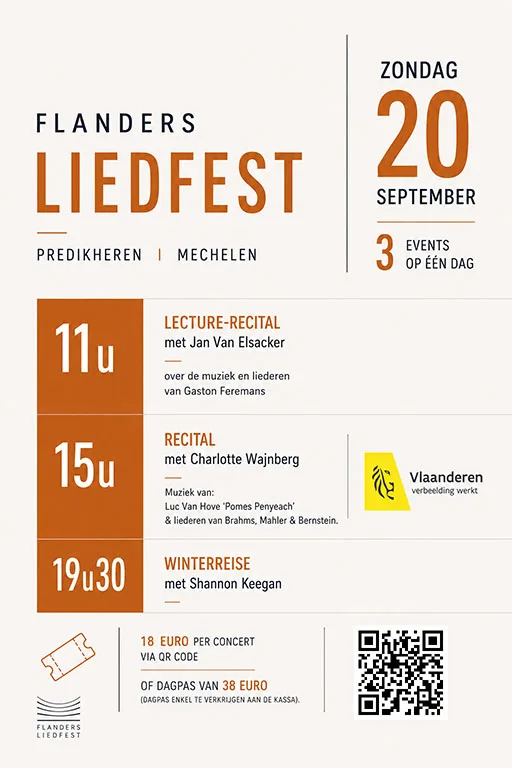
This conversation took place following the Flanders Liedfest, the festival in Mechelen where internationally acclaimed tenor Jan van Elsacker will soon take the stage. He will not simply be performing repertoire there, but will honor his own grandfather with some lieder and stories: composer Gaston Feremans.
Jan, you never personally knew your grandfather, since he passed away in February 1964 at the age of 56 and you were born in 1965. How did you get to know him so well?
Jan nods thoughtfully and takes a moment to gather the memories. "That's true," he begins. "But as a young boy of about sixteen, I listened to his records almost daily and gradually began to immerse myself in his scores. Nowadays, I'm also going through thick folders of his personal letters, kept in the Letterenhuis. Then you really see what kind of network he was part of: there is correspondence with Willem Elschot, Stijn Streuvels and poet Karel Vertommen, who wrote a lot of texts for him. Recently I even found a special manuscript in the archive with a dedication stamp to André Rieu Sr., the father of the famous violinist, who was then a conductor in Amsterdam! Through these documents I really get to know the man behind the music."
And was this man a true musical prodigy?
"He was enormously talented, yes. Born under the Mechelen Sint-Romboutstoren, as a child he already sang arias from Die Schöpfung with a beautiful tenor voice and at a young age he already played the extremely difficult First Piano Concerto of de Jong. He became director of the academy in Aalst at a very young age and later also director of the N.I.R., the then Flemish Radio. But unfortunately he also experienced a great deal of tragedy."
You're referring to the war years and the difficult period that followed?
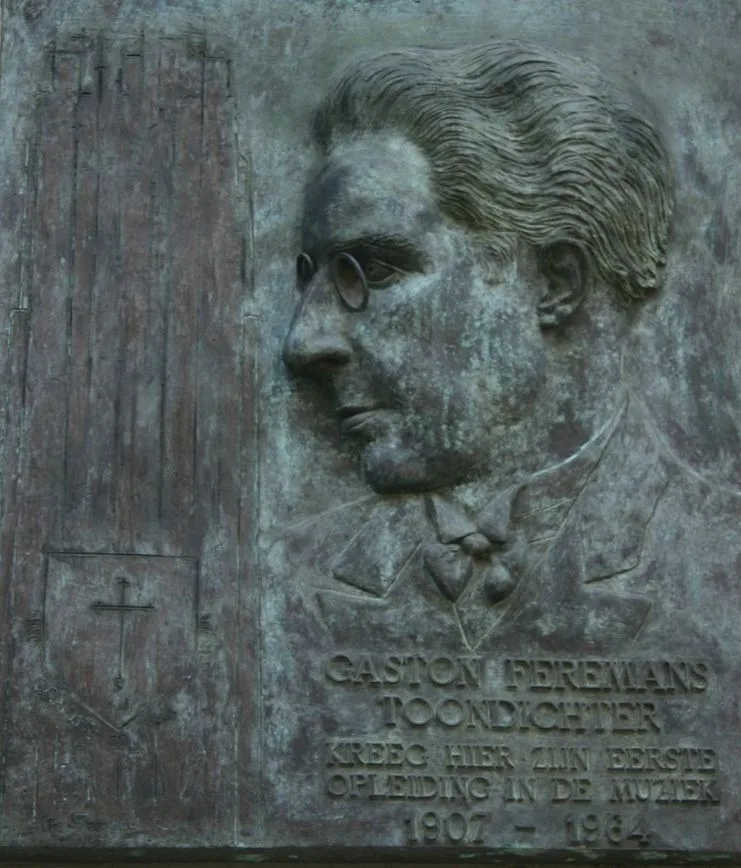 Jan sighs and wholeheartedly confirms this. "Because he was an outspoken Flemish activist and worked at the radio during the occupation, he was arrested in 1945. This happened precisely on the day my mother, Marina, made her first communion. After his release, his civil rights were taken away. To support his large family, he worked as a sexton in the Sint-Antoniuskerk in Antwerp and orchestrated, purely out of financial necessity, many works by his colleague Jules Van Nuffel for the radio. He did have deep respect for him and for composer Jef Van Hoof. Unfortunately, my grandfather remained seriously ill for the rest of his life."
After this harsh reality, Jan becomes quieter for a moment, but a moved look soon reappears in his eyes. "But music was also a true purification for him even in those dark times. In that freezing prisoner camp, he founded the 'Feremanskoor', also known colloquially as the 'Klompenkoor'. When they rehearsed his specially composed Missa Recollectionis (Mass of Reflection) for Christmas, the men broke into tears at the first Kyrie. The music gave them a glimmer of happiness in a pitch-black period." Or as they put it themselves: "Master Feremans had worked for weeks on a three-part mass. It was bitterly cold and there was no fire in the barracks. On the roof edge of the chapel barrack, icicles hung a meter long. But every afternoon there was singing and working. At the first sounds of the Kyrie, the pent-up pain broke open. Tears rolled down everyone's cheeks — tears of sorrow, but also an indescribable glimmer of heartfelt happiness that for many became a real star in those dark days."
So there was a lot of pain in his life. But I understand he also possessed a very sharp, musical talent?
At this thought, Jan begins to laugh heartily. "Absolutely! My uncle Jan, Gaston's eldest son, once asked me if I could improvise on the piano. He then told me that my grandfather once had to play the Brabançonne at an official occasion. Well, as a convinced Flemish person, he managed to weave the melody of De Vlaamse Leeuw through it in an extremely subtle way. That just typifies him completely. At the end of his life, he worked with that same passion on a gigantic dream project, the Geuzensymfonie, on texts by Karel Vertommen. Due to his early death, that was unfortunately never completed."
That uncle Jan was also very important for the musical legacy, wasn't he?
"Absolutely," Jan confirms with much warmth in his voice. "Uncle Jan was an engineer, but himself also very musically talented. He digitized a huge portion of his father's oeuvre. In 1997 he still organized a major memorial concert for Gaston's 90th birthday. And in 2007, the Marnixring had Het Bronzen Hart and Concerto Grosso by Gaston Feremans performed again. My uncle Jan was there. During rehearsal I saw him become moved several times. For him, these were not just compositions. He had seen his father write this music and had experienced that period himself. The combination of memory, loss and pride made a deep impression. I still carry that image with me today." Jan added that Het Bronzen Hart is actually a personification of the Sint-Romboutstoren. Gaston had indeed lost his heart to the tower and cathedral.
You yourself sing at an international level, but as a child you were already on stage. Was that musical blood already present then?
Jan laughs out loud. "You can say that again! Did you know that in 1977 as a young boy I sang along in Hoe de slakken een huisje kregen, a youth cantata based on a fairy tale by Queen Fabiola? I got to sing the solo of Yogo, the little snail. Years later, when Fabiola was seriously ill, the radio was looking for material from her and then they dug up that old recording with my 'snail solo' from the VRT archives!"
Wonderful! To return to your grandfather's music for a moment: what do you see as a singer in his work, and what would you recommend to people who don't know him yet?
 "Gaston Feremans' work falls under post-romanticism and is characterized by extremely rich harmonization and orchestration," Jan explains, returning to his serious tone. "His absolute masterpiece is Het Bronzen Hart, an ode to the Sint-Romboutstoren in Mechelen in which he combines a carillon — based on a theme by Jef Denyn — with a symphony orchestra. But for those who want to discover him, I really recommend his brilliant folk song arrangements, such as 't Sneeuwwit vogeltje or Heer Halewyn. What he made of them truly gives you goosebumps."
Jan pauses for a moment and then adds: "For me personally, it's always a matter of finding which works suit my voice well. I select that repertoire extremely carefully, because his music requires a lot of space and openness when singing. By the way, it's a nice coincidence that I also studied singing at the conservatory under Liane Jespers. She sang and recorded, at the time under the direction of conductor Staf Nees, an enormous amount of his work and was my grandfather's absolute favorite singer."
It seems there is currently a real rediscovery of his work taking place. Where can we listen to his music again soon?
"There's a lot happening at the moment!" he tells us proudly. "Recently, I was contacted from Aalst. After a moment of considerable concern, we received fantastic news: the original manuscript of his Priester Daenscantate from 1939, which was never performed due to the war, was safe and sound in the archives of the Letterenhuis. In Aalst they hope to finally bring that newly discovered work to life on 10 November 2027. In addition, there is the Vlaamse Liedfest in Mechelen, supported by pianist Aaron Wajnberg and the Marnixring. There are a lot of nice initiatives planned around my grandfather there, where I myself get to take the stage to sing some songs and tell about his life. There is also a larger, official concert planned for late January, where among other things his most beautiful song cycle, De Jaarkrans, will be performed."
After reading this piece, you may well ask yourself why the title of this interview is 'Jubel!'? Well, be sure to go to the Flanders Liedfest, because there Jan will, with a bit of luck, give you the answer to this question. It will probably be an emotional answer... just like the music itself and the whole rest of the day!