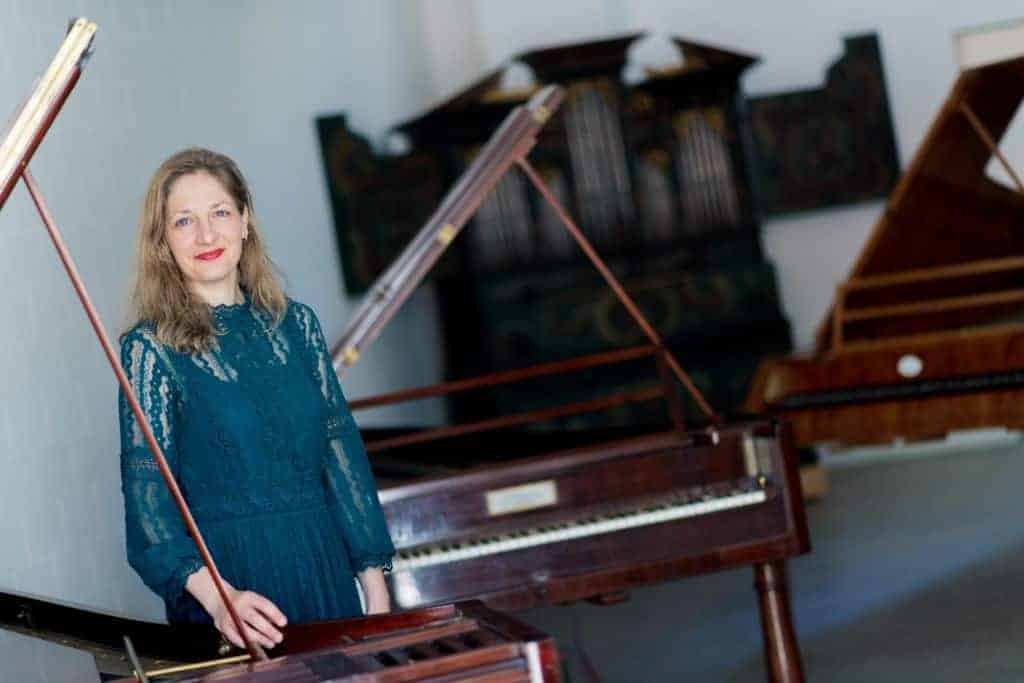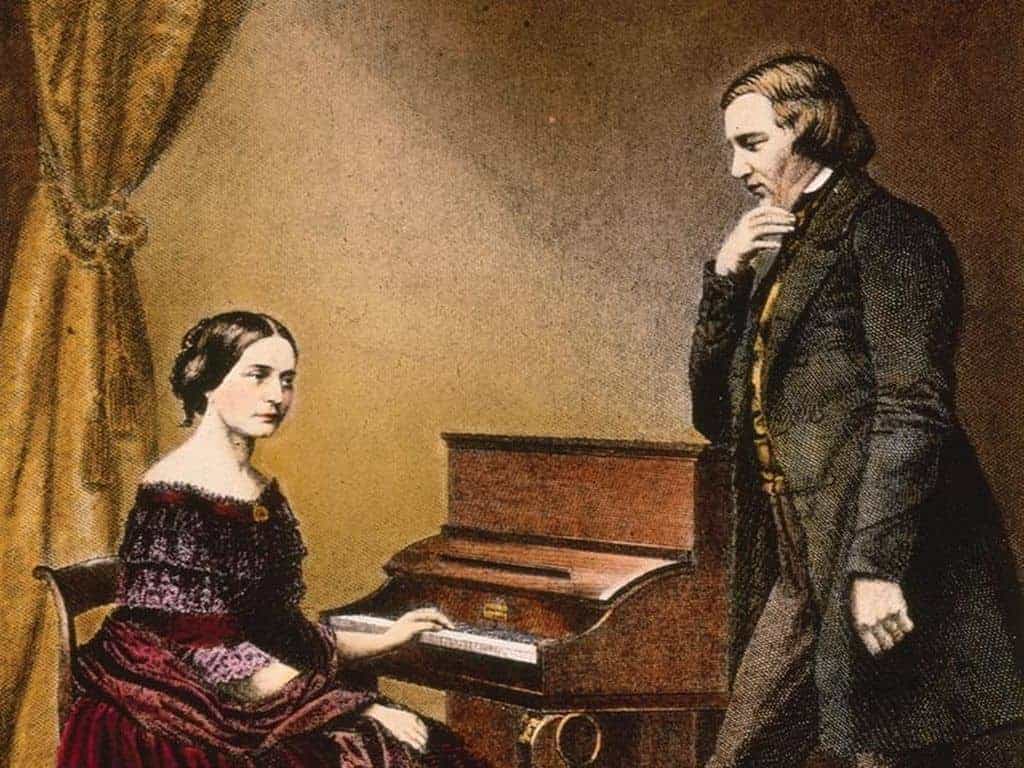
On Saturday evening, March 23, 2024, AMUZ will be immersed in the full romanticism of the piano by Els Biesemans. That evening she will make it the home of Robert and Clara Schumann.
The programme that Els compiled is inspired by the 'Davidsbund' that Schumann created - a group of like-minded people, consisting of living composers, but also already deceased ones, who fought against the 'Philistines'.
Schumann founded the journal 'Neue Zeitschrift für Musik' in 1834, which still exists today. He wrote numerous articles on music, often under different pseudonyms. He also gave other authors different names, such as 'Jeanquirit', pseudonym for Stephen Heller, who was a composer he valued and a kind of foreign correspondent from Paris. In addition to many etudes for piano, he also composed virtuosic music, such as this fantasy on a theme by Schubert. Schumann felt great admiration for Mendelssohn and an intimate friendship. And of course Clara was a constant in his life. The Davidsbündlertänze are based on a musical motto from one of her Mazurkas, which also resounds in the programme.
- Franz Schubert (1797-1828)
Impromptu B-flat major, op. 142 no. 3
- Stephen Heller (1813-1888), alias "Jeanquirit"
Caprice brillant on "Wohin" by Franz Schubert, op. 33 no. 1
- Clara Schumann (1819-1896) alias "Chiarina"
Romance in G minor op. 21 no. 3
- Felix Mendelssohn Bartholdy (1810-1847) alias "Felix Meritis"
Variations sérieuses, op. 54
- Clara Schumann (1819-1896)
Mazurka from Soirées musicales, op. 6
- Robert Schumann (1810-1856) alias "Florestan" and "Eusebius"
Davidsbündlertänze, op. 6
A word about the programmed works
The Davidsbündlertänze (later called 'Davidsbündler') are eighteen pieces for piano composed in 1837 by Robert Schumann, whom he named after his invented music society Davidsbündler.
Robert Schumann's early piano works were considerably influenced by his relationship with Clara Wieck. On September 5, 1839, Schumann wrote to his former professor: "She was practically my only motivation for writing the Davidsbündlertänze, the Concerto, the Sonata and the 'Novelettes'. They are an expression of his passionate love, fears, longings, visions, dreams and fantasies.
The theme of the Davidsbündlertänze is based on a mazurka by Clara Wieck. The intimate character pieces are his most personal work. In 1838, Schumann told Clara that the dances contained "many marriage thoughts" and that "the story is a whole Polterabend (German wedding celebration where old dishes are broken to bring good luck)". He also wrote to her that he had never been so happy while composing.
The pieces are musical dialogues between Schumann's characters Florestan and Eusebius. They represent respectively the tempestuous and the lyrical, poetic side of Schumann's nature. Each piece is attributed to one of them or to both. Their names follow the first piece and the appropriate initial or initials follow each of the other pieces, except the sixteenth (which passes directly into the seventeenth, whose attribution applies to both) and the ninth and eighteenth, which are respectively preceded by the following remarks: "Here Florestan ended, and his lips trembled painfully", and "Rather superfluously Eusebius remarked the following: but all the while great bliss spoke from his eyes."
Els Biesemans is an internationally sought-after pianist, organist, chamber musician and lied accompanist. Her concerts are characterized by stylish and unconventional programmes.
With a striking nuanced touch and expressive virtuosity, she brings to life the versatility of fortepianos, organs, harpsichords and modern pianos. Els Biesemans is known as a brilliant interpreter of famous composers and as a discoverer of forgotten musical gems. Julian Prégardien, Marie-Claude Chappuis, Giuliano Carmignola, Avi Avital, Pieter Wispelwey and the Gringolts Quartet are some of her musical partners.
After studying at the Lemmens Institute in Leuven, she focuses on the keyboard repertoire of the 18th and 19th centuries at the Schola Cantorum Basiliensis. With a repertoire ranging from the Middle Ages to the present day, she wins many awards. The Antwerp artist is laureate of international competitions in Bruges, Paris, Prague, Tokyo and Montreal. She won first prizes at the Ciurlionis competition in Vilnius and at the Arp Schnitger competition in Bremen. Her concert career takes place in Europe, Japan, Canada and America. She is repeatedly invited to the Berlin Philharmonie, the Tonhalle Zürich, Salle Philharmonique Liège, BOZAR Brussels, Maison de Radio France Paris, at Musikfest Bremen, the Bach Festival Montreal, Bachfest Leipzig, Musikfestspiele Sanssouci Potsdam. Various CDs document her work. As a soloist on the fortepiano, she shared the stage with, among others, La Cetra and Andrea Marcon, Capriccio Barockorchester, Hofkapelle München, Orchestra of the Opera in Zurich, La Festa Musicale and Ensemble 1800. With her own Ensemble Elsewhere, she explores the repertoire of the 19th century.
- Els lives in Zürich. She directs the fortepiano festival «Flügelschläge» there.
- WHAT: Piano recital about and around Robert Schumann
- WHO: pianist Els Biesemans
- WHERE & WHEN: 23 March 2024, AMUZ, Antwerpen, 8 pm
- WEBSITE: AMUZ – book tickets here
- PHOTOS: © Tatyana Jenni