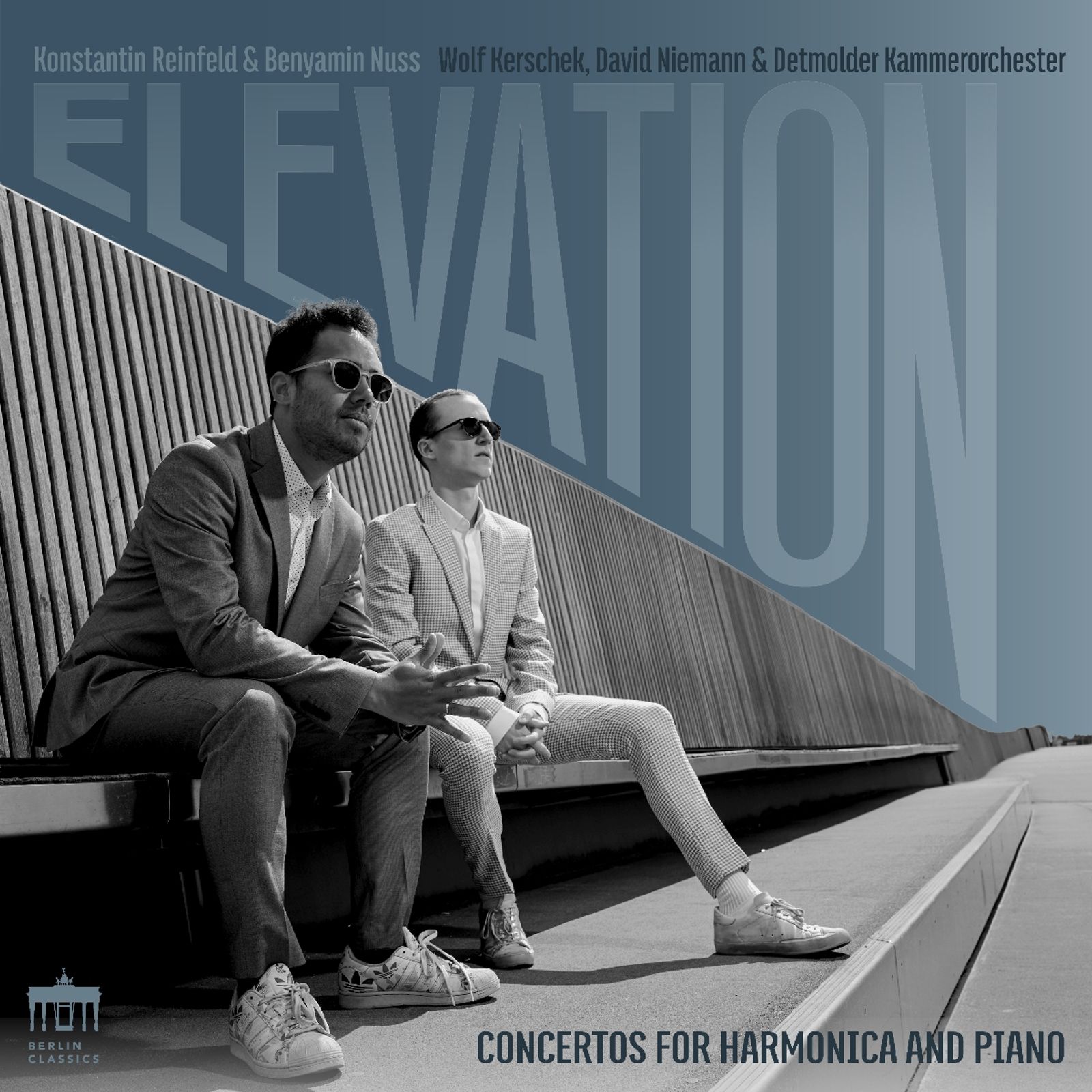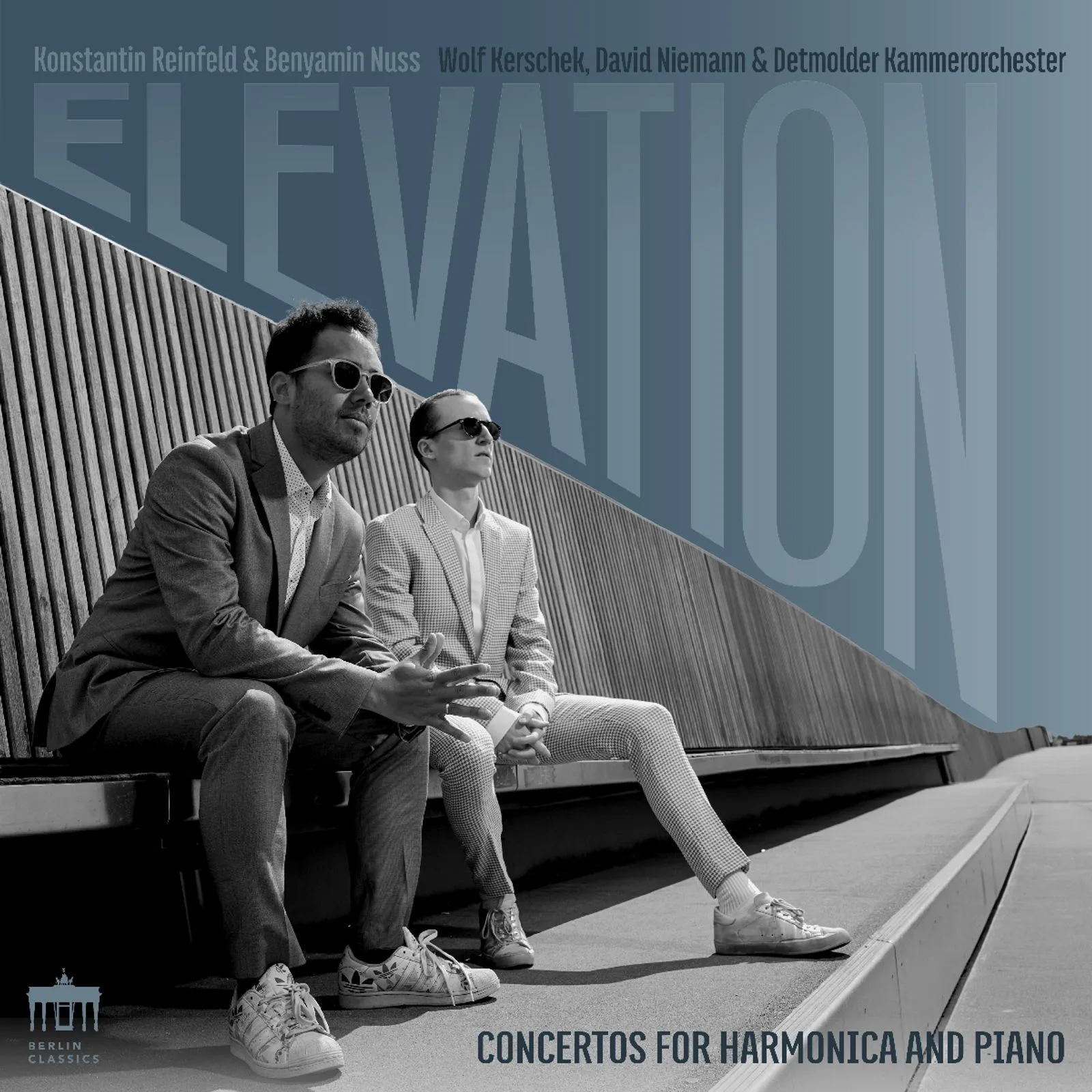
When one thinks of the harmonica, blues, folk or popular music quickly come to mind. That a diatonic harmonica can also take on a prominent solo role in new concert music for piano and orchestra is considerably less familiar. That is precisely the starting point of Elevation, the new CD by Konstantin Reinfeld and Benyamin Nuss. With an orchestral suite by Wolf Kerschek (b. 1969) and a concerto by Benyamin Nuss (b. 1989), the two musicians bring together music in which the harmonica emerges as a versatile concert instrument. At the same time, the boundaries between classical music, jazz and other musical idioms blur.
Reinfeld and Nuss have worked together for years and move between classical repertoire, jazz, improvisation and crossover. For Elevation, their duo is joined by the Detmolder Kammerorchester under the direction of David Niemann. Over a little more than 54 minutes, two composers approach the same unusual ensemble from different angles. Both works, moreover, appear here in their world premiere recordings.
The Baroque as a starting point
The joy of playing is evident from the first bars of the CD. In Kerschek's accessible and melodic Orchestral Suite for Harmonica, Piano and Chamber Orchestra, the harmonica immediately shows how many facets the instrument can have. Reinfeld moves effortlessly between lyrical melodies, rhythmic sharpness and virtuosic passages, while Nuss regularly gives the piano part a color of its own. Jazzy undertones and unexpected timbres give the music a liveliness far removed from a traditional Baroque pastiche.
Kerschek takes the Baroque dance suite as a starting point but gives the historical forms a personal musical interpretation. The five movements bear titles such as Gyrating Gigue, Spooky Sarabande, Courageous Courante and Amusing Allemande, followed by The Last Waltz. Behind these playful names lies music that constantly changes color and character. The Baroque forms function as a framework within which different musical worlds can coexist and interpenetrate.
Reinfeld draws from his instrument a broad spectrum of colors and expressive possibilities: from singing lines to rhythmically sharp and technically demanding passages. The familiar associations with the blues recede into the background. The harmonica fits naturally into the colorful orchestral sound.
The Detmolder Kammerorchester under David Niemann is also given ample room. The strings and percussion in particular provide extra color and rhythmic accents. The piano too has space to shape the musical course: Nuss moves smoothly between the lyrical passages and the jazzy moments, while piano, harmonica and orchestra continually respond to one another. It is precisely this interplay that makes the suite so appealing. The sometimes surprising stylistic combinations never sound forced and hold the listener's attention.
From darkness to light
Already in the lyrical Allegro of Nuss's Concerto for Harmonica, Piano and Orchestra it becomes clear that the work develops gradually. The piano sets the tone immediately, and Nuss shows himself here both as composer and pianist. The orchestra carries the musical movement further, while Reinfeld's harmonica adds an extra melancholic color. The rich string sound, the clear accents and the woodwinds give the whole a broad, warm character.
In the Andante the mood becomes more intimate and calmer, but it never becomes entirely idyllic. Beneath the seemingly calm surface lies a light, almost biting undertone, which remains audible especially in the strings. The harmonica, by contrast, tells its own melancholic story here. This is music that leaves room for stillness, yet retains enough tension not to sink into mere comfort.
The Presto then brings a clear turnaround. The harmonica now takes on a very different role, and Reinfeld, like Nuss at the piano, can fully give himself over to the energetic interplay. The strings and woodwinds once again lend the music color and momentum. The second theme, introduced by the horn, moreover brings a lighter and more hopeful turn.
The development from melancholy and stillness to movement and lightness gives Nuss's concerto a clear arc of tension. Piano and harmonica each have their own character, but their relationship constantly shifts: they seek each other out, take over from one another, and in the Presto finally come together in an energetic exchange. The combination of lyricism, melancholy and rhythmic vitality makes one curious about how this work would sound in the concert hall – and hopes that it will find its way there too.
Two composers, one discovery
The strength of Elevation lies in the naturalness with which Reinfeld and Nuss approach this unusual ensemble. Both composers start from the specific sound and possibilities of the harmonica, but place very different emphases. With Kerschek, the combination becomes a colorful meeting place of Baroque, jazz, world music and contemporary sound language. Nuss opts for a more personal and concentrated development, in which melancholy gradually gives way to movement and openness. It is precisely this difference that makes the two works a convincing whole.
The choice of the relatively small Detmolder Kammerorchester also suits the instrumentation. The harmonica does not have the mass of a violin or piano sound and can easily be overpowered in a heavily scored orchestra. The chamber-music scale keeps the balance between soloists and ensemble clear. The recording, made in February 2023 in the Kulturstiftung Marienmünster, does justice to that balance. Every instrument in the orchestra remains clearly audible, while piano and harmonica step clearly into the foreground and at the same time blend naturally into the whole.
Elevation is thus more than an original choice of repertoire. The CD shows how many musical possibilities this unusual instrumentation offers when composers and performers take it seriously as a starting point. Reinfeld and Nuss make the harmonica audible in a musical setting where you would not immediately expect it. Anyone who wants to look over the musical wall would do well to add this CD to their collection.