

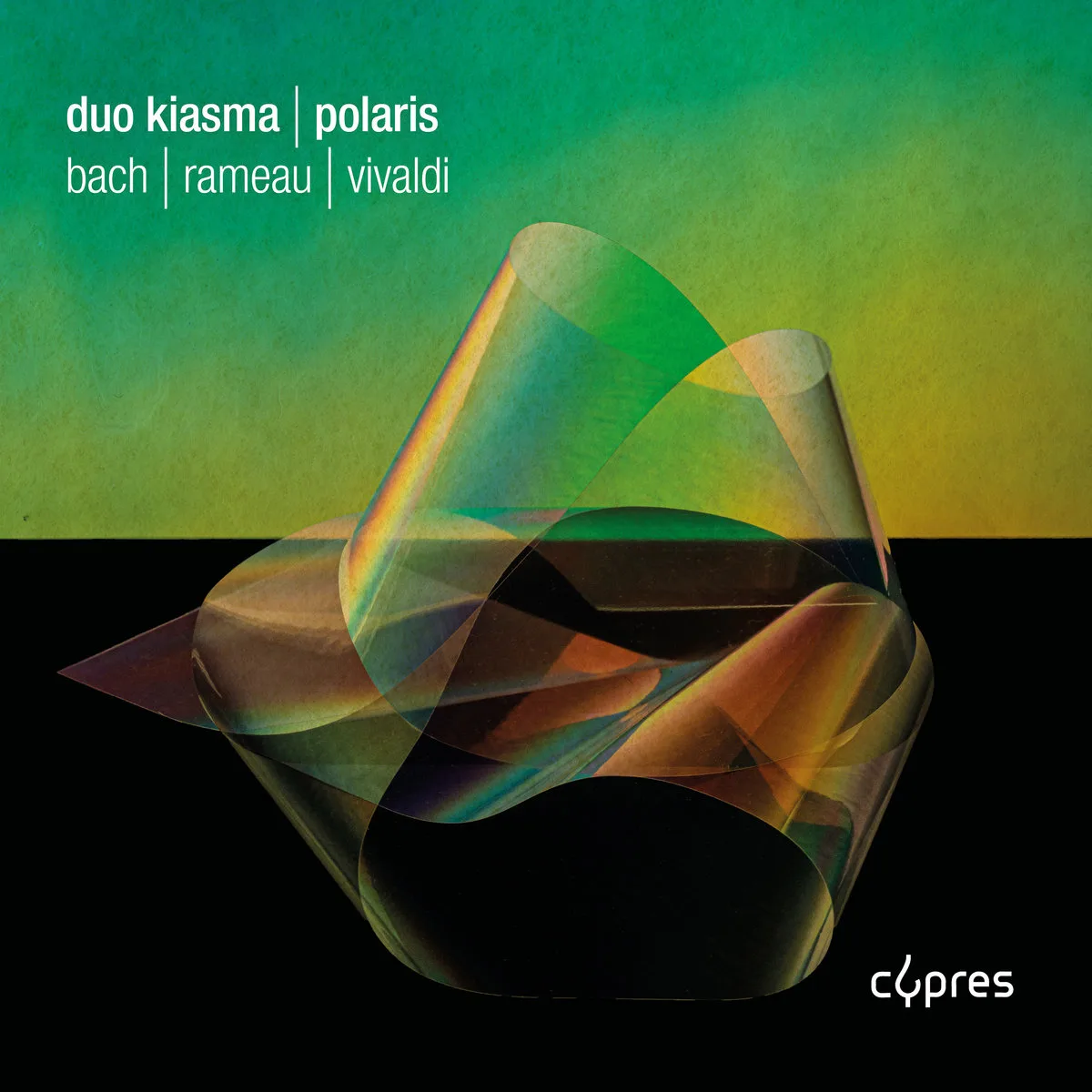
A cello and an accordion. On paper it may not seem like the most obvious combination for music by Bach, Rameau and Vivaldi. When you listen to Polaris, you quickly wonder why not. Pierre Fontenelle and Frin Wolter let both instruments blend so naturally with each other that the unusual instrumentation hardly feels unusual after just a few minutes. Moreover, the bow and bellows prove to have surprisingly much in common: both can breathe, sing, whisper and exert power. Precisely that kinship forms the starting point of this exceptionally successful new recording by Duo Kiasma.
Fontenelle and Wolter have formed Duo Kiasma since 2016 and have never paid much attention to stylistic boundaries. Their repertoire has included arrangements and transcriptions of Bartók and Gluck among others over the years, as well as music by Ennio Morricone and Daft Punk. Gradually, Baroque music came increasingly into focus. With Polaris, this development finds a clear place in their trajectory. Bach, Rameau and Vivaldi serve as the three main points of reference, with some surprising excursions that make clear that the duo has by no means lost its sense of adventure along the way.
The third English Suite in g, BWV 808, by Johann Sebastian Bach opens the CD and immediately occupies a considerable part of it. It is a bold choice, because music so strongly connected with the keyboard must be reconceived in this instrumentation. Fortunately, Duo Kiasma does not attempt to imitate the harpsichord. Fontenelle and Wolter search for what cello and accordion can themselves add to the music. The accordion can carry several voices at once and gives polyphony clear shape, while the cello can highlight lines, colour them and make them sing. This creates a Bach that sounds familiar and at the same time is illuminated from a different angle. Especially in the slower passages, the breathing quality of both instruments comes beautifully to the fore, while in the faster dance movements the rhythmic liveliness and excellent rapport between the two musicians stand out.
After that, Polaris makes a remarkable leap to Heitor Villa-Lobos. The famous aria from Bachianas Brasileiras No. 5 forms the starting point for the duo's own variations. This is a particularly well-chosen pivot point within the programme. Villa-Lobos himself looked at Bach from a completely different time and musical culture. Fontenelle and Wolter continue that movement, as it were, and take the material further into the twenty-first century. What begins with one of Villa-Lobos's best-known melodies develops gradually into something quite unique, ultimately even incorporating a substantial dose of energy from rock music. It works because it never feels like an effect being applied from the outside. Rather, it is a free interpretation of existing musical material, entirely in the spirit of a duo that has made arrangement and recomposition an essential part of its identity.
With Jean-Philippe Rameau, Polaris then returns to the eighteenth century. Les Tendres Plaintes from Zoroastre, Lieux funestes from Dardanus and Air vif and Entrée de Polymnie from Les Boréades offer ample opportunity to explore the colour possibilities of cello and accordion. Here Wolter in particular demonstrates how refined an accordion can sound when the instrument is not treated as a replacement for another keyboard instrument. The bellows allow for subtle dynamic nuances, while Fontenelle can move around it with a warm and supple cello tone. The lyrical side of Rameau is given full space, without losing the dancing elegance of his music.
Antonio Vivaldi's Sonata for cello and basso continuo in e, RV 40 also seems almost made for this combination. Here the cello finds itself of course much closer to its original role. Fontenelle can fully utilize the cantabile character of his instrument, while the accordion gives the continuo part a very distinctive colour. In the Largo movements, the shared breath of both instruments comes through particularly beautifully. The Allegro movements then show another side of the duo: lively, sharply responsive and rhythmically alert. The music gains momentum without sounding rushed.
After Bach, Villa-Lobos, Rameau and Vivaldi, the CD ends with Danny Boy. The well-known Irish song may at first glance seem like an odd one out, but as a closing piece it works excellently. The melody naturally lends itself to the singing qualities of the cello, while the accordion is an instrument unlike any other connected to folk music, memory and melancholy. Thus the album ends with a simple, human directness. After all the inventiveness of the preceding arrangements, it turns out that Fontenelle and Wolter can still tell something personal with a melody that almost everyone knows.
That is ultimately the great merit of Polaris. This CD does not aim to prove that you can also play Baroque music on cello and accordion. Everything sounds far too natural for that. Duo Kiasma uses the special combination of its instruments to view music that we often hear in very different instrumentations afresh. In doing so, Fontenelle and Wolter stay close enough to the scores to respect their character, but take sufficient freedom to be present as musicians themselves. Their playing is virtuosic where necessary, but virtuosity is never an end in itself. Much more important are their sense of colour, phrasing and mutual dialogue.
The recording also contributes to this. Polaris was recorded from 16 to 18 February 2026 at the Trifolion in Echternach, with Denis Guerdon responsible for artistic direction, recording, editing, mixing and mastering. Cello and accordion each receive sufficient space and detail, while together they continue to form one sound world.
The physical release on Cypres has been carefully prepared. The CD comes in a gatefold cardboard sleeve and is accompanied by a booklet with photographs and information about Duo Kiasma, Pierre Fontenelle, Frin Wolter and the music. The total playing time is 54:40 minutes. Polaris, catalogue number CYP1693, is released on 18 September 2026.
The title is well chosen. The Pole Star served for centuries as a reference point for travellers, and for Duo Kiasma too, Polaris seems to be a positioning: after ten years of making music together, Fontenelle and Wolter show where their musical compass has taken them so far. That turns out to be a place where Bach and Vivaldi feel surprisingly at home alongside Villa-Lobos and Danny Boy, and where cello and accordion are no longer a curious combination, but simply two instruments that breathe together.
Polaris is therefore much more than a successful experiment with an unusual instrumentation. It is an inventive, warm and particularly musical CD that gives familiar repertoire a different light and at the same time makes one curious about where Duo Kiasma will travel next.
