

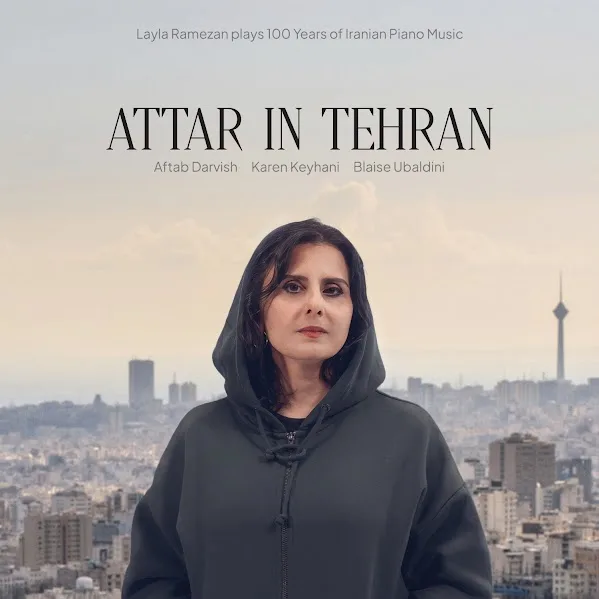
On November 20, 2026, “Attar in Tehran” will be released, the third part of the project 100 Years of Iranian Piano Music by Iranian pianist Layla Ramezan. The album presents new works by two composers from the generation after the revolution of 1979, inspired by “The Conference of the Birds” by the twelfth-century poet Farid ud-Din Attâr. Piano, Persian poetry, recorded sounds and electronics come together in this refreshing project. On the occasion of this release, we spoke with her.
The sound of a city
“When I close my eyes, Tehran first returns to me as a soundscape,” Ramezan tells us. “The honking of cars, the calls to prayer, the voices in the bazaars, but also the sounds from my childhood during the war between Iran and Iraq: the sirens, the news broadcasts and the constant presence of history in everyday life.”
The pianist was born in Tehran and has lived in Lausanne for many years. When she left Iran, she took with her more than memories alone: “a sound memory and the most precious treasure, the Persian language.” She calls Attar in Tehran her dialogue with that heritage, “a journey between personal memory and collective history, between the Tehran of my childhood and the Tehran of today”.
That journey also runs through Persian poetry. As a child, Ramezan read and recited verses by Hafez, Saadi, Rumi and Attâr. In Iran, their poetry is passed down from generation to generation and still forms part of everyday life: “Even when I did not always understand the meaning of the words, the rhythm of the poetry and the sound of certain words filled me with joy. I feel exactly the same when I play great works on the piano, for example by Schubert. Poetry and music touch the same part of my soul.” She has a mystical view of music: “Practising music, giving a concert or discovering a new work is for me always a step towards self-knowledge.”
In the footsteps of the Simorgh
The idea for the album arose in 2022. Initially, Ramezan wanted to focus exclusively on The Conference of the Birds, and the record was to be called Simorgh, after the mythical bird the birds in the poem seek. Since then, according to her, Iran has been going through “one of the darkest periods in its modern history”. This changed the context of the project. She wanted to avoid clichés about the country.
She therefore invited two Iranian composers with whom she feels a strong bond: Karen Keyhani and Aftab Darvishi. Both were born after the revolution of 1979. Like Ramezan, they grew up in Iran, and Keyhani still lives there: “We share a common history, a collective memory and experiences that connect us in a very personal way: our shared past in Tehran.” The original impulse for the album, she says, was her own life in Iran before she left for Europe.
In Attâr's poem, the birds set out in search of the Simorgh, a journey through seven valleys that each represent a stage of inner transformation. Keyhani wrote a work about the gathering of the birds before they depart. His musical language is strongly influenced by his practice of the santur, a Persian string instrument, and according to Ramezan forms a natural bridge between the Persian tradition and the contemporary piano. Darvishi chose the seven valleys as the starting point for her composition. Ramezan describes the work as “of striking purity and deep evocative power”.
The two scores were only the starting point. Together with Blaise Ubaldini, Ramezan then worked on the electronic composition: “As we worked, we gradually discovered new balances between the piano, the recorded sounds, the poetry and the electronics. Certain passages began to develop naturally. Some were adapted, expanded or transformed, so that all the elements could together form a single sound architecture.” Ubaldini's ties with Iran and his knowledge of the culture contribute to their shared desire to present a more sensitive and complex picture of the country.
A century of Iranian piano music
Attar in Tehran is the third part of a four-part project. The first album, Iranian Composers of the 1950s, was released in 2017. It was followed in 2019 by Sheherazade by Alireza Mashayekhi, the composer who, according to Ramezan, deserves more attention outside Iran. The album offers, in her view, a good introduction to his music. The fourth part, possibly planned for 2028, will focus on the founders of Iranian piano music.
With the series she wants to let people hear the richness and diversity of this repertoire. Although the piano is not originally part of the traditional Persian musical tradition, the instrument offered Iranian composers new possibilities thanks to its wide range and the rich variety of harmonic colours. It has “opened up new perspectives” for a tradition that is essentially monodic and based on improvisation and oral transmission.
For Ramezan, this repertoire reflects the history of Iran itself: a culture that absorbs various influences and transforms them into something of its own. In her view, Persian identity cannot be captured in a single style or characteristic. Iranian composers of the twentieth and twenty-first centuries have “explored new forms of freedom and renewal” by using the Western musical language and compositional techniques while at the same time drawing inspiration from their own tradition. She sees a parallel with Debussy, who, through his acquaintance with Eastern musical cultures, was likewise inspired to explore new tone colours and expressive possibilities.
A different image of Iran
In the West, according to Ramezan, the audience is generally more familiar with traditional Persian music, while the classical piano music of Iranian composers remains largely unknown: “I want to show a more sensitive, richer and more complex image of Iran, one that goes beyond the political crises to which the country is so often reduced. Despite the restrictions and the wounds of history, the artistic scene in Iran remains remarkably lively and creative.”
At the same time, she does not wish to convince anyone: “I am not trying to change people's perception. Above all, I want to bring the music and the ideas behind it to life. Everyone is free to feel, interpret and experience music in their own way.” Iranian listeners can feel proud when they hear works by compatriots, while the repertoire may be a first introduction to a new musical world for listeners in Europe or North America. For Ramezan, music remains first and foremost a universal language: “Every audience listens from its own history, culture and sensitivity. Ultimately, I believe that music touches something deeply human, beyond our cultural differences.”
Two worlds in one life
Performing, research and cultural mediation are not separate for Ramezan. She spent half of her life in Iran and the other half in Europe. Through her work she brings, as she puts it herself, “my own life and experiences to the stage, shaped by the different cultures I carry with me”. With the scores, she tries to remain as faithful as possible to the written music, both in the case of Iranian composers and in the classical European repertoire: “I think my Persian background comes through naturally. I share a collective memory and a common cultural heritage with these composers, which creates a shared language between their compositions and my interpretation.”
The work was not always easy: “At first it was not simple, because this repertoire sometimes evoked painful memories of my country and my life there. But I managed to turn that vulnerability into a source of strength, despite very deep wounds. This journey has helped me reconnect with myself and to dedicate myself as sincerely as possible to the art of musical interpretation.”
The project has also confirmed for her that tradition and renewal are not opposites, but constantly inspire each other. For her, tradition is not a closed chapter, but a living memory that continues to develop. The image with which she sums up that experience gives this article its title: “When I play this music, I sometimes feel that I am walking at the same time through the ruins of Persepolis and through the modern, polluted streets of Tehran. Two worlds, two different eras, that coexist within me.”