

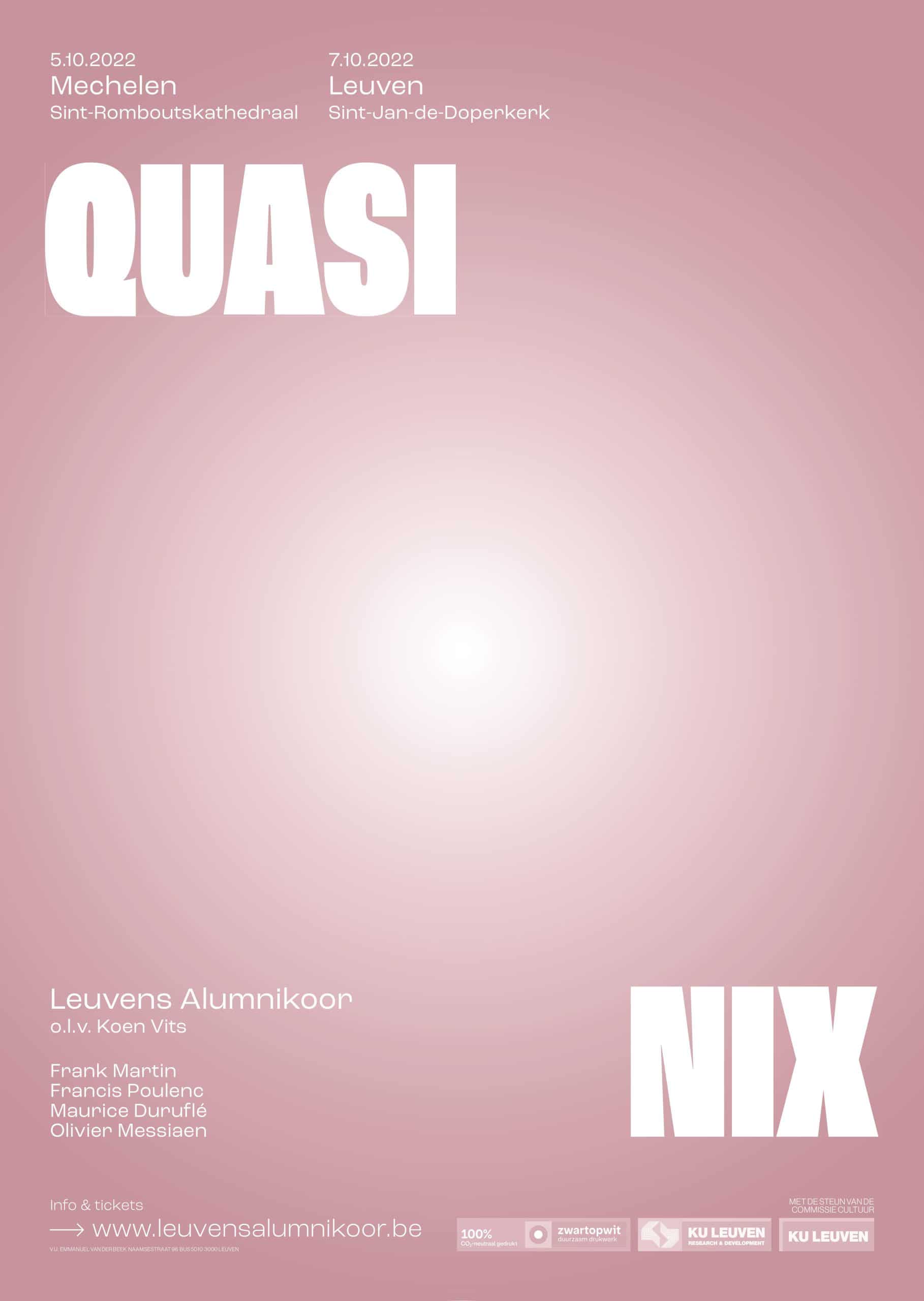
5 October Sint-Romboutskathedraal Mechelen
7 October Sint-Jan-de-Doperkerk in Leuven
The young Belgian choir director, composer, musician and teacher Koen Vits (1989) approaches life with enthusiasm. He is the dedicated conductor of the Mannenkoor Terpander, the Gemengd Koor Tourdion and the Leuvens Alumnikoor. With the latter, he brings to the Sint-Romboutskathedraal in Mechelen on 5 October and to the Sint-Jan-de-Doperkerk in Leuven on 7 October the concert 'Quasi Nix'. A misleading title, as the audience receives a generously filled programme centred around the beautiful 'Messe pour double choeur a capella' by Swiss/Dutch composer Frank Martin (15 Sept. 1890 – 21 Nov. 1974), plus works by French composers Maurice Duruflé (11 Jan. 1902 – 16 June 1986), Francis Poulenc (7 Jan. 1899 – 30 Jan. 1963) and Olivier Messiaen (10 Dec. 1908 – 27 April 1992). With appropriate vitality, he begins this new season with many compelling challenges.
-Your schedule and creative energy are quite breathtaking. Conductor of no fewer than 3 choirs!
It is indeed a busy period. In total it's 6 choirs if you include the choirs from the Academy.
-You studied choir direction and composition at the Lemmensinstituut in Leuven. Where does that fascination and interest come from? It's a niche that few students choose.
That's true and it wasn't the original plan either. Regular education didn't suit me. I went to the Lemmensinstituut, it was the ideal outlet for all the musicality bubbling inside me. First the secondary department, then I progressed to the higher education department. I intended to study music pedagogy. At that time you received all theoretical directions in the first two years: pedagogy, therapy, composition and direction all together, and from the third year you had to make a choice. In my second year we did two major choir projects. The first was 'A Sea Symphony' by Vaughan Williams (12 Oct. 1872 – 26 Aug. 1958), his first symphony, a magnificent work. I loved singing in it. The second project was music by the deceased directors of Lemmens': Lemmens himself, Tinel, Desmet, Van Nuffel, Vyverman, etc. There was a man conducting who inspired me so much. How he worked with the choir, his leadership and vision. It grew in me: that's what I want to be able to do too. With a very small heart I approached that great gentleman, Kurt Bikkenbergs, with the question: "May I please join your students?". He accepted me and so the ball started rolling. He also inspired me to study composition.
-What is the most difficult aspect of conducting?
Perseverance, inspiring people, lifting them above themselves and… the extension of that, the conductor who ultimately makes himself dispensable. Who can work so pedagogically with his people that, so to speak, he can hand out a score and the choir gets on with it. That is the ultimate goal. Of course, getting that far is something else. As a conductor you also need to have excellent physical condition.
-Leaving aside the Academy choirs, you conduct three choirs? What makes them unique?
They are three completely different choirs. Each with its own very distinct way of working. In terms of repertoire there are sometimes overlaps. The mixed choir Tourdion and the Alumnikoor work very much on a project basis. I of course choose music that is adapted to the technical capabilities of the different choirs and that appeals to the people who sing in them.
-For choir members, is it purely meaningful leisure activity or are they musically educated singers?
They are all amateur singers, but many of them have considerable choir experience. Many have been singing in choirs for years, some even started in a children's choir.
-Singing gives people access to another dimension within themselves.
The voice is the purest instrument that exists. It is the only instrument that truly comes from within. Actually, in a manner of speaking, you are voicing your soul. In that way music can easily reach the audience. It touches them emotionally more quickly.
-Also the magic of voices intertwining.
Yes, a purely human sound. No sound produced by vibrations in a piece of brass, or by keys and hammers on strings. But truly just a sound produced by the human body and coloured emotionally.
-'Quasi Nix' becomes the sparkling opening of the season calendar for the Alumnikoor.
Actually the concert was scheduled for March of last academic year. Normally we start a project in October and finish in spring with a concert. From November to February, however, all choir activities were suspended. The coronavirus pandemic caused delays. We had to postpone the concert out of necessity. It is the closing event of a project.
-Tell us more about the Alumnikoor first.
The Alumnikoor consists mainly of former members of the Leuvens Universitair Koor. Men and women who have caught the choir bug and like to continue it. That's how it came about. I myself conducted the Universitair Koor. In my first year I performed Martin's mass. At that time three members expressed the wish to be able to continue singing. They asked me to start a new choir together with them.
-Frank Martin is here for many of us a rather unknown name. Born in Geneva in 1890. An important part of his life, namely from 1946 until his death in 1974, he lived in Naarden, in the Netherlands.
That's correct. He also composed music that is not always very accessible. It's not easy listening.
-Despite his versatile stylistic orientation, his great teacher was Johann Sebastian Bach.
The harmonic perfection of Bach appeals to us. Certainly the wealth of religious music that Bach left behind. Martin was also an enormously devout man. Bach is the source of inspiration for many, I think.
-With our Northern neighbors, Frank Martin is not an unknown. Bernard Haitink, for years conductor of the Royal Concertgebouw Orchestra of Amsterdam, has conducted many works by Frank Martin.
Because he lived there for so many years, his third wife was Dutch, he is of course better known in the Netherlands. His home has now been converted into the Frank Martin Museum.
-The concert is announced as 'Quasi Nix'. How did you come up with that title?
That's thanks to the choir members who put their heads together about the name the project should have. The title literally also comes from a work by Duruflé that we sing. But the title is more about the quieting of the music. It's quite a heavy program. In that sense: it's not a jubilant or exuberant concert. It's all more about introspection.
-Martin was convinced that art -and music in particular- aims to lift humans above the everyday and let them dwell for a moment in a better world. 'Quasi Nix' is the flag that covers this cargo.
Absolutely. The program is steeped in a spiritual context. Four composers from old to young. They have each composed deeply devout music. That's palpable. It's music you dwell in through a soundscape created by the inspiration that sits in the music. Apart from that, singing together in itself has something magical. It immerses the listener in a sea of sounds.
-The audience is engaged not only with an imaginative title 'Quasi Nix', but curiosity is further piqued: Frank Martin wrote an impressive piece of music that was never allowed to be performed. It lay in a drawer for 40 years. When it finally happened in the 1960s, the audience was mesmerized.
That's top-notch promotional talk!
Yes, and there's nothing false about it. On one hand: everyone who hears the music is gripped. It's such compelling, such an emotional music. People's jaws literally drop. On the theoretical side, on the other hand, it checks out on all fronts. It's brilliant, expertly written. Martin wrote it as an extremely personal alliance with God. He composed 'Messe pour double choeur a capella' from his personal faith. He kept the composition in the top drawer of his desk for years until finally one of his friends was able to convince him to perform it in the 1960s, forty years after composing it in the 1920s, for the first time.
-Was it his intention that this work should be consigned to silence and oblivion?
Yes, it was something between him and God. Nobody else had anything to do with it.
-The choir sings about longing and raises the vibrations.
Absolutely, there's almost more between the notes and the staff than on the staff itself.
-You then bring in three leading composers from the last century to create a complete program. From what perspective did you specifically choose those three?
Partly from the perspective of faith. Faith was very important to Martin, it was an anchor for him. That absolutely comes through in his mass and magnificent oratorio. That way you also flow seamlessly into Messiaen, who was likewise a deeply devout man. He wrote a lot of organ music and choral music. You automatically end up with Poulenc as well. He struggled his whole life with a conflict: that very flamboyant and bon-vivant life and on the other hand the very quiet and deeply devout life. Poulenc who went on pilgrimage through France after one of his best friends had died. Duruflé fits perfectly in between as a composer who worked extremely meticulously and who devoted almost his whole life to the service of the church.
-You also compose yourself. Creating choral work, is that a bit like conjuring with sound and language?
One could describe it that way. Although, Ravel demonstrated beautifully that not all choral music needs to have text. Composing choral music is something quite different from instrumental music. One of the facets: you're always working with a text. On one hand the very theoretical facets: the word stresses, which text am I going to repeat, how am I going to distribute the text, etc. On the other hand you're also dealing with the message of the text writer. What he wants to convey but not always literally in the words, but also between the lines. A message that you want to serve in the music or counteract, or whatever. Both from a purely theoretical and poetic perspective, the text largely determines the music.
-You also compose yourself, instrumental music or choral music?
Only choral music. During my studies, I wrote some instrumental musical works as finger exercises. After my third bachelor's degree, my teacher at the time said: "I think you should change teachers." Jeroen D'hoe writes vocal music for solo singers alongside instrumental music, but very little choral music. That's when I switched to Kurt Bikkembergs. If anyone knows how to compose for choir, it's him.
-How would you promote the concert 'Quasi Nix'?
The strength of this concert: it is a moment of stillness that will be a welcome relief for many people, a contrast to everyday life where we are overwhelmed by noise, hustle and sound. The four composers make audible what music can mean for us today, can bring us to rest and perhaps also put us in contact with a higher dimension in these hectic times.