

For the first time, after more than a year, being able to attend a performance again at the international art center deSingel is gratifying. To enjoy the diverse art offering again. And your reporter is not alone. The Red Hall of deSingel is nearly full for an introduction.
Mónica Calle is an actress and theater maker and visiting deSingel for the first time. In Portugal, her home country, she has already built a remarkable track record. As a tender anarchist, she is now conquering the international stages. She is not a supernova and did not rise directly to the top. A hit as a young thing is always possible, but it is experience, advancing aesthetic insight, study, vision of the world, that makes an impression. In 'Carta' the Latin term for cartography she provides together with 15 actresses and 15 musicians Beethoven's Seventh Symphony with a new interpretation. It is a meditation on and resistance against prevailing norms in which the female body is central.
Introduction
[caption id="attachment_23687" align="alignright" width="308"]
 © Filipe Ferreira[/caption]
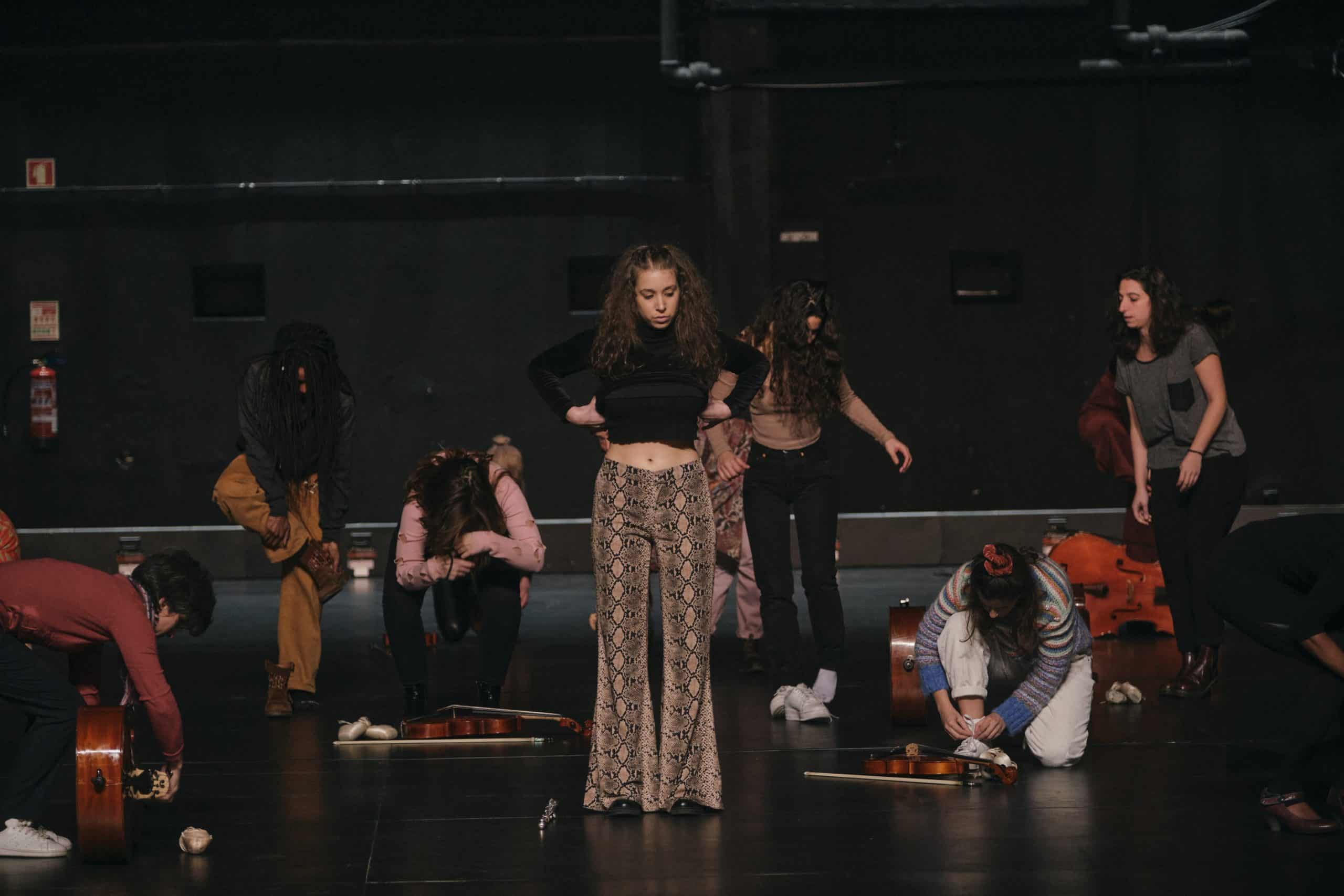
A colorfully dressed group of women enters the stage, an instrument in hand. Immediately you realize: how beautiful is it that all these colorfully dressed women are so authentic? Barely thousands of km away from us women are disrespectfully reduced to shadows by the taliban! Nothing is explicitly explained, you can make the connections yourself.
Director Mónica Calle is part of the company, steps forward and greets the audience jovially and naturally, presents the performers of her creation one by one and then leaves the stage.
Mise-en-scène
The instruments are placed on the ground and freely, without hesitation, the women undress. What you see is dignity and purity. Naked you can't fake anything. Away distinction, it becomes one entity. This is part of the Calle aesthetic. After presenting their pure being, they gather their belongings and instrument and disappear with them into the wings. Gradually they return to the stage and line up in a single row at the back of the stage. A row of thirty young women seeking connection. Here no fussing about perfect or imperfect bodies, they are who they are and form shoulder to shoulder a long strong dam.
[caption id="attachment_23686" align="alignright" width="327"]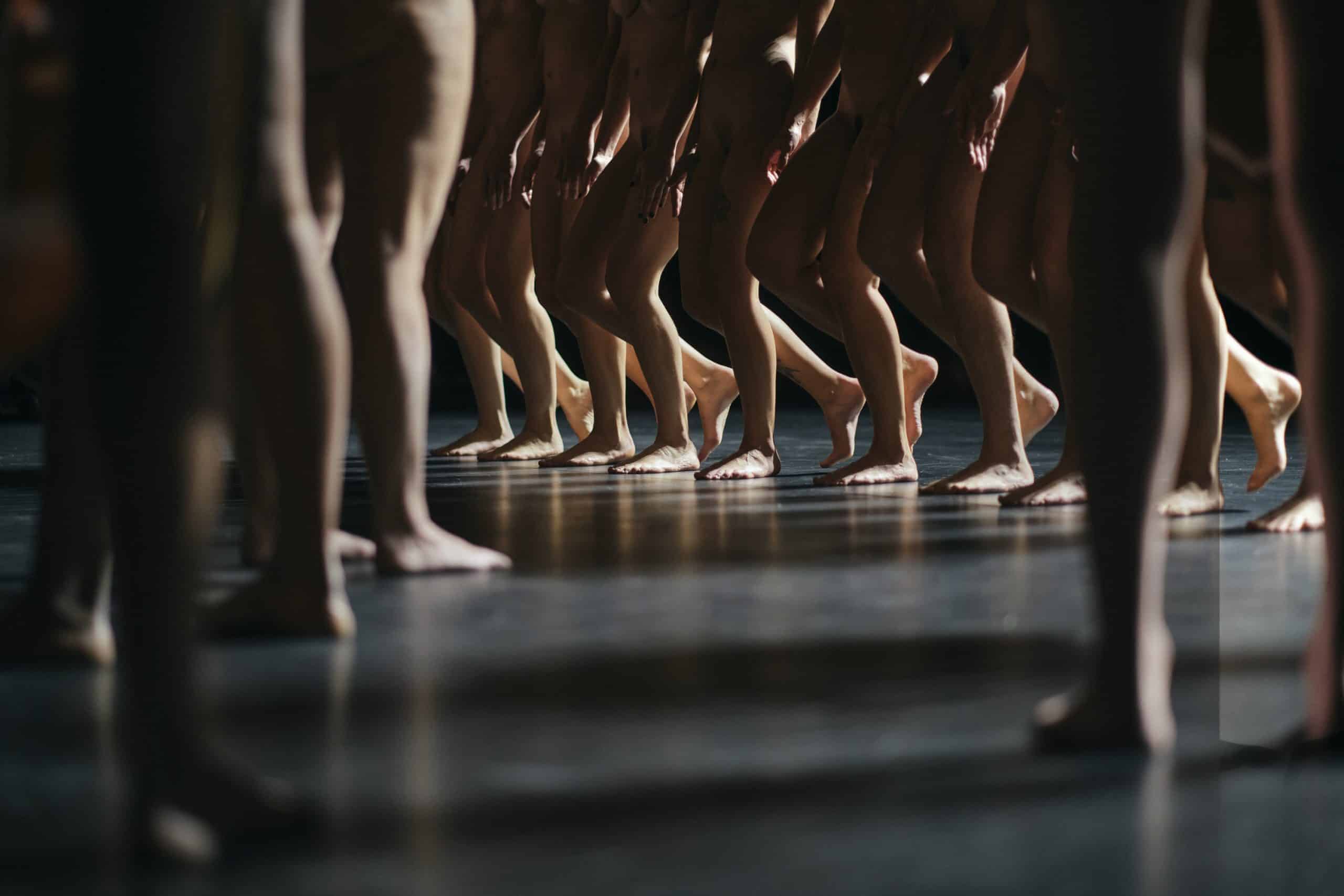 © Filipe Ferreira[/caption]
A movement is initiated centrally: right foot forward, left leg raised. The footwork, the movement is picked up left and right and spreads like a wave on the beach to the last in the row. The action is repeated in a tight terse rhythm. Young bodies radiating primordial dynamism.
Through the warm lighting, the bodies have a golden sheen. They look like sculptures of fertility goddesses from Paleolithic times. Gradually you hear sound, subtle sound vibrations, humming, a melody grows. Through continuous loops and voice reproductions, the 7th Symphony is placed in a different light. The synchronized movements continue for a while. You end up in a universe of changing insights. Gradually figures break away from the line and disappear. They return with their instrument. The group of musicians grows. The music sounds hesitant at first but then in full beauty. Richard Wagner called Beethoven's 7th Symphony, referring to the lively rhythms of the work, 'the apotheosis of dance'. Calle plays into this by having some performers perform a few dance steps on pointe.
[caption id="attachment_23688" align="alignright" width="318"]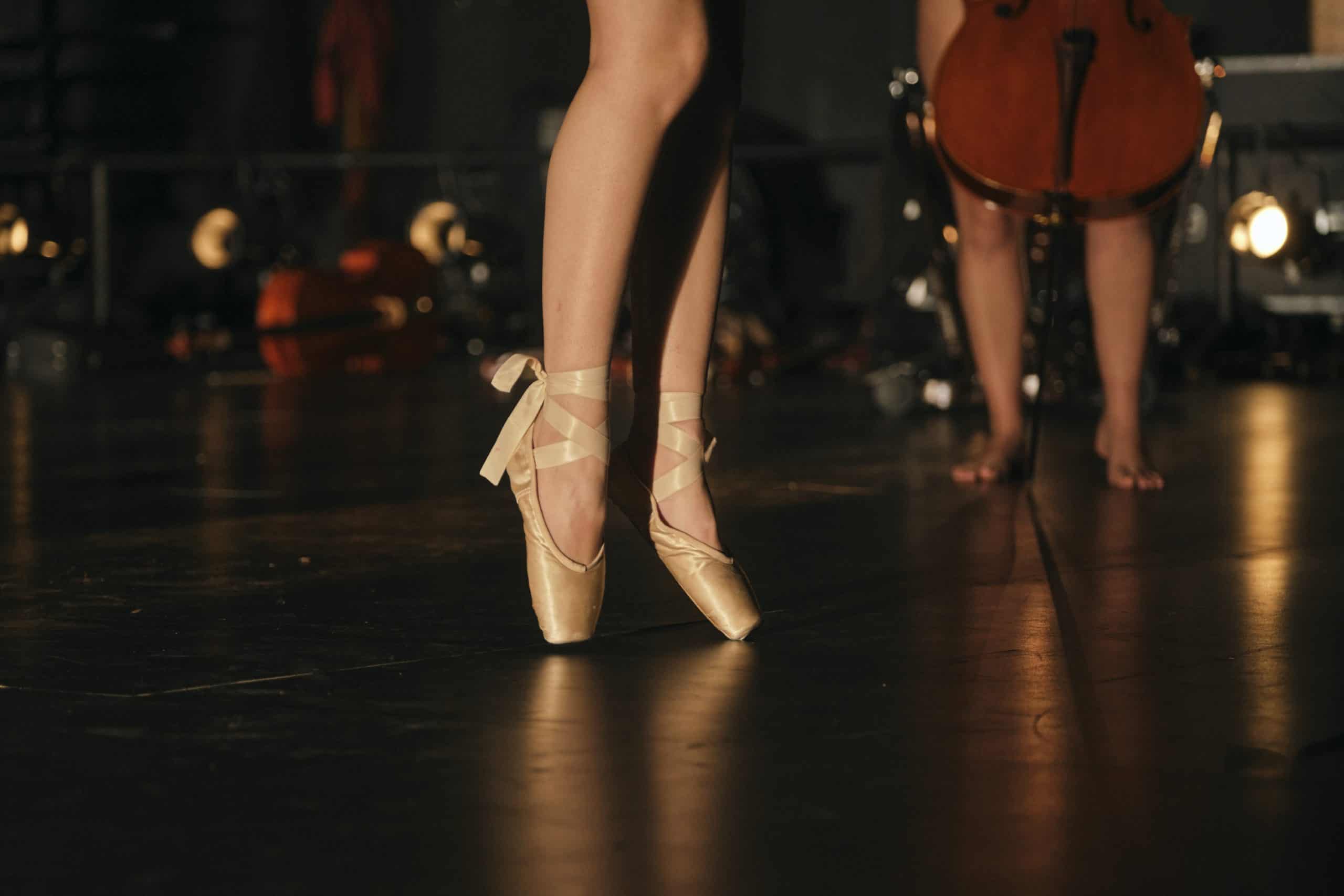 © Filipe Ferreira[/caption]
The whole is full of beautiful moments, slowing down, accelerating, breaking off and building up again in an interplay of energies and intensities. The vast majority of the women position themselves again, this time in a V-shape like the flight of birds, while the music continues. The footwork is resumed, the right arm is also raised to shoulder height, as if they are winged on the left side. A quote from Aldious Huxley: "After silence, music is the most appropriate means to express the inexpressible." Director Mónica Calle goes even further, adds another dimension. All light fades. In complete darkness the instrumentalists continue playing. As a hint to make the invisible visible. It also triggers the senses. Now that all other stimuli fall away, the music comes in pure and undiluted. Fragments from Beethoven's 7th Symphony float like miniatures, atmospheric and beautifully colored.
The light comes back on. Once again the women position themselves in a line at the back of the stage. The warm lighting fades. The women become dark shadows against a white background and run towards the front, back again and forward in a war of attrition. How do we resist, and how do we overcome individually and collectively? Once again they all stand in one line. The humming starts again, you imagine yourself in a giant beehive. The sound transforms into a different rhythm, a different melody in a chain of associations. They cling their voices to the winding vocal line. A melody, an earworm that locks itself in your brain.
'Carta', proximity and touch as resistance against the evolution towards a sterile and unequal society. Mónica Calle, visiting deSingel for the first time, and her debut was appreciated.
INFO:
- where and when: Friday 17 September Red Hall
- direction: Mónica Calle
- performers: Sofie Vitória, Mónica Garnel, Mafalda Jara, Silvia Barbeiro, Lucília Raimundo, Eufrosina Makengo, Ana Agua, Roxana Ionesco, Cleo Travares, Maria Inés Roque, Miu Lapin, Inés Vaz, Sofia Dinger, Carolina Varela, Marta Félix, Joanna de Verona, Brígida Soussa, Sofia Santos Silva, Berta Vidal, Madalena Rato, Mariana Correira,Bruna de Moura, Beatriz Almeida, Sofia Duarte Carvalho, Cire Ndiaye, Sofia Miguel Castro, Mariana Sardinha, Angela Flores Baltazar, Mafalda Tuna, Maria da Rocha, Kristina Van de Sand, Sara Miguel
- musical direction: Martim Sousa Travares
- lighting design: Joé Alvaro Correire
