The music of Hildegard von Bingen today appears in the most diverse contexts: from historically informed performances to productions in which electronic beats and new-age sounds give her visions a contemporary guise. This inevitably raises the question of whether this was truly the intention of the Benedictine abbess from Bingen. But perhaps that is not even the right question. More important, perhaps, is why her music still moves so many people today.
For me, Hildegard remains an exceptional figure. She was a Renaissance woman long before the Renaissance existed: mystic, composer, physician, writer, administrator and intellectual. In a world that barely allowed room for female authority, she corresponded with popes and emperors and developed a vision of humanity, nature and spirituality that remains highly relevant. Her music cannot possibly be separated from that broader worldview. She did not compose art for art's sake, but music as part of a spiritual and human quest. That idea also forms the starting point of this recording.
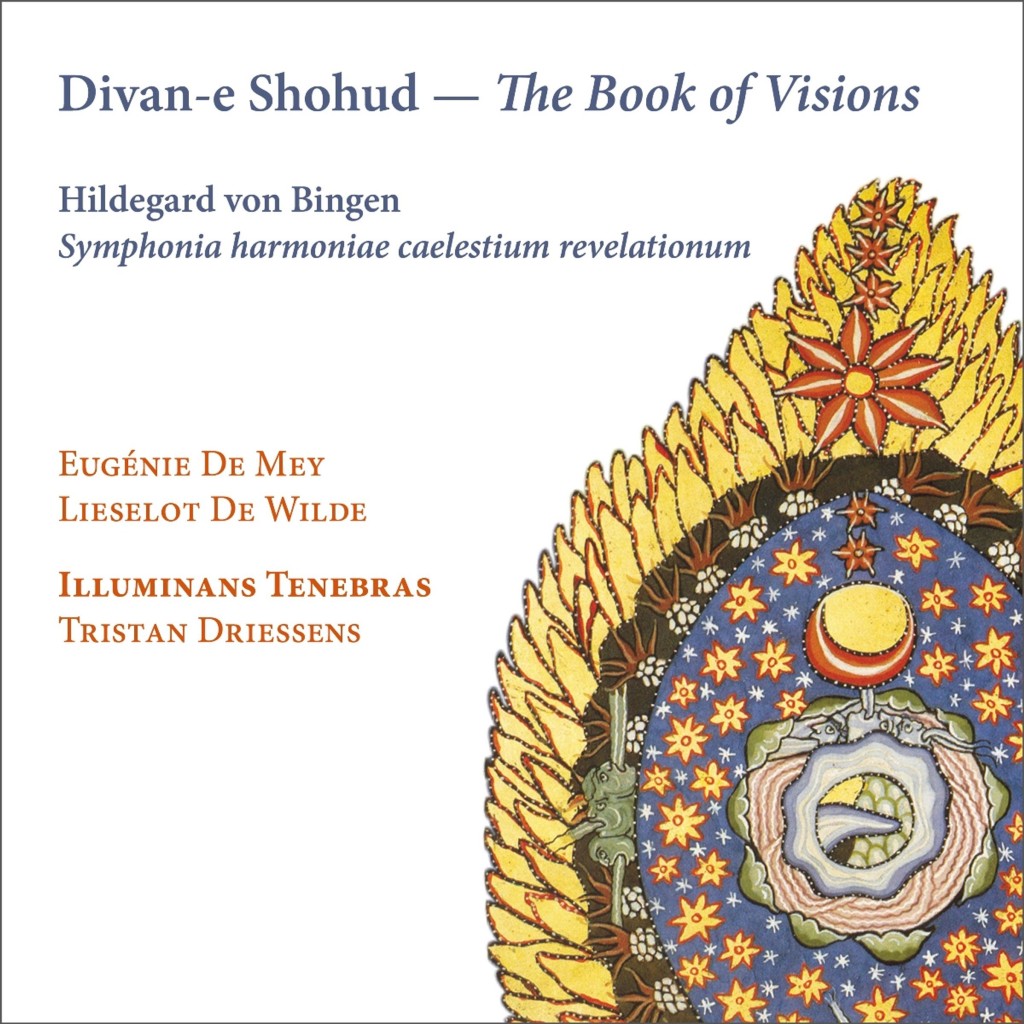
With Divan-e Shohud – The Book of Visions, the ensemble Illuminans Tenebras opts for a bold approach. The starting point is the famous Dendermonde Codex, one of the most important sources for Hildegard's oeuvre, today preserved at KU Leuven. The selected chants are presented here not as museum pieces, but placed alongside improvisational traditions from the Arab and Ottoman musical worlds. The combination of voices, ney flutes and oud is no superficial exoticism. The point of departure is the observation that Hildegard's monodic lines show striking points of contact with modal traditions from the Middle East. This is an idea that is discussed at length in the booklet and that, while listening, sounds surprisingly natural and convincing.
This also explains why this recording leaves such a direct impression on me. During a performance of the Bestion Monteverdi Vespers, Eugénie De Mey had already completely convinced me of her ability to give early music a natural intensity. I also knew Lieselot De Wilde from a very different context, including through the Spectra Ensemble, where contemporary music is often central. Here, both singers meet in a repertoire that on paper seems far removed from those worlds, yet in which the same quest for sound, colour and meaning becomes audible. The vocality and ensemble singing of these two women are undeniably impressive and at times otherworldly.
What stands out above all is the calm this recording radiates. A housemate, without excessive prior knowledge of Hildegard, remarked that the music has something trance-like and at the same time has a calming effect. I can hardly put it better myself. From beginning to end, an atmosphere arises that does not so much carry you away as gradually surround you. The long vocal lines, the dissonances, the breathing sound of the ney and the subtle accompaniment of the oud create an ethereal space in which time seems to matter a little less.
For me, the connection with the Arabic musical world becomes most tangible in Cum Processit. Here the boundaries between medieval Western Europe and the East almost entirely seem to dissolve. The improvisatory instrumental passages connect so organically with Hildegard's melodies that one wonders why this link was not made much earlier. Of course, one can debate the historical legitimacy of instrumental accompaniment for music that was presumably performed mainly vocally. Yet while listening I notice that this question gradually loses its importance. The sound world that emerges here is so coherent and so naturally constructed that it creates its own world, one that in my view corresponds closely with the world of there and then in Bingen.
Illuminans Tenebras avoids any form of spectacle. The instruments never dominate, but neither do they function as decoration. They seem to reveal an additional layer that is latently present within the melodies. As a result, Hildegard's music acquires something timeless, and it becomes an encounter between traditions that recognise one another.
The recording itself contributes to this. The acoustics of the Begijnhofkerk in Sint-Truiden provide sufficient space without letting the voices disappear into a mist of reverberation. Details remain audible, while the contemplative atmosphere is preserved.
That this music originates from the Dendermonde Codex gives this project an additional dimension for Flemish listeners. Not because we deserve any credit for it, but because it is always surprising how a manuscript from our own region can, after nine centuries, still inspire such a lively artistic dialogue.
I have now played this CD several times and each time I discover new accents. That is always the finest compliment one can pay a recording. Divan-e Shohud presents Hildegard von Bingen as a voice that still has something to say today. As such, this release could become an important reference for anyone who wishes to get to know her music.