


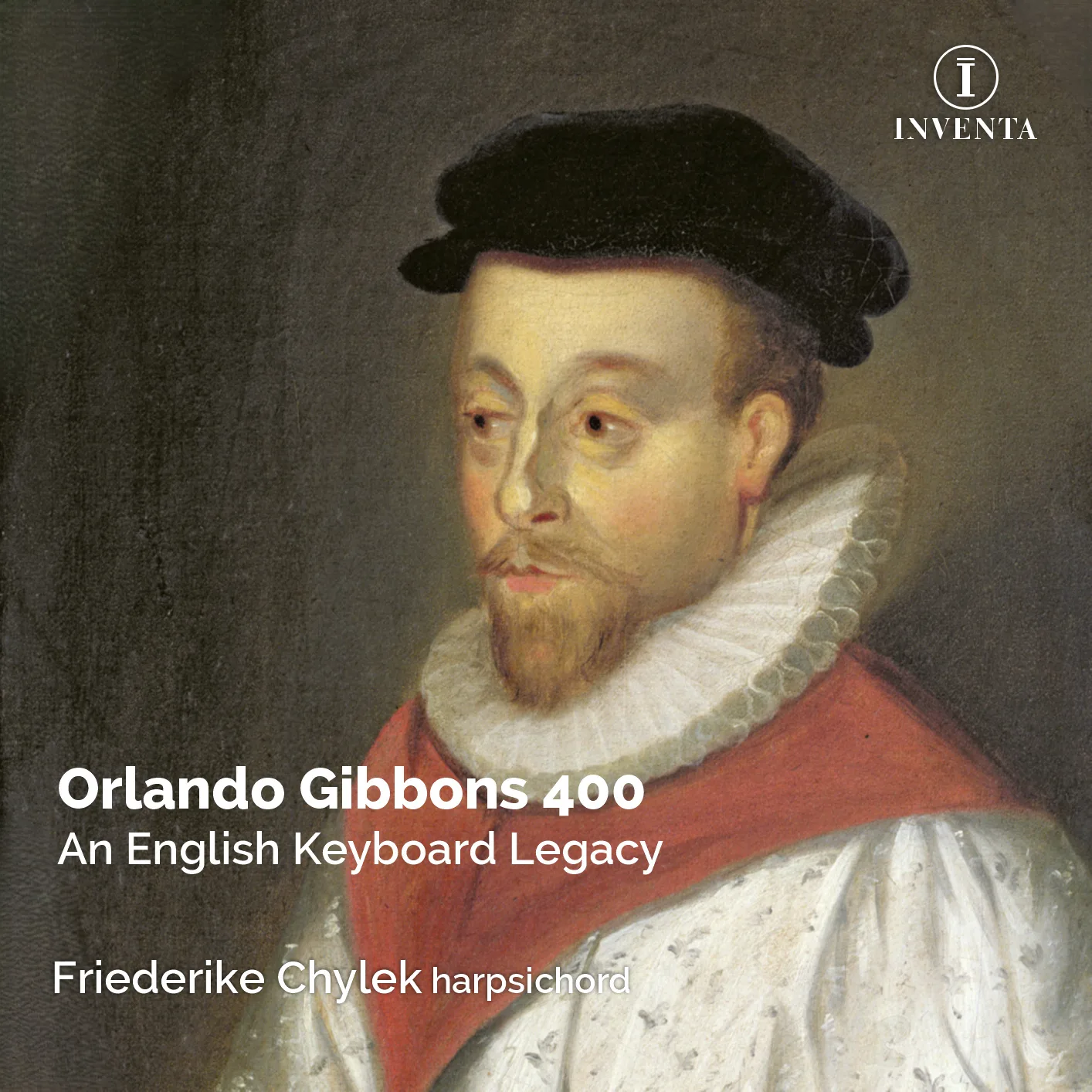
When an email arrived at the editorial office from harpsichordist Friederike Chylek, drawing our attention to her new CD "Orlando Gibbons 400 – An English Keyboard Legacy", my interest was immediately piqued. The CD, released on June 5, 2026 on Inventa Records (Resonus Classics), accompanied her throughout the entire commemorative year of Gibbons' four-hundredth death anniversary. What struck me most was how Gibbons is described in the CD booklet: not as the "end of an era", but as a composer who brings together and further explores the ideas of his predecessors Byrd and Bull. Before I would attempt a review, I wanted to know more about that vision and about the harpsichordist herself. Out of that curiosity we entered into conversation and this article was born.
The musical memory that stays with Friederike Chylek most deeply takes her back to her early childhood, to a spinet that her parents had purchased because a piano was not an option due to the neighbours. As a small girl she lay under the instrument listening while her mother played the well-known prelude in C major by Johann Sebastian Bach. A few years later she tried to find the first notes of Schumann's Album für die Jugend on that same instrument herself, and was fascinated when she recognized under her own fingers the piece she had heard so often on record – the playful beginning of her musical education. Later she turned more seriously to the piano, continued to play the recorder for a long time and received lessons from Myriam Eichberger at sixteen and seventeen years old. During that period her interest in early music grew. A chamber music class with Lars Ulrik Mortensen, in which his then student Olga Watts accompanied her on the harpsichord, made a lasting impression. Shortly afterwards her choice was made: she would study harpsichord.
From Bach to Gibbons
That transition meant not only a choice for a different instrument, but also for a different way of thinking about music. When she switched from piano to harpsichord at the age of nineteen, Chylek initially felt the need to work extremely meticulously on just a few pieces for months on end, to master the specific musical language and refine the expression further. The rhythmically free style of a Frescobaldi toccata or a Prélude non mesuré by d'Anglebert was a completely new world for her.
A few years later, during her studies in historical improvisation with Rudolf Lutz at the Schola Cantorum Basiliensis, she discovered that it was possible to learn to speak, as it were, in the individual language of a particular composer. Her graduation project consisted of several sonatas in the style of Domenico Scarlatti. She regards historical knowledge as an important foundation, but only insofar as it is relevant to the music she plays; research itself serves mainly as a supplementary function for her. The fact that she is more practically oriented than a scientifically inclined musician became clear to her when she once attended six weeks of university musicology lectures and noticed that her thoughts kept drifting away to her harpsichord pieces during the lectures.
This practical orientation also determines her relationship to the instrument itself. The harpsichord is still associated with a rather intellectual or museum-like sound ideal. Chylek has experienced someone telling her after a concert that they initially needed a few minutes to get used to the sound, but were then captivated by the music. She can even understand when someone doesn't find the instrument beautiful: when listening to other harpsichord recordings, she sometimes notices that an instrument, as it is played more perfectly, can actually sound increasingly mechanical.
Her starting point is therefore not the instrument, but the music. First she develops a purely musical conception of a composition – structure, harmonic direction, melodic lines, the independence of the voices – and only then does she try to bring those ideas to sound through the instrument. This doesn't always work as a matter of course on a harpsichord and sometimes even partly relies on imagination when playing. With a differentiated tone and touch, lively articulation and an organic sense of timing, she tries to make the musical essence and emotional content of the composition audible through the peculiar character of the instrument.
The difference between solo and ensemble playing also shows how central listening is for her. During a solo performance, her perception is strongly focused on musical design, over which she has full control – although a solo work too, through the polyphonic and imitative structure of English Renaissance music, already contains a dialogue between the voices themselves. In an ensemble her attention turns more outward, seeking the impulses of her fellow players, to the point where the sense of a duo partner's intention becomes almost a blind understanding or a synchronization of expression.
A musical home in England
That English renaissance music would ultimately become a musical home for Chylek seems almost obvious given her fascination with listening. She is drawn to the clarity and simplicity of the harmony, but equally to its subtlety, which allows this music to be peaceful, sublime and profoundly expressive for her at the same time – the most profound music within the harpsichord repertoire, as she calls it herself. Moreover, the repertoire is so complex and refined that according to her there is virtually no end to refining an interpretation, something she has been doing with pleasure since her teenage years, while the lively, cheerful dance pieces have an entirely different but equally convincing appeal. As a church musician, Chylek also plays music from other periods on organ and piano, but on the harpsichord she repeatedly returns to English music, which after five cd recordings has grown into a kind of musical home for her.
Within that English tradition, William Byrd stands alone at the top for her. Byrd, who received the honorary title "Father of English Musicke" during his lifetime, she sees as the supreme culmination of English keyboard music of the renaissance. His compositional technique is based on what is still taught as Palestrinean counterpoint, but more importantly for her is the timelessness of his oeuvre, which can easily stand alongside masterworks from other periods and according to her should be part of the world's musical heritage.
That does not mean that Orlando Gibbons and John Bull are merely footnotes to Byrd. Their musical language clearly differs from his and both contributed to the further development of the English tradition, especially through their innovations in technique and virtuosity – Gibbons was even described as the "best finger of that age". Four centuries later, after Bach, Beethoven and Chopin, Chylek finds that technical exceptional position less decisive than the lasting musical power of Byrd's oeuvre.
How Gibbons builds on his predecessors, Chylek illustrates with his Galliard in C and Galliard: Lord Salisbury. Melodically and as far as the sparsely ornamented first sections are concerned, both works could according to her just as well be in the style and tempo of Byrd's Galliard BK 60b. But the varied repetitions in the Galliard in C are so virtuosic, and contain such rapid ornamentations in the Galliard: Lord Salisbury, that the basic tempo must be considerably slowed down. That slower type of galliard was popular in that transitional period; as the most extreme example of it she mentions Piper's Galliard II by John Bull.
Yet Gibbons remains a far less obvious name for a broad audience than Byrd. Chylek suspects that his music simply does not fit the current spirit of the times. In a work such as the Pavan: Lord Salisbury, Gibbons reduces the musical means almost to the essence: where Byrd in pavanes such as the Pavan: Ph. Tregian richly ornaments and elaborates the melodic lines, Gibbons here virtually abandons those ornamentations entirely, creating space for silence – and according to Chylek precisely thereby for greater emotional depth. It was also a remark by Glenn Gould, who once described Gibbons as the most spiritual composer of all, that initially made her curious and partly led her to engage more intensively with his music. After completion of the project, however, she cannot entirely follow Gould where he places Gibbons even above Byrd, especially given the fact that Gibbons, who died at 41, lived approximately half as long as Byrd and thus left behind a considerably smaller oeuvre.
The Gibbons project accompanied Chylek throughout the entire jubilee year. It began with a concert on the occasion of the four-hundredth anniversary of his death, which also served as preparation for the cd recording; a few days later she went into the studio. Artistically, that chronology was particularly appropriate, although it proved less fortunate from a marketing perspective, because the cd only appeared at the end of the commemorative year. For Chylek, however, the significance of the project does not lie in the jubilee as such, but in bringing Gibbons, Byrd and Bull once again more prominently to public attention. The three composers died within a period of only five years – Byrd in 1623, Gibbons in 1625 and Bull in 1628 – and according to her a jubilee can help generate interest that hopefully continues to exist.
Between source and intuition
The composition of the album itself also testifies to attention to dramaturgy. Chylek devotes a great deal of time to the order of the works in all her cd recordings: not only the alternation between short and long, fast and slow pieces plays a role, but the tonal progression must also be correct, so that the programme as a whole tells a story and becomes a closed unity.
During the intensive recording process, works can present themselves to her differently than expected. The Fantasia in a she experiences as strongly constructed, with slowly progressing melodic lines that might work more convincingly on an organ; the piece did appear in Parthenia, the first printed collection of virginal music in England, but Chylek suspects that this type of learned work appeals more to counterpoint teachers than to a broad audience, and admits to having some difficulty with it herself. Conversely, the virtuosic but compositionally simple The Queen's Command offered little room for musical deepening, which made it a challenging task for her.
That relationship between knowledge, tradition and intuition also forms the core of her interpretive approach. For Chylek, historically informed performance does not mean the performer must switch themselves off: because every person is an individual, musical expression may always be personal, as long as the composer's intention remains paramount. She does draw a line where an interpretation goes against historical sources, particularly in the field of basso continuo and tempo; within these boundaries she trusts her intuition, which becomes sharper the longer she lives with a work or composer – an attitude she already developed as a fifteen-year-old, when she first asked herself during the study of a Debussy piece why she was not allowed to decide independently how to interpret a passage. However, she rejects artistic freedom that serves only to use the music for self-presentation.
 In her most ideal moments, even the distinction between performer and interpreter disappears. Chylek refers to the experience some musicians describe as "it plays itself" – what science might call a flow experience – where the music seems to unfold of its own accord during playing and the interpretation flows directly from it. That is not an everyday experience, but during preparation, interpretation remains essential for her, always with the question in the background of how the composer might have intended it.
The recording makes that process even more intense. The most important musical decisions have already been made before the studio, but the programme makes a developmental leap during the recordings, thanks to repetition with maximum concentration. Her interpretation is then tested by sound engineer Małgorzata Albinska-Frank, with whom she has been collaborating for thirteen years and who moves in an exceptionally broad repertoire – Chylek must, as it were, convince ears that have heard everything, while she herself has a precise idea of how the harpsichord should sound. Together they search for the boundaries of interpretation: how freely can this music be played, how intense can the expression be without sounding romantic?
In this way they developed an idiosyncratic working method: instead of completing one piece after another, they record large sections of the programme back-to-back per session and discuss them together afterwards – an approach that resembles more of a concert situation and allows for more inspired playing. For the Gibbons recording, Chylek even asked her sound engineer and harpsichord tuner at the end of the sessions to simply sit in the hall and listen. Nearly forty percent of the CD material ultimately came from these last two run-throughs of the programme on the third recording day.
Listening in a changing world
Outside the studio too, Chylek touches on a question that occupies many early music performers: how do you reach an audience in a time when music is mainly consumed in short fragments? According to the director of an early music agency she spoke with about this, the maximum attention span of listeners is now only 46 seconds. Stories about the historical background of music and ideally as inventive as possible videos of the musicians would therefore have become more important.
Chylek understands that early music must find other paths to the listener and even sees it as positive when communication better aligns with the needs of the audience. But when daily visibility on social media in influencer style becomes more important than the quality of performance, she finds that regrettable. Such constant self-presentation does not suit every musician, and therefore does not feel authentic to everyone.
That same balance between authenticity and accessibility plays a role in her instrument choice. Her primary responsibility is to play a work as well as possible, without historical authenticity becoming a barrier to a larger audience. That is why she has so far not used an original virginal for her CD recordings: historically perhaps the most authentic choice, but she fears that the recording would then only reach a small circle of experts.
Asked how she would describe Gibbons' musical world in three words to someone who had never heard this music, Chylek chooses polyphony, virtuosity and contemplation. Polyphony refers to the vocal origin of English keyboard music, where the voices – such as soprano, alto, tenor and bass in a choir – move independently of each other. Virtuosity stands for the shift that took place in Gibbons' time, when that equality of voices gave way to a single, freer solo voice. And contemplation finally refers to the depth that is valued more today than the virtuosity for which Gibbons was primarily known during his lifetime – also by figures such as Glenn Gould.
In service of the music
After five CDs of English Renaissance music, Chylek is already looking ahead. She considered making an integral recording of all keyboard music by William Byrd, but ultimately realized that quantity is not her strongest suit. After William Byrd – Keyboard Music from 2022, she therefore wants to record a new CD entirely devoted to Byrd, with his pavanes and galliards at the center, bringing together fourteen years of experience with this repertoire into something that meets her ideal image in every detail – possibly her last album of English keyboard music.
Asked what a listener should know about her as a musician, should they hear her recording for the first time twenty or thirty years from now, she gives an answer that is remarkably little about herself: she hopes that it is clear how much appreciation she had for William Byrd, John Bull and Orlando Gibbons, and how much time and effort she has invested in presenting their music as convincingly as possible.