

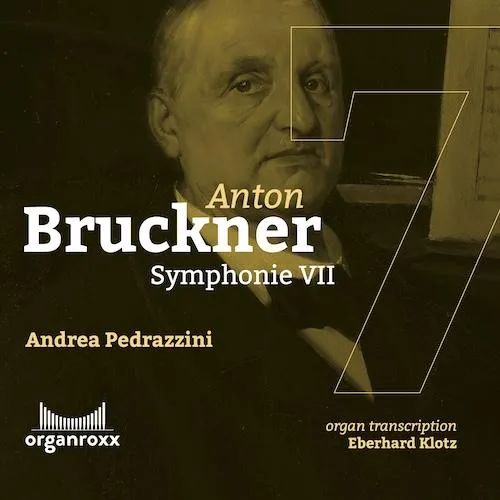
Anton Bruckner (1824-1896) was known in his time as a brilliant organist and improviser, even though only a limited number of organ works have been preserved from his hand. The fact that this reputation never translated into a substantial organ oeuvre remains remarkable. In 1871 he went to London, where as one of the special guests he was allowed to play the organ at the Royal Albert Hall at its inauguration. Where do we find that great organist then?
Perhaps in his symphonies. Whoever listens to Bruckner from the organ's perspective hears how strongly his symphonic thinking is connected to the instrument. He builds sound blocks and places them opposite each other, alternates massive tutti with thin lines and lets his music breathe through long pauses and silences. Those silences are never mere interruptions for Bruckner: just as in a church space the reverberation after a chord lingers for some time, the preceding sound remains present in his silences as well.
Bruckner sometimes seems to register rather than orchestrate. A melody takes on a different color when it moves from one group to another; a voice emerges from a mass of sound and later disappears into it again. Crescendos arise not only because louder playing occurs, but because new layers are gradually added. It is precisely this way of thinking that makes his symphonies so akin to the organ and perhaps explains why an organ transcription, however far removed it is from the original orchestra, can nevertheless reveal something essential about Bruckner's music.
As a symphonist, Bruckner had to wait a long time for recognition: only with his Seventh Symphony, at sixty years of age, came the great breakthrough. The premiere in Leipzig on December 30, 1884 under the direction of Arthur Nikisch marked his first major success as a symphonist. The composer who had long made a name for himself as an organist thus found a broad audience only late for the music with which he is so strongly identified today.
When this CD with the organ transcription of his Seventh arrived at the editorial office, my interest was immediately aroused. Of course, certain orchestral passages sound inevitably different on organ – as in arrangements for smaller ensemble, piano duo or jazz ensemble, part of the original orchestral sound disappears. But what takes its place can reveal another aspect of the score. I already knew the impressive Adagio from the organ arrangement by Erwin Horn, played by Robert Kovács on the Bruckner organ at St. Florian, where the slowly progressing music takes on an intensity that seems almost naturally connected to the organ. However, I had not yet heard a complete Seventh on organ.
From orchestra to one gigantic instrument
This recording was made on the monumental Seifert organ of the Maria Basilica in Kevelaer, built between 1905 and 1907 and now equipped with 135 stops after various extensions and restorations. It is one of the great representatives of German-Romantic organ building and with its enormous wealth of colors particularly suited to Bruckner's late-Romantic world. More than 1,200 stop changes were required for this recording. This fact alone makes clear how meticulously Eberhard Klotz has worked out his transcription.
Klotz does not attempt to literally imitate every orchestral instrument – that would also make little sense. An organ cannot replace the breathing of a string group or the individual color of horns and Wagner tubas. What he does do is translate the various musical layers and functions into the possibilities of the instrument. This makes details that easily disappear into the whole in the orchestral version sometimes surprisingly clear here. That demands more from the organist than virtuosity: he must constantly switch between different stops and tonal characters while maintaining the grand arc of tension of the symphony.
Andrea Pedrazzini succeeds convincingly in this. At times you don't even feel like you're listening to a transcription: the rich melodic arcs come across so directly that you forget there is no orchestra here, but one organist at one instrument. From the first notes you get goosebumps. The famous opening melody of the Allegro moderato does not appear as in the orchestra from the tremolo of the violins, but seems to emerge from space itself and gradually gains weight. Pedrazzini takes approximately 25 minutes for it, well over five minutes longer than many usual performances, but that playing time feels nowhere like a drawback. He builds tension carefully, dares to pull back on the throttle again and above all tells a story. The great climax is delightfully slowly prepared, but so intensely that the music grabs you by the throat.
The Adagio – Sehr langsam und sehr feierlich continues that broad approach. At approximately 26 minutes, this movement also ranks among the slowest performances I know, but again the time Pedrazzini takes proves not to be an end in itself. The music is stretched nowhere; it simply gets the opportunity to sound completely out. The long melodic lines take on an almost vocal intensity, while the dark registers beneath open an enormous space. The Wagner tubas cannot of course be literally imitated here, but their solemn function takes on a convincing new form in the organ sound.
The variations on non confundar in aeternum are led to their climax with great care. Each new layer seems to follow logically from the previous one, so that the climax does not appear as a sudden effect, but as the inevitable outcome of what preceded it. And then it strikes you how little you miss the cymbal crash and timpani. That sounds almost impossible for anyone who knows Bruckner's Seventh well, but the tension is constructed here so organically that the absence of orchestral percussion does not feel like a loss. The funeral music that Bruckner wrote after the death of Richard Wagner also takes on a memorable form here.
The Scherzo is played fairly broadly and in great detail. Personally, I would have sometimes wished for a bit more sharpness and demonic energy here – anyone who listens to a performance under Sir John Barbirolli, for instance, experiences a more nervous, more rousing Bruckner. Pedrazzini consciously chooses a different path and brings detail and rhythmic firmness to the fore, without allowing the music to run away in a demonstration of organ power. On an instrument of this scale, that temptation is never far away – the fact that he resists it, does him credit, even if I sometimes would have forgiven him for it.
The approach to the Finale is particularly successful. The music begins from the sparse and is built up step by step, so that the construction unfolds almost before your ears. That is refreshing, especially since this finale in orchestral performances is often worked through rather hurriedly: here each part is given time to relate to the next. The sound can become impressively massive, but remains embedded in a clearly constructed arc of tension, so that the symphony does not end in a display of organ power, but in the fulfillment of everything that preceded it.
A different perspective on Bruckner
Anyone who knows Bruckner's Seventh exclusively as an orchestral work will miss colors and details here – an organ cannot replace the orchestra, and fortunately this recording does not pretend it does. More interesting is what the transcription does make visible. By reducing the orchestral abundance to a single instrument, Bruckner's long lines and sound blocks become more tangible, the silences gain more weight, and the counterpoint sometimes becomes surprisingly clear. You hear a score that you may have listened to hundreds of times suddenly from a different angle. The transcription does not change the symphony, but it does change your way of listening.
In doing so, Pedrazzini makes genuine music, without any form of theatricality. An instrument with this scale and this register of possibilities invites display; Pedrazzini consistently chooses not to. There is no need to make Bruckner greater or more dramatic than he already is; the music is simply given space to develop its own power.
And so at the end the organist from the beginning reappears. Perhaps we should not look for him in the few organ works that Bruckner himself left behind, but in the way his symphonies are constructed: as vast sound spaces in which voices appear, disappear, accumulate and dissolve again. In this Seventh, that hidden affinity between composer and instrument becomes particularly audible.
This recording thus arouses curiosity for more. Hopefully it will not be limited to this single symphony and it forms the beginning of a complete cycle of Bruckner's symphonies in organ transcription. If the other parts of his oeuvre are approached in the same convincing way, there is still much to discover. I am already looking forward to a sequel.
