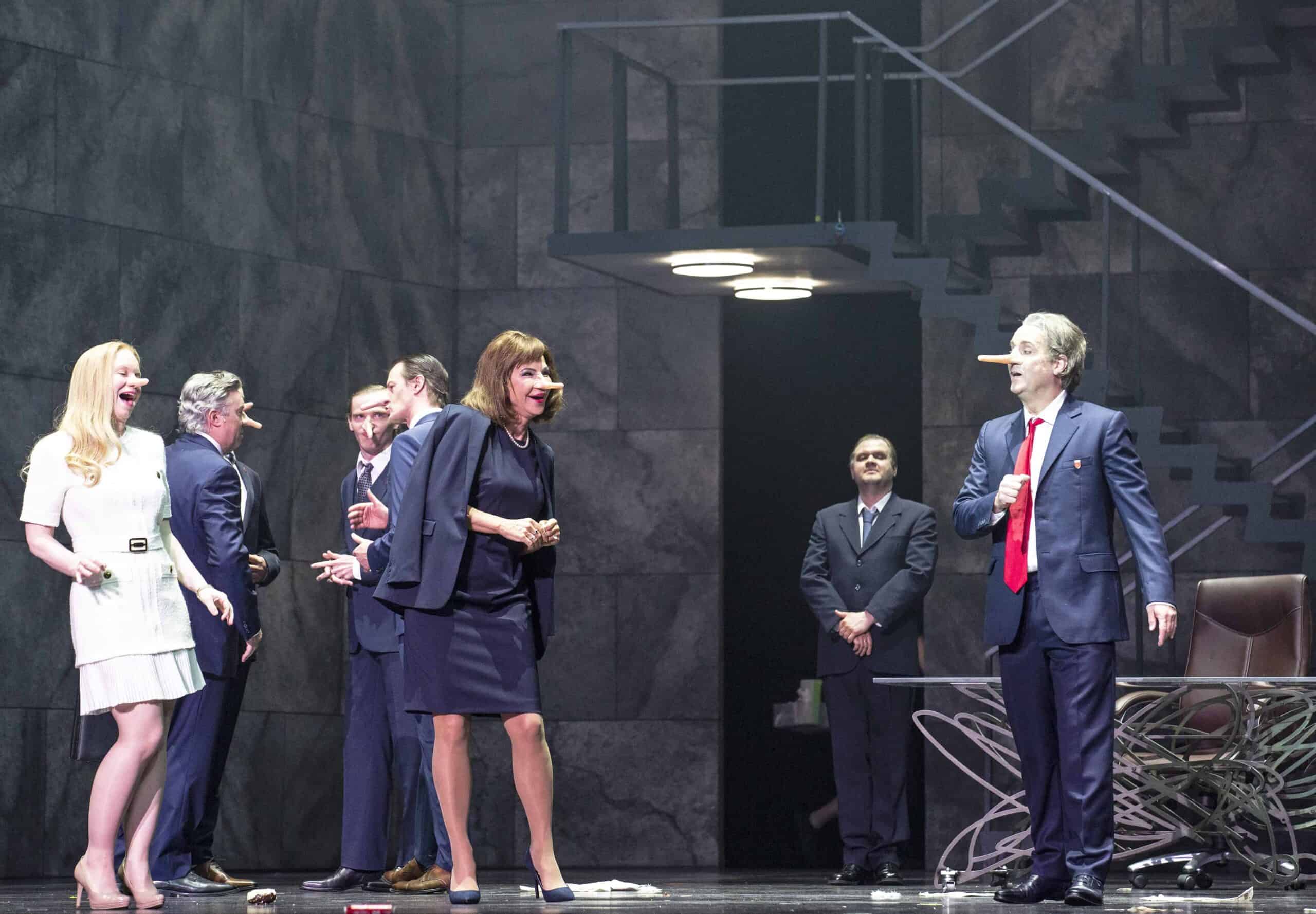
My first evening back in the Belgian opera sphere was immediately one of positive, surrealistic proportions. Personally, I have always wanted to review Nos (The Nose, 1928), the absurd opera by Dmitri Shostakovich. In the past I had already heard about the famous lost extremity.
The production of Nos at De Munt, conducted by conductor Gergely Madaras – 38 years old, inspired by master conductor Georg Solti, and with a musical energy that is truly impressive – is certainly worth recommending. The vocal performances of singers such as baritone Scott Hendricks (Kovalyov), tenor Nicky Spence (The Nose), tenor Anton Rositskiy (Ivan, Kovalyov's valet) and tenor Alexander Kravets (Police Inspector) – to name a few, as it is a difficult choice – bring a vocal diversity to bear. Do not expect soft Bel Canto tones – Nos is shrill, violent and aggressive. This can only be celebrated, as it conveys what you experience as a spectator in the grotesque story by author Nikolaj Gogol: you are constantly taken by the nose (musically)!
Gogol, Shostakovich, and a nose
It sounds like an absurd joke, but it is the basis for the opera in three acts with epilogue written by the then twenty-one-year-old Russian composer. Gogol's work Nos (1835-36) is one of the grotesque genre. In this story, just as in the opera, Kovalyov's nose takes on a life of its own. The first layer shows an absurd story about someone who literally chases after his own nose, but the second layer tells of the problem of social climbing: people who do everything – good or bad – to rise in rank. With this in mind, you feel this tension return in the opera production at De Munt. Grotesque literature is more than just strange, enervating confrontations. It is not shock for the sake of shock, but underlying it there is always some sort of social commentary. Grotesque is thus not the same as scurrilous. What it is, and that is certainly the case with the orchestration and performance of Nos, is overwhelming.
Look beyond your nose
This is a golden recommendation that I as a reviewer certainly want to pass on, otherwise you will be overwhelmed by all the violence on stage. Also take time – whether with eyes closed or not – to listen to the masterful work of the percussion. There is a rule, listening to classical music, that I always follow: if it sounds easy to perform, then it certainly is not! The complexity of the tempi (the time signatures by which the music is determined) sometimes alternate faster than the chromatic tones in the vocal parts.Nos is not only impressive with what happens on stage, but also beside it. On the stage itself, in addition to the fantastic cast, there is also something to be said about the staging. For this stage, much was played with verticality, horizontal movement came from the singers who came on and off the stage.
Vocally, the cast was sublimely chosen. The choice of who to discuss is then difficult to make, so I want to celebrate everyone for their vocal interpretations. Listening to the voices, there are especially three that have stayed with me: Kravets', Rositskiy's, and mezzo-soprano Natascha Petrinsky. Let me call it a singers' professional misunderstanding, but I love to hear a depth that flows vocally like full, golden syrup. This is a comparison I also like to give to the legendary soprano Leontyne Price. Petrinsky immediately commanded the stage from beginning to end. The same applies to Kravets and Rositskiy. The former's changing leaps – high and attacking, or low and full – you could not miss, each one was like a bull's-eye. The latter worked vocally like a sort of golden thread. There was something bright, pure about his voice, in contrast to the violence of the rest – it sounded like a light in the darkness.
I run out of words for this, so hereby: you would miss something as a spectator if you let this spectacle – both musically and visually – pass you by. Bravo, De Munt, Bravo!
WHAT: Nos (1928) by Dmitri Shostakovich.
WHO: Gergely Madaras (conductor), Àlex Ollé (director), Scott Hendricks, Nicky Spence, Alexander Roslavets, Anton Rositskiy, Alexander Kravets, Natascha Petrinsky, Eir Inderhaug, Giselle Allen, Symphony Orchestra and Choir of De Munt.
WHERE: De Munt/La Monnaie, Brussel.
WHEN: Tuesday 20/06/2023, to be seen until 02/07/2023.