

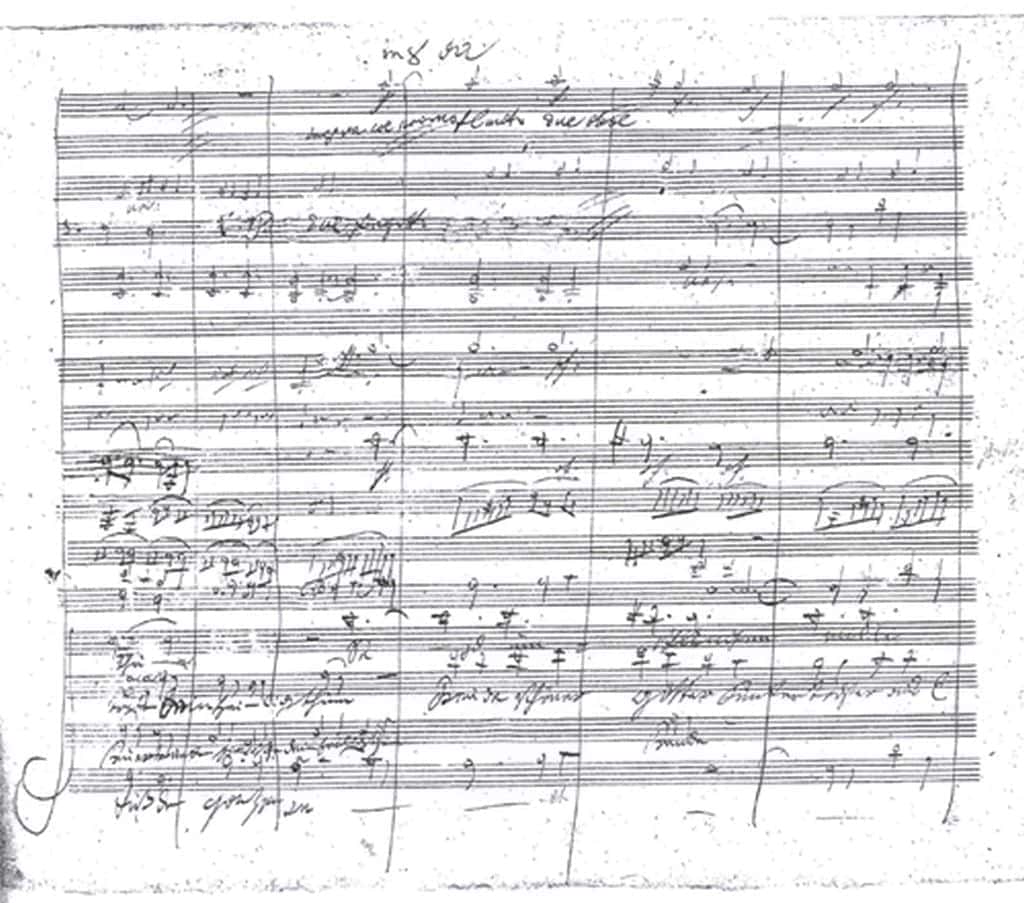
We are writing May 7, 1824 – 2024. It is exactly 200 years ago today that Ludwig Van Beethoven's ninth symphony had its world premiere. That it would grow into one of the most iconic compositions of all time, the hearing-impaired genius did not know. And if he had known? Perhaps he realized it very well in any case…
The story that Beethoven did not hear his ninth himself because he was as deaf as a doornail must finally be put to rest. The composer was not deaf. He did suffer from a severe form of tinnitus that had bothered him since his teenage years. This can be deduced from the fact that during a walk with his music teacher in Bonn he did not hear one or more birds singing while his teacher pointed out the beautiful song. Tinnitus can drown out sounds. You don't hear something else because of the disturbing tinnitus sound, but actually you are not deaf.
It is a fact that Beethoven could hear on the left – you can find that in his scribbled notes. So you can assume that he did hear his ninth even though the myth says he heard nothing. That was supposed to be the reason that when unprecedented applause erupted after the final notes at the premiere, he remained standing with his back to the audience and wept because he had heard nothing. However, there is not a single testimony citing Beethoven where he would claim that. The only recorded testimony is that of the soprano soloist who went to Beethoven on stage and turned him toward the audience because she thought he could not hear the applause and cheering. He wept even more intensely.
Personally, it is my conviction that Beethoven could hear his symphony, however severe the tinnitus was – however distorted – and that he wept from deep emotion that he had succeeded. Tears also out of gratitude to the musicians he turned to, not the audience had accomplished something. Beethoven did not do it for the applause of that premiere, he did it for Mankind. That is why the 'Ode an die Freude'.
Miles of paper have been written about this symphony. The structure, the story, how it came about and so on. Very much fascinating and educational literature is available so that it is not for us to bring our own vision but only to state that the man who is ¼ of us through his grandfather Louis, knew very well what he had accomplished and that he still managed to hear it despite everything. What he could not foresee is that this immensely popular symphony with its extremely difficult vocal parts would conquer Japan like no other country. And what he also could not foresee is that his music would be used for Friedrich Schiller's text "Ode an die Freude" as a European national anthem, admittedly in an arrangement by Herbert von Karajan. Incidentally, it laid no golden eggs for him and the conductor's descendants still enjoy the rights. But good that Beethoven didn't know that, he would be particularly angry about the fact that someone else fills his pockets so well with his work. Whether he would be pleased with the fact that this part of his creation became a hymn, I leave aside.
Be that as it may, deaf or not deaf, hymn or no hymn, the ninth symphony will survive for a long time, a very long time and perhaps even longer than the EU and inspire people, fill them with admiration, enthuse them. Actually, you could say that Beethoven's Ode an die Freude is actually an 'Ode an Beethoven', even if that was not his intention. The greatest honor belongs to him, the creator, the genius, the wonder Beethoven. Dear Ludwig Van Beethoven, hereby: thank you very much! With a deep bow to you, emperor of Music.
- PHOTOS: © Wikipedia

