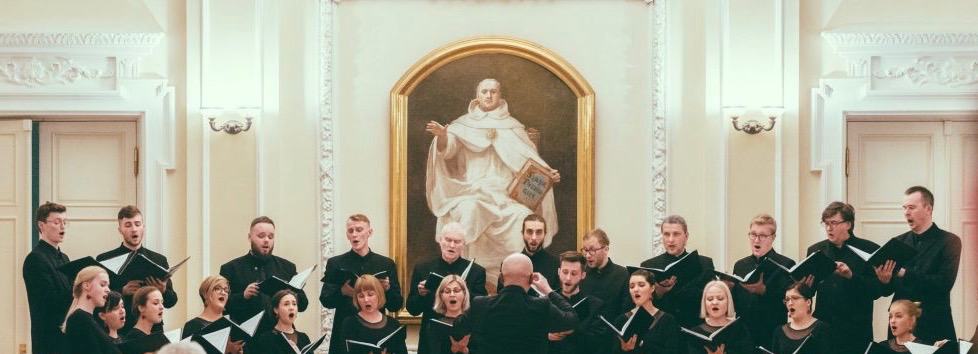
Works For Choir is a collection of songs that sketches the plurality of Arvo Pärt's oeuvre. Mystical minimalism, silence, soft dissonances, extremely slow homophony… for Pärt, sound quality comes above all else. Without resorting to virtuosity, this Estonian composer knows how to compose sublime sounds that are a great challenge for any choir. The Vilnius Municipal Choir Jauna Muzika and their conductor Vaclovas Augustina will have done their homework, but the result is a collection of heavenly music brought together on a cd.
Religious music in a secular world
The Estonian composer Arvo Pärt (°1935) was born a Lutheran in the times of the Soviet Union where any form of religion was officially forbidden. An important turning point in his life was his conversion to the Eastern Orthodox Church in 1972. This duality is also reflected in his music.
The young Pärt began his compositional career in neoclassicism under the influence of Russian composers such as Sergej Prokofjev and Dmitri Sjostakovitsj. In this way, Pärt explored different styles and genres. Like Stravinsky, Pärt also turned to Schönberg's dodecaphony and later also serialism. However, these were not so popular with the regime and in 1968 he came into conflict with the anti-religious Soviet regime because of his Credo. Soviet censorship decided to ban these early works. After also hitting an artistic wall himself, Pärt decided to delve into medieval chants and polyphony from the Renaissance. This was the beginning of his second musical period with sparse music — think of Für Alina (1976) and Spiegel im Spiegel (1978), — for which he is now known.
Pärt is convinced that religion plays an important role in all life processes without being conscious of it. For that very reason, he admits that religion plays a very important role in his compositions. Yet the music is not intended to convey religious or orthodox values to the listener. Instead, Pärt opts for values that can touch every individual and every person. Everyone hears what they want to hear in it. The music transcends the meaning of the composer and the text. It contains a kind of universally accessible spirituality that can appeal to everyone regardless of one's background.
Tintinnabuli and Spartan sobriety
In a quest for the spirituality of classical music, Pärt invented a new compositional technique that he called tintinnabuli. The word means bells or little bells in Latin. The style is characterized by simple harmonies (which according to the composer sound like bells; hence the name) and 2 types of voices. The first is called the "tintinnabular voice" and sounds the tonic triad in the form of an arpeggio while the second voice moves stepwise, diatonically. Für Alina is the first work in Pärt's oeuvre in which this technique came to sound.
The works on the cd Works For Choir all date from the period 1989 to 1991 and thus make use of this tintinnabuli technique. The first work is The Beatitudes (1990, rev. 1991) for mixed choir and organ. The text is a blessing passage from the Bible (Matthew 5:3-12) where Jesus teaches his disciples on the mountain. Line by line, these divine virtues are sung in a recitative style. Each clausula is assigned its own harmony. As the harmony keeps rising one step at a time, each verse (on the words "Blessed are they") begins with the same chord progression. With each new harmonic rise, the tension builds further. After all the clausulae have been sung, a musical climax follows on amen. This is followed by an organ cadenza that now playfully reverses the harmonies previously heard in descending order.
Mary's song of praise is popular with both composer and audience. With composers because the Magnificat (Luke 1:46–55) has been arranged many times throughout the centuries. With the audience because it is one of Pärt's most performed works. It is also an example where the tintinnabuli technique is handled rather smoothly and transparently. Both the harmony and the melody have do as their tonal center. This is most clearly audible during the solo passages. The soprano recites the Latin text consistently on a do while a lower melodic line hovers around the note. Furthermore, Pärt regularly makes use of drones in the tutti passages (usually this is the note sol, as is first heard in the second line). The Vilnius Municipal Choir manages to express Mary's grateful joy in a soft, serene and restrained manner.
While Magnificat radiates transparency, the work that follows is enigmatic and mysterious. In 1994 Pärt described Summa (1977, rev. 1990) as the most strict and enigmatic work he composed in the tintinnabuli style. The original work dates from 1977. Because of the Soviet regime, even the title was encoded. The title Summa gives no indication that the text is based on the Latin Credo. The music itself is apparently simple, but just as with the title, the code must first be cracked to understand it. Behind the homophonic setting lies a complex circular structure. Pärt hinted that this circle carries symbolic meaning, but what he precisely means by this remains speculation. Various researchers are of course prompted to think and speculate about this. David Patrick is of the opinion that "the geometric structure of Summa is a perfect representation of knowledge and experience of the existence of God — the core statement of faith in the text of the Credo." Whether this is truly what Pärt tried to convey in sound will remain an enigma pending further clarification. This unsolved riddle undoubtedly contributes to the mysterious character of this work.
WHAT: Arvo Pärt: Works for Choir
WHO: Vilnius Municipal Choir Jauna Muzika conducted by Vaclovas Augustina
RELEASE: Cugate Classics
PHOTO: © Nikolai Østergaard
ORDER: JPC